


Quick Commerce vs. Traditional E-Commerce: Key Differences
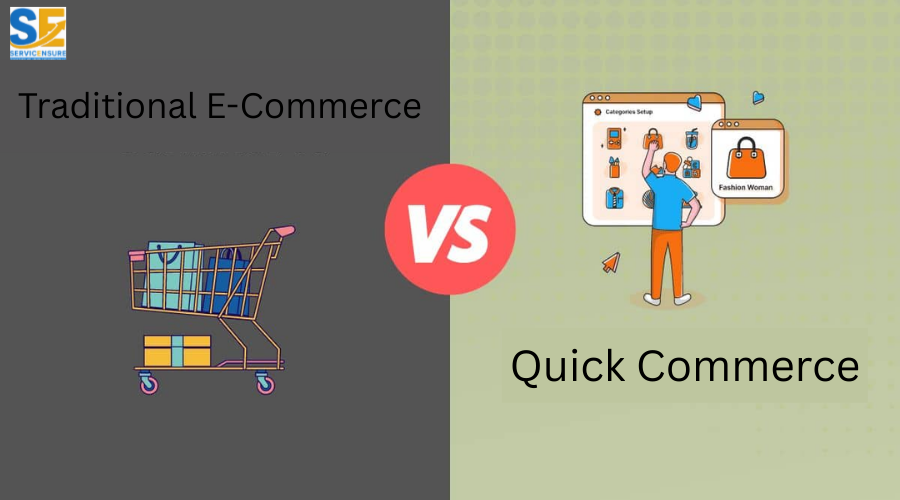
Since digitalization, online shopping is among the areas that have seen the most evolution. Online shopping has evolved from basic storefronts to a highly optimized digital marketplace. These marketplaces prioritize speed, convenience, and personalization. Alongside established platforms, these services have also reshaped how customers interact and complete a purchase. Due to this shift, an important comparison has come to the surface: Quick Commerce vs. Traditional E-Commerce. In order to compete in the digital landscape, you must understand which model is best for your business. Therefore, in this blog post, we will discuss the comparison between these models to help you identify the best one for your business.
What Is Quick Commerce and How Does It Work?
Quick commerce is also often referred to as Q-commerce and is a modern model that is designed to deliver products to customers in a matter of minutes. This model is usually for fulfilling immediate and everyday needs, like groceries and household essentials. Its primary goal is to maximize speed and convenience, making it ideal for time-sensitive and impulse purchases.
Quick commerce heavily relies on a highly optimized and hyperlocal operational structure to provide rapid deliveries. Mentioned below are the core elements of quick commerce.
Dark Stores: These are small and strategically located stores that contain essential stocks and can deliver them quickly to the customer.
Hyperlocal Fulfillment: Orders are processed from a nearby location to minimize the delivery time.
Rapid Order Processing: This is an automated system that helps streamline workflows to ensure quick packing and dispatch.
What Is Traditional E-Commerce and How Does It Work?
In the comparison of quick commerce vs. traditional E-commerce, the latter refers to a conventional online store. Customers can visit this store through a website or application and place their orders. Also, the deliveries of traditional E-commerce are also predefined, and can range from a few days to a week. Furthermore, this model has also been the foundation for countless online stores across multiple niches over the years. Its core structure focuses on scale, inventory depth, and cost-efficient logistics rather than providing instant fulfillment.
These platforms rely heavily on a centralized system to handle high-order volumes and data efficiently. If you want this type of store, then it is advised that you reach out to an E-commerce web development services to ensure a smooth journey. Below, we have listed the core operational elements of a traditional E-commerce store.
Wide Delivery Windows: The platform optimizes shipping timelines for cost and scale rather than speed.
Broader Product Range: These platforms can contain thousands or even millions of products across categories.
Scalable Logistics: These platforms can also be partnered with third-party logistics providers to enable efficient expansion and nationwide reach.
Quick Commerce vs. Traditional E-Commerce Comparison
In order to experience the benefits of quick commerce or of traditional E-commerce, you will first need to understand the difference between them. Below, we have shared a detailed comparison table for quick commerce vs. traditional E-commerce.
|
Aspects |
Quick Commerce |
Traditional E-Commerce |
|
Delivery Speed. |
Fast delivery, usually within 10-30 minutes. |
Delivery can take around 1-7 days. |
|
Primary Focus. |
Speed, convenience, and immediate needs. |
Variety, scalability, and cost efficiency. |
|
Product Range. |
Limited to essential, high-demand items. |
Broad catalog across multiple categories. |
|
Fulfillment Model. |
Hyperlocal fulfillment using nearby dark stores. |
Centralized warehouses serving large regions. |
|
Inventory Strategy. |
Small, fast-moving inventory. |
Large and diverse inventory. |
|
Customer Buying Behavior. |
Impulse and urgency-driven purchases. |
Planned and research-based purchases. |
|
Order Processing. |
Highly optimized for rapid picking and dispatch. |
Optimized for volume and accuracy. |
|
Logistics Complexity. |
High last-mile intensity due to instant delivery. |
Balanced logistics with scheduled shipping. |
|
Operational Costs. |
Higher per-order delivery costs. |
Lower per-order delivery costs at scale. |
|
Geographic Reach. |
Primarily urban and high-density areas. |
Local, national, and international reach. |
Choose The Right Commerce Model For Your Business Future
If you want your business to succeed in the competitive digital market, then the first step to ensure that is understanding the difference between quick commerce vs. traditional E-commerce. As customers' expectations, along with the competition, continue to evolve, choosing the right commerce model has become both a technical and strategic decision. By understanding your customers, their behavior, and your objectives, you can identify the right model and ensure that your business is ready for the future.

 English
 Arabic
 French
 Spanish
 Portuguese
 Deutsch
 Turkish
 Dutch
Dutch
 Italiano
 Russian
 Romaian
 Portuguese (Brazil)