


Automotive Air Purifier Market Forecast: Increasing Adoption in Passenger Vehicles 2030
Automotive Air Purifier Market: Revolutionizing In-Car Air Quality
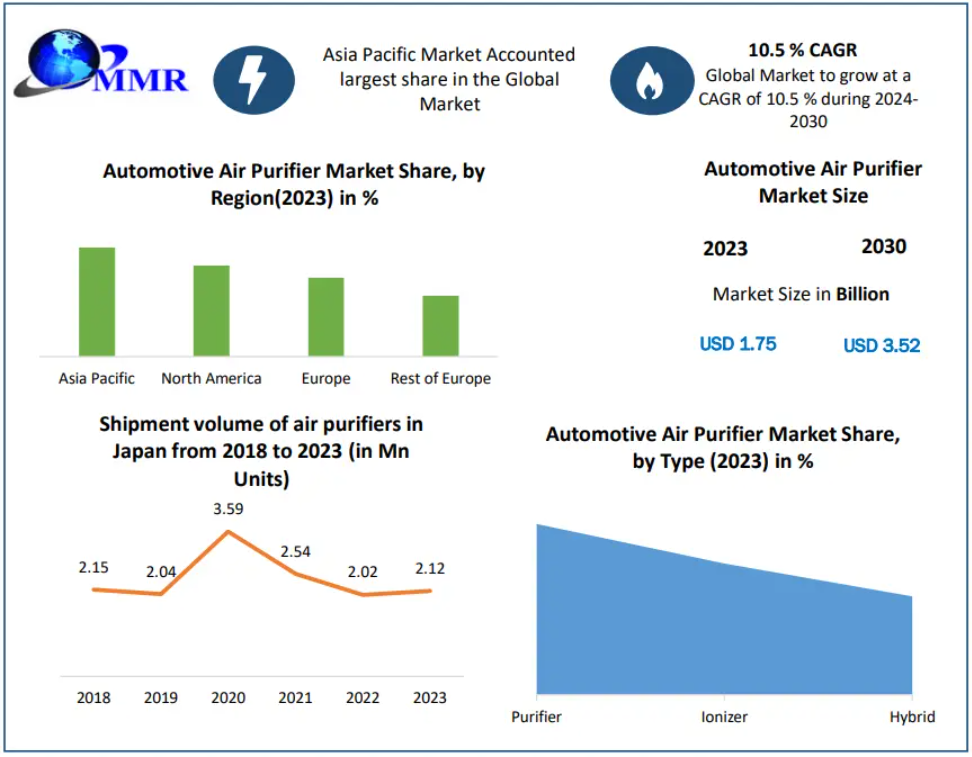
The global Automotive Air Purifier Market was valued at USD 1.75 billion in 2023 and is projected to reach USD 3.52 billion by 2030, growing at a CAGR of 10.5% during the forecast period. The rising concerns over air pollution, coupled with increasing awareness about respiratory health, are fueling the demand for innovative air purification solutions within vehicles.
Overview of Automotive Air Purifiers
Automotive air purifiers are designed to improve the quality of air inside vehicles by removing allergens, pollutants, odors, and harmful particles. These devices leverage technologies such as HEPA filters, activated carbon filters, ionizers, and UV-C light to purify cabin air efficiently. Many modern purifiers come with smart features, including real-time air quality monitoring, filter replacement alerts, and smartphone connectivity, allowing drivers to maintain a healthy cabin environment effortlessly.
As urbanization intensifies and people spend significant time in vehicles, maintaining clean in-car air has become a top priority for health-conscious consumers. The growing adoption of electric vehicles (EVs) and premium passenger cars further amplifies the need for efficient air purification systems.
To know the most attractive segments, click here for a free sample of the report:https://www.maximizemarketresearch.com/request-sample/13992/
Key Market Drivers
- Rising Air Pollution and Health Awareness
Increasing urban air pollution and growing awareness about respiratory health have become key drivers of the market. Consumers are increasingly seeking measures to protect themselves from particulate matter, allergens, and vehicle emissions. Governments worldwide are enforcing stricter emission regulations and indoor air quality standards, encouraging automotive manufacturers to integrate air purifiers into vehicles. - Technological Advancements
Innovations in filtration technologies, such as HEPA, activated carbon, photocatalytic, and ionic filters, have enhanced purifier efficiency. UV-C sterilization and ionization further eliminate bacteria and viruses, providing a cleaner and safer in-car environment. Smart features like mobile app integration, filter status alerts, and automated purification modes are adding value and driving consumer adoption. - Rising Demand for Comfort and Convenience
Modern consumers expect a premium driving experience, including clean and fresh air. Automotive air purifiers contribute to passenger comfort by eliminating odors, allergens, and pollutants, enhancing overall driving satisfaction. Increasing disposable incomes, especially in emerging markets, further support the adoption of these devices.
Challenges Facing the Market
- Price Sensitivity
High cost remains a barrier for widespread adoption, particularly in cost-sensitive markets. Manufacturers face the challenge of delivering advanced features while keeping the devices affordable for a broader consumer base. - Limited Awareness
Despite rising air quality concerns, many consumers remain unaware of the benefits of automotive air purifiers. Education and marketing campaigns are essential to increase adoption rates. - Maintenance Requirements
Regular filter replacement and device maintenance can deter users. Designing low-maintenance, user-friendly systems is critical to ensure long-term satisfaction and performance. - Integration Challenges
Fitting air purifiers into diverse vehicle types, especially larger commercial vehicles or convertibles, poses design and technical challenges. Ensuring uniform purification across varying cabin sizes is a key hurdle.
Market Segmentation
By Offering:
- HEPA Filters: Dominates the market due to high efficiency in trapping small particles.
- Activated Carbon Filters: Effective in removing odors and gases.
- Photocatalytic Filters: Uses light-driven reactions to neutralize pollutants.
- Ionic Filters: Releases ions to remove airborne particles.
By Vehicle Type:
- Passenger Vehicles: Largest market share, driven by daily commuting needs.
- Commercial Vehicles: Growing demand in taxis, buses, and fleet vehicles.
- Electric Vehicles: Emerging segment, integrating advanced air purification features as standard.
By Sales Channel:
- OEM (Original Equipment Manufacturer): Integrated directly into vehicles during production.
- Aftermarket: Portable and retrofit solutions for existing vehicles.
To know the most attractive segments, click here for a free sample of the report:https://www.maximizemarketresearch.com/request-sample/13992/
Regional Insights
The Asia Pacific region dominates the automotive air purifier market, owing to rapid urbanization, rising traffic congestion, and high air pollution levels. Countries such as China, India, Japan, and Southeast Asian nations have seen increasing consumer demand due to health awareness and higher disposable incomes. North America and Europe also represent significant markets due to stringent emission regulations and the growing preference for premium in-car experiences.
Leading Manufacturers
North America: Honeywell, Blueair, Sharp Corporation
Europe: Philips, Mann+Hummel, Blaupunkt
Asia Pacific: Panasonic, Xiaomi, Samsung, Daikin, Kent RO, Toyota Boshoku, LG Electronics
Latin America: Electrolux
Middle East & Africa: Sharp Middle East FZE
Global Players: Dyson, Blue Pure, 3M, Smith Corporation, Coway
Future Outlook
The automotive air purifier market is poised for robust growth as urban air pollution, health consciousness, and technological innovation drive consumer adoption. With smart, efficient, and user-friendly solutions gaining traction, manufacturers are investing in R&D to enhance purification capabilities while catering to emerging vehicle segments. By 2030, the market is expected to witness widespread adoption across passenger, commercial, and electric vehicles, transforming in-car air quality management globally.

 Arabic
 French
 Spanish
 Portuguese
 Deutsch
 Turkish
 Dutch
Dutch
 Italiano
 Russian
 Romaian
 Portuguese (Brazil)
 Greek
Greek