


Metal Carbide Nanoparticles Market Competitive Landscape Evolving with New Technologies
Introduction: Unlocking the Potential of Advanced Nanomaterials
The metal carbide nanoparticles market is emerging as a vital segment within the broader nanomaterials and advanced materials industry. Metal carbide nanoparticles, known for their exceptional hardness, thermal stability, electrical conductivity, and chemical resistance, are increasingly used across diverse applications such as energy storage, catalysis, electronics, aerospace, and cutting tools. As industries seek materials that can withstand extreme environments while delivering high performance, metal carbide nanoparticles are gaining attention as next-generation solutions. Their nanoscale size further enhances surface area and reactivity, making them indispensable in high-precision and high-efficiency applications.
Market Overview: Size, Growth, and Future Outlook
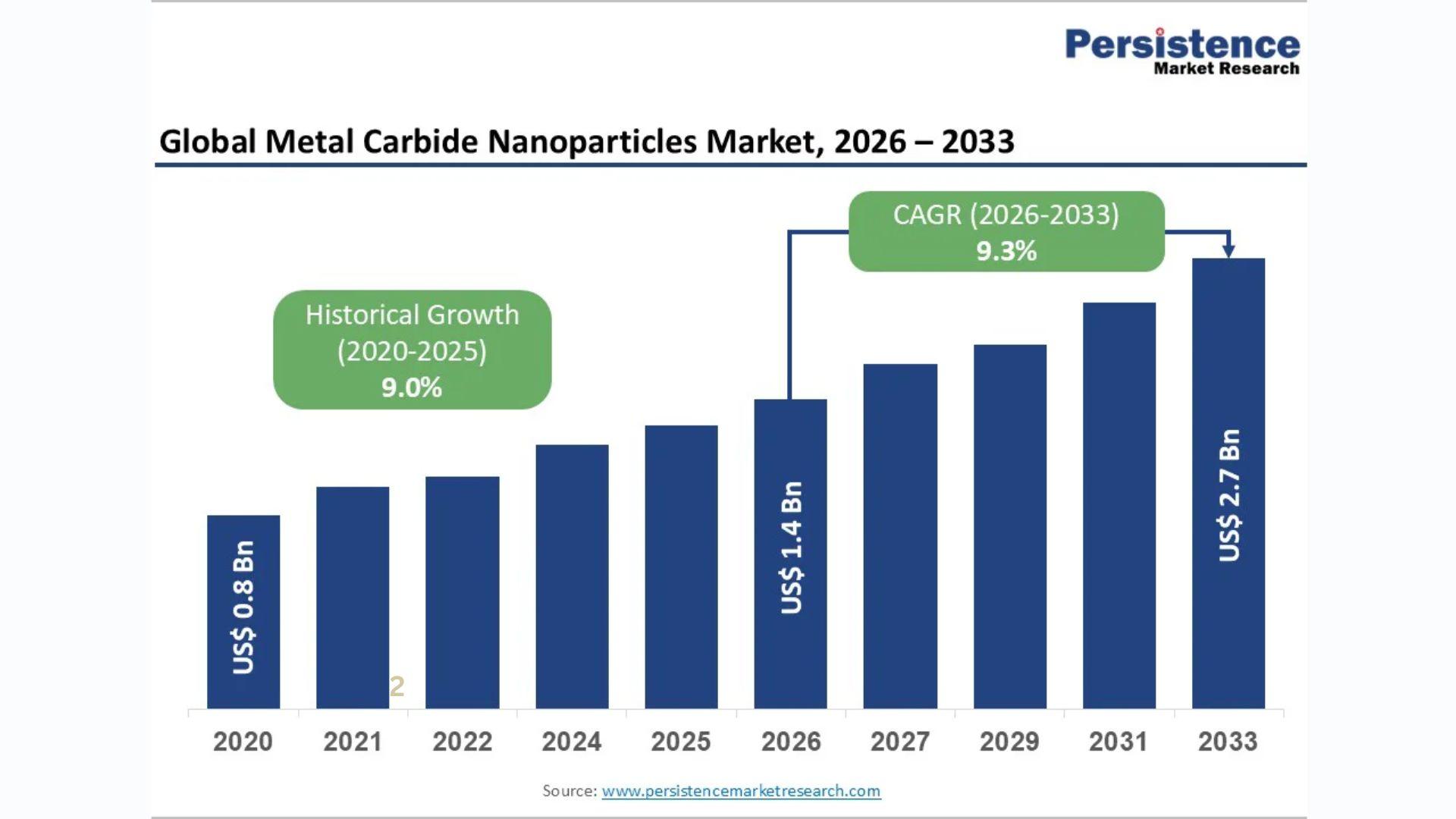
The global metal carbide nanoparticles market is witnessing steady growth, supported by rising research activities and expanding industrial adoption. According to the Persistence Market Research report, the global metal carbide nanoparticles market is projected to be valued at around US$ 1.4 billion in 2026. Over the forecast period, the market is expected to experience robust expansion, reaching approximately US$ 2.7 billion by 2033. This growth reflects a healthy compound annual growth rate (CAGR) of 9.3%, driven by technological advancements, increased demand from high-performance industries, and growing investments in nanotechnology-based innovations.
This upward trend indicates that metal carbide nanoparticles are transitioning from niche laboratory materials to commercially viable components across multiple sectors. Their role in enhancing efficiency, durability, and performance is positioning them as strategic materials in both industrial manufacturing and advanced research.
What Are Metal Carbide Nanoparticles Used For?
Metal carbide nanoparticles are widely used due to their superior mechanical, thermal, and chemical properties compared to conventional materials. These nanoparticles are commonly applied in cutting tools and wear-resistant coatings because of their exceptional hardness and durability. In the energy sector, they play a crucial role in lithium-ion batteries, supercapacitors, and fuel cells by improving conductivity and catalytic efficiency. Metal carbide nanoparticles are also extensively used in catalysts for chemical reactions, including hydrogen production and petroleum refining. Additionally, their growing use in electronics, aerospace components, and biomedical research highlights their versatility and importance in modern high-performance applications.
Get Your FREE Sample Report Instantly – Click Now
Key Growth Drivers: Factors Accelerating Market Expansion
One of the primary drivers of the metal carbide nanoparticles market is the increasing demand for high-performance materials in industrial applications. Industries such as aerospace, automotive, and defense require materials that can operate under extreme temperatures, pressures, and corrosive environments. Metal carbide nanoparticles, with their excellent thermal and mechanical stability, fulfill these requirements effectively.
Another significant growth driver is the rising focus on energy-efficient technologies. Metal carbide nanoparticles are being increasingly used in energy storage systems, including batteries and supercapacitors, to enhance charge capacity and lifecycle performance. Their catalytic properties also make them essential in renewable energy technologies such as hydrogen generation and carbon capture, further boosting market demand.
Role of Nanotechnology and Research Advancements
Advancements in nanotechnology are playing a critical role in shaping the metal carbide nanoparticles market. Continuous research and development efforts have led to improved synthesis methods that enable precise control over particle size, morphology, and composition. These improvements are enhancing the functional performance of nanoparticles and expanding their application scope.
Academic institutions and research organizations are collaborating with industrial players to explore new use cases for metal carbide nanoparticles. Government funding and supportive policies for nanotechnology research are further accelerating innovation. As a result, the market is benefiting from a steady pipeline of advanced products and customized solutions tailored to specific industrial needs.
Application Insights: Expanding Use Across Industries
Metal carbide nanoparticles find applications across a wide range of industries, with cutting tools and wear-resistant coatings representing a major share of demand. Their hardness and resistance to abrasion make them ideal for machining, drilling, and metal-forming operations. In the electronics industry, these nanoparticles are used to enhance conductivity and thermal management in advanced electronic components.
The chemical industry also represents a significant application area, where metal carbide nanoparticles are used as catalysts to improve reaction efficiency and reduce energy consumption. In the biomedical sector, ongoing research is exploring their potential in drug delivery, imaging, and biosensing, opening new avenues for future market growth.
Regional Analysis: Market Trends Across Geographies
From a regional perspective, North America and Europe currently dominate the metal carbide nanoparticles market due to strong research infrastructure, high industrial adoption, and significant investments in advanced materials. These regions are home to several leading nanomaterials manufacturers and research institutions, which continue to drive innovation.
The Asia Pacific region is expected to witness the fastest growth over the forecast period. Rapid industrialization, expanding electronics manufacturing, and increasing government support for nanotechnology research in countries such as China, Japan, and South Korea are fueling regional demand. Additionally, the growing automotive and energy sectors in emerging economies are creating lucrative opportunities for market participants.
Challenges and Market Constraints
Despite its promising growth outlook, the metal carbide nanoparticles market faces several challenges. High production costs associated with advanced synthesis techniques can limit large-scale adoption, particularly in cost-sensitive industries. Maintaining consistency in particle size and quality during mass production also remains a technical challenge.
Health and environmental concerns related to nanoparticle exposure and disposal are additional constraints. Regulatory frameworks governing nanomaterials are still evolving, and compliance with safety standards can increase operational costs for manufacturers. Addressing these challenges through sustainable production methods and clear regulatory guidelines will be crucial for long-term market growth.
Competitive Landscape and Industry Dynamics
The metal carbide nanoparticles market is moderately fragmented, with a mix of established materials companies and emerging nanotechnology startups. Market players are focusing on strategic partnerships, product innovation, and capacity expansion to strengthen their competitive position. Investments in research and customization capabilities are becoming key differentiators, as end users increasingly demand application-specific solutions.
Companies are also exploring cost-effective production technologies and alternative raw materials to improve profitability and scalability. As competition intensifies, innovation and technological expertise are expected to play a central role in shaping market leadership.
Future Outlook: Opportunities and Strategic Growth Areas
Looking ahead, the metal carbide nanoparticles market is poised for sustained growth, supported by expanding industrial applications and continuous technological advancements. Emerging opportunities in renewable energy, electric vehicles, and advanced electronics are expected to create new demand streams. The integration of metal carbide nanoparticles into next-generation materials and composites will further enhance their commercial potential.
With the market expected to grow at a CAGR of 9.3% and reach US$ 2.7 billion by 2033, stakeholders across the value chain—from material suppliers to end users—stand to benefit from this upward trajectory. Companies that invest in innovation, sustainability, and strategic collaborations will be well-positioned to capitalize on the evolving metal carbide nanoparticles market.
Conclusion: A Market Driven by Performance and Innovation
The metal carbide nanoparticles market represents a high-growth segment within advanced materials, driven by the need for superior performance, efficiency, and durability. As industries increasingly adopt nanotechnology-enabled solutions, metal carbide nanoparticles are set to play a pivotal role in shaping future technological advancements. With strong market fundamentals, expanding applications, and a favorable growth outlook, the industry offers significant opportunities for innovation and long-term value creation.
Explore the Latest Trending Research Reports:

 English
 Arabic
 French
 Portuguese
 Deutsch
 Turkish
 Dutch
Dutch
 Italiano
 Russian
 Romaian
 Portuguese (Brazil)
 Greek
Greek