


Purified Terephthalic Acid Market Supply Chain Trends Impacting Pricing
Introduction to the Purified Terephthalic Acid Market
Purified terephthalic acid (PTA) is a critical petrochemical intermediate widely used in the production of polyester fibers, polyethylene terephthalate (PET) resins, and films. These materials are essential across industries such as textiles, packaging, automotive, construction, and consumer goods. With the global economy increasingly dependent on synthetic fibers and lightweight, durable plastics, the PTA market has emerged as a foundational pillar of the polyester value chain. Continuous growth in apparel consumption, packaged food and beverage demand, and industrial applications has positioned PTA as a strategically important commodity in the global chemical industry.
What is Purified Terephthalic Acid and Why Is It Important?
Purified terephthalic acid is an organic compound primarily produced through the oxidation of paraxylene. It serves as the main raw material for manufacturing polyester, which is further processed into fibers, bottles, films, and engineering plastics. The importance of PTA lies in its versatility and scalability, as it supports high-volume manufacturing while maintaining consistent quality. As polyester continues to outperform natural fibers in terms of durability, cost efficiency, and ease of processing, PTA demand remains directly linked to global industrialization, urbanization, and consumer lifestyle changes.
What Factors Are Driving Growth in the Purified Terephthalic Acid Market?
The growth of the purified terephthalic acid market is driven by rising demand for polyester fibers and PET packaging across multiple industries. Rapid expansion of the global textile industry, particularly in Asia Pacific, is a major contributor, as polyester remains the most widely used synthetic fiber due to its affordability and performance. In addition, increasing consumption of bottled beverages, ready-to-eat food, and pharmaceutical packaging is boosting PET resin demand, directly supporting PTA production. Technological advancements in PTA manufacturing, coupled with capacity expansions and strong downstream integration, are further enhancing market growth. Sustainability initiatives promoting recyclable PET materials are also creating long-term growth opportunities.
Market Size and Growth Forecast
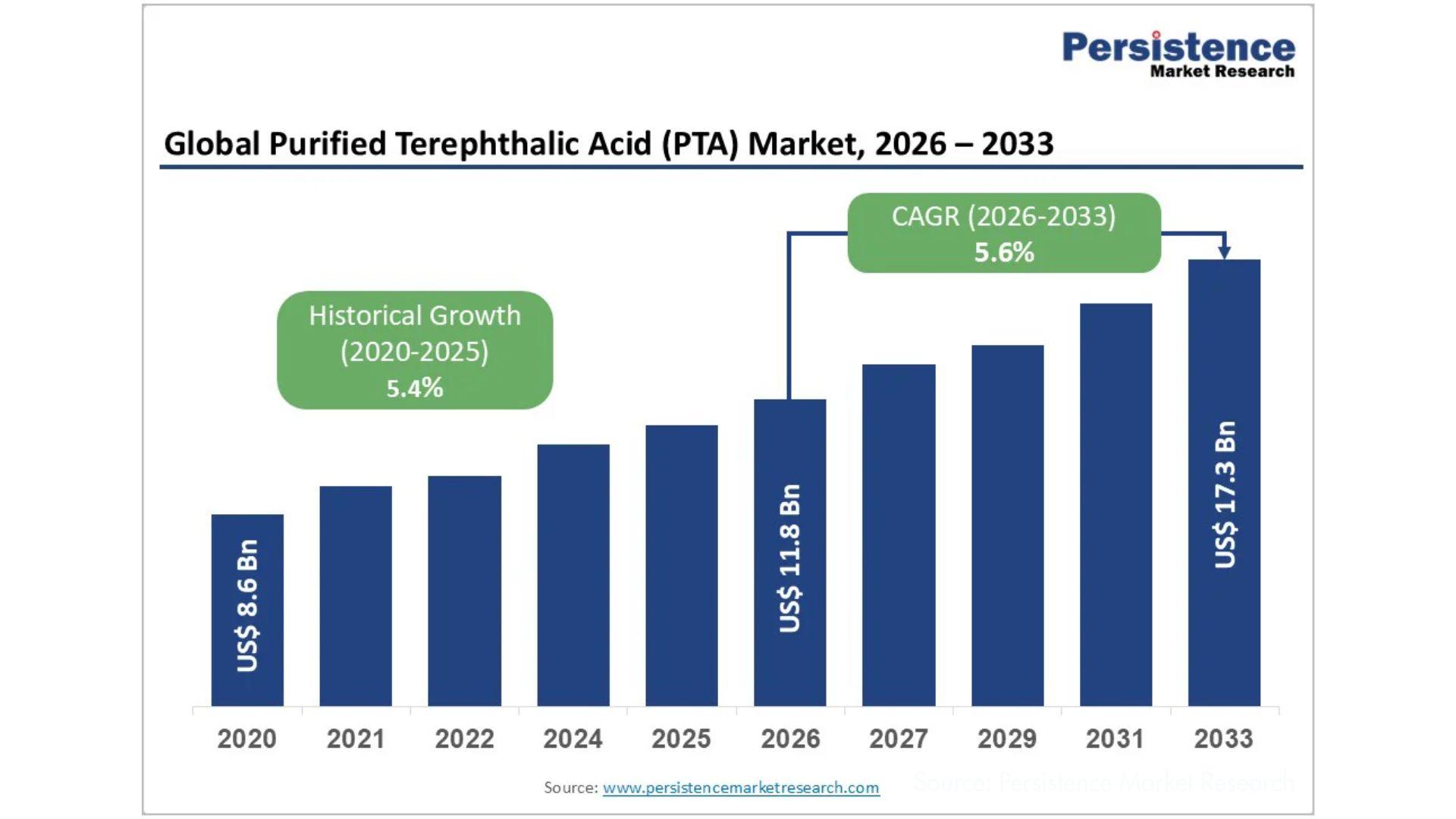
The purified terephthalic acid market is poised for steady expansion over the forecast period, supported by strong downstream demand and capacity additions across key regions. According to a Persistence Market Research report, the global purified terephthalic acid (PTA) market is expected to be valued at around US$ 11.8 billion in 2026. Over the coming years, the market is projected to grow consistently and reach approximately US$ 17.3 billion by 2033. This expansion reflects a compound annual growth rate (CAGR) of 5.6% between 2026 and 2033, highlighting the stable demand outlook and long-term growth potential of PTA across industrial and consumer applications.
Key Demand Drivers Shaping the Market
One of the primary drivers of the purified terephthalic acid market is the continuous rise in polyester fiber consumption. Polyester dominates the global textile market due to its durability, wrinkle resistance, and cost advantages over natural fibers such as cotton and wool. Growing populations, increasing disposable incomes, and fast fashion trends are further accelerating textile production, thereby strengthening PTA demand.
Another major growth driver is the expanding PET packaging industry. PET is widely used for packaging beverages, food products, personal care items, and pharmaceuticals due to its lightweight, transparency, and recyclability. As global consumption of packaged goods continues to increase, particularly in emerging economies, the demand for PTA as a key raw material for PET resin production is expected to remain strong.
Role of Industrialization and Urbanization
Rapid industrialization and urbanization, especially in developing regions, are playing a crucial role in shaping the purified terephthalic acid market. Infrastructure development, rising automotive production, and increased use of industrial textiles are driving polyester consumption beyond traditional apparel applications. Polyester-based materials are increasingly used in construction, insulation, tire cords, conveyor belts, and automotive interiors, all of which rely heavily on PTA-derived products. This diversification of end-use applications is strengthening market resilience and reducing dependence on any single sector.
Regional Market Insights
Asia Pacific dominates the global purified terephthalic acid market, both in terms of production and consumption. Countries such as China and India are major contributors due to their large-scale textile manufacturing bases, expanding packaging industries, and strong domestic demand. China, in particular, leads global PTA capacity, supported by integrated petrochemical complexes and continuous investments in capacity expansion.
North America and Europe represent mature markets with stable demand, driven primarily by packaging, automotive, and industrial applications. While growth rates in these regions are comparatively moderate, increasing focus on recycled PET and circular economy initiatives is supporting sustained PTA consumption. Meanwhile, the Middle East is emerging as an important production hub, benefiting from easy access to raw materials and growing petrochemical investments.
Technological Advancements and Capacity Expansion
Technological innovation is playing a significant role in improving production efficiency and cost competitiveness within the purified terephthalic acid market. Modern PTA plants are increasingly adopting advanced oxidation processes, energy-efficient catalysts, and integrated production systems to reduce operational costs and environmental impact. These advancements enable manufacturers to achieve higher yields, improved product purity, and better alignment with sustainability goals.
Capacity expansion remains a key strategic focus for major market players, particularly in Asia. New PTA plants and debottlenecking projects are being undertaken to meet rising polyester and PET demand. Vertical integration with upstream paraxylene production and downstream polyester manufacturing is also becoming more common, helping companies optimize supply chains and manage price volatility.
Sustainability Trends and Environmental Considerations
Sustainability is emerging as a critical factor influencing the purified terephthalic acid market. Growing environmental concerns related to plastic waste and carbon emissions are prompting regulatory bodies and manufacturers to invest in recycling and circular economy solutions. Recycled PET (rPET) is gaining traction across packaging and textile industries, indirectly supporting PTA demand through closed-loop recycling systems.
At the same time, producers are focusing on reducing the carbon footprint of PTA manufacturing by adopting cleaner technologies, improving energy efficiency, and exploring bio-based feedstock alternatives. These initiatives are expected to enhance the long-term viability of the market while aligning it with global sustainability targets.
Challenges Impacting Market Growth
Despite its positive outlook, the purified terephthalic acid market faces certain challenges. Volatility in crude oil and paraxylene prices can significantly impact PTA production costs and profit margins. Additionally, environmental regulations related to emissions and waste management may increase compliance costs for manufacturers.
Overcapacity in certain regions, particularly in Asia, can also lead to pricing pressures and intense competition among producers. Managing supply-demand balance while maintaining profitability remains a key concern for industry participants.
Future Outlook of the Purified Terephthalic Acid Market
The future of the purified terephthalic acid market appears stable and promising, supported by consistent demand from polyester fibers and PET resins. As global consumption patterns continue to evolve toward convenience, durability, and sustainability, PTA will remain a vital raw material within the chemical value chain. With a projected CAGR of 5.6% through 2033 and market valuation expected to rise from US$ 11.8 billion in 2026 to US$ 17.3 billion, the industry is well-positioned for long-term growth driven by industrial expansion, technological innovation, and sustainability-focused developments.
Explore the Latest Trending Research Reports:

 English
 Arabic
 French
 Spanish
 Deutsch
 Turkish
 Dutch
Dutch
 Italiano
 Russian
 Romaian
 Portuguese (Brazil)
 Greek
Greek