


Aquafeed Market Growth, Size & Trends Forecast 2025-2033
Market Overview:
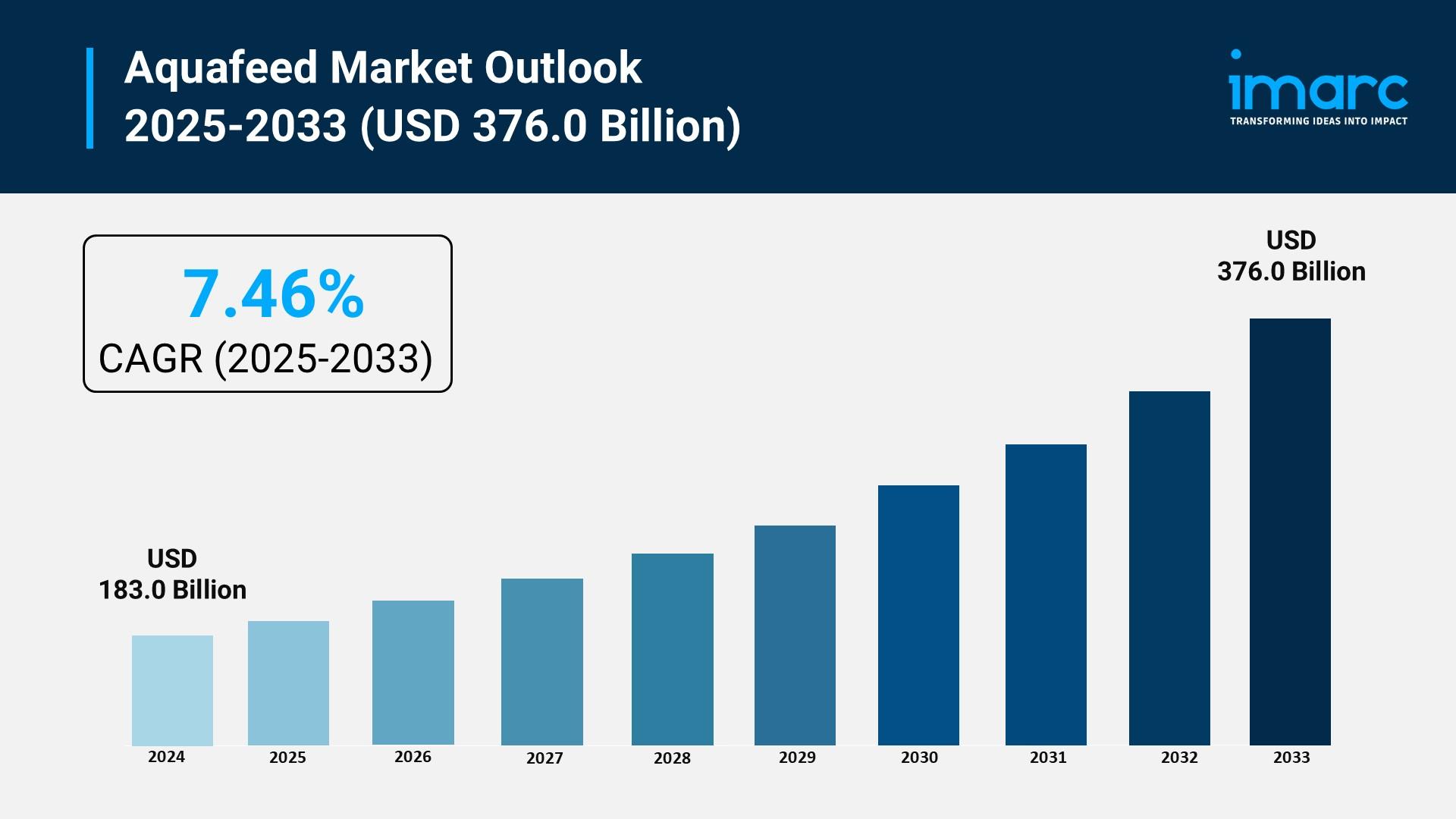
The aquafeed market is experiencing rapid growth, driven by rising global seafood consumption and production, government support and strategic initiatives for aquaculture, and technological advancements in feed formulation and efficiency. According to IMARC Group’s latest research publication, “Aquafeed Market: Global Industry Trends, Share, Size, Growth, Opportunity and Forecast 2025-2033”, The global aquafeed market size reached USD 183.0 Billion in 2024. Looking forward, IMARC Group expects the market to reach USD 376.0 Billion by 2033, exhibiting a growth rate (CAGR) of 7.46% during 2025-2033.
This detailed analysis primarily encompasses industry size, business trends, market share, key growth factors, and regional forecasts. The report offers a comprehensive overview and integrates research findings, market assessments, and data from different sources. It also includes pivotal market dynamics like drivers and challenges, while also highlighting growth opportunities, financial insights, technological improvements, emerging trends, and innovations. Besides this, the report provides regional market evaluation, along with a competitive landscape analysis.
Download a sample PDF of this report: https://www.imarcgroup.com/aquafeed-market/requestsample
Our report includes:
-
Market Dynamics
-
Market Trends and Market Outlook
-
Competitive Analysis
-
Industry Segmentation
-
Strategic Recommendations
Growth Factors in the Aquafeed Market
-
Rising Global Seafood Consumption and Production
The sustained and increasing global demand for seafood is the primary factor driving the growth of the aquafeed market. Aquaculture, which relies heavily on formulated feeds, is now essential to meet this demand, as wild-catch fisheries have plateaued. For instance, global aquaculture production recently reached a record level of over 130 million tonnes, representing more than 50% of the world’s fish production. This expansion, particularly in high-volume regions like Asia-Pacific, which accounts for over 70% of the global aquafeed market share, necessitates a continuous and growing supply of high-quality feed. As consumption of popular farmed species such as carp, tilapia, and salmon continues to rise in both developing and developed economies, the requirement for efficient, growth-promoting aquafeed formulations escalates to ensure reliable, year-round production.
-
Government Support and Strategic Initiatives for Aquaculture
Governments worldwide are actively promoting aquaculture as a key component of national food security and export strategies, directly stimulating the aquafeed industry. These initiatives often involve substantial financial backing and favorable regulatory frameworks. For example, a major Asian government allocated over $\$70$ million for the continuation of its ‘Blue Revolution Scheme,’ a program that includes support for various fisheries development initiatives like marine fishery, mariculture, and aquaculture. Such dedicated government investments encourage farmers to adopt more intensive and high-yield farming practices, which, in turn, boosts the adoption of formulated, species-specific, and high-protein aquafeeds to optimize farm productivity and meet national production targets.
-
Technological Advancements in Feed Formulation and Efficiency
Innovations in feed science and manufacturing technology are constantly improving the Feed Conversion Ratio (FCR) and nutritional value of aquafeeds, making them a more cost-effective choice for farmers. The use of specialized, high-density, extruded floating and sinking pellets has dominated the market, with the dry form segment alone accounting for over 65% of the total revenue share, primarily due to its stability and high palatability for aquatic species. Furthermore, large multinational companies are heavily investing in research and development to produce novel feeds. For example, a leading aquafeed producer recently inaugurated a new, state-of-the-art production facility in a key emerging market, equipped with multiple production lines and an estimated annual capacity of around 50,000 metric tons, underscoring the shift toward high-tech, high-efficiency feed production.
Key Trends in the Aquafeed Market
-
Integration of Novel and Alternative Proteins
The aquafeed industry is undergoing a significant transition by shifting away from marine-derived ingredients like fishmeal and fish oil to more sustainable, novel protein sources. This trend is driven by volatile marine ingredient prices and concerns about wild fish stock sustainability. Companies are increasingly incorporating insect meals, such as Black Soldier Fly larvae, as well as plant-based concentrates and single-cell proteins (SCPs) like microalgae into their formulations. For instance, a major North American industry cluster recently announced a multi-million-dollar initiative focused on developing a novel microbial protein to replace traditional fishmeal and soy, highlighting the industry’s commitment to reducing the environmental footprint and diversifying the protein supply chain.
-
Adoption of Functional Feeds and Health-Focused Additives
There is a pronounced trend toward specialty feeds that go beyond basic nutrition by incorporating functional additives to enhance the health, immunity, and stress tolerance of farmed species. This is a direct response to the intensification of aquaculture and the increased risk of disease outbreaks. The amino acids segment, for example, is a top contributor to the additive market, commanding an estimated share of nearly $30\%$ of the overall revenue, due to their essential role in optimizing protein synthesis and enhancing overall fish performance. Other functional ingredients, such as probiotics, prebiotics, and enzymes, are rapidly gaining traction to improve gut health, feed digestibility, and ultimately, fillet quality, leading to premium pricing for the final seafood product.
-
Precision Aquaculture and Data-Driven Feeding Systems
The emerging use of smart technologies, including sensors, automation, and Artificial Intelligence (AI), is driving the development of precision aquaculture, which optimizes feeding in real-time. This trend minimizes waste, improves FCR, and enhances the sustainability profile of farming operations. Some advanced farms are implementing automated feeding platforms that monitor fish behavior, biomass, and water quality parameters to deliver the exact amount of feed needed at optimal times. This data-driven approach is particularly impactful in high-value species like salmon, where every point of efficiency gain translates into significant operational savings and improved environmental performance.
We explore the factors propelling the aquafeed market growth, including technological advancements, consumer behaviors, and regulatory changes.
Leading Companies Operating in the Global Aquafeed Industry:
-
Nutreco
-
Cargill
-
Alltech
-
Biomar
-
Skretting
Aquafeed Market Report Segmentation:
By Species:
-
Carps
-
Marine Shrimps
-
Tilapias
-
Catfishes
-
Marine Fishes
-
Salmons
-
Freshwater Crustaceans
-
Trout
-
Others
Carps account for the majority market share in aquafeed, as they are adaptable omnivores that thrive on a variety of feed types, including plant-based ingredients.
By Ingredients:
-
Soybean
-
Corn
-
Fish Meal
-
Fish Oil
-
Additives
-
Others
Soybean holds the largest share of the aquafeed market, serving as a widely used, digestible plant-based protein source that complements or replaces fishmeal in feeds.
By Additives:
-
Vitamins and Minerals
-
Antioxidants
-
Feed Enzymes
-
Others
Vitamins and minerals represent the leading segment in aquafeed additives, essential for promoting health, growth, and development in aquatic species.
By Product Form:
-
Pellets
-
Extruded
-
Powdered
-
Liquid
Pellets dominate the aquafeed market, as they are easy to handle, customizable for different fish sizes, and suitable for various feeding habits.
Regional Insights:
-
North America (United States, Canada)
-
Asia Pacific (China, Japan, India, South Korea, Australia, Indonesia, Others)
-
Europe (Germany, France, United Kingdom, Italy, Spain, Russia, Others)
-
Latin America (Brazil, Mexico, Others)
-
Middle East and Africa
Asia Pacific leads the aquafeed market, accounting for the largest share, supported by significant demand across major countries like China, Japan, and India.
Note: If you require specific details, data, or insights that are not currently included in the scope of this report, we are happy to accommodate your request. As part of our customization service, we will gather and provide the additional information you need, tailored to your specific requirements. Please let us know your exact needs, and we will ensure the report is updated accordingly to meet your expectations.
About Us:
IMARC Group is a global management consulting firm that helps the world’s most ambitious changemakers to create a lasting impact. The company provide a comprehensive suite of market entry and expansion services. IMARC offerings include thorough market assessment, feasibility studies, company incorporation assistance, factory setup support, regulatory approvals and licensing navigation, branding, marketing and sales strategies, competitive landscape and benchmarking analyses, pricing and cost research, and procurement research.
Contact Us:
IMARC Group
134 N 4th St. Brooklyn, NY 11249, USA
Email: sales@imarcgroup.com
Tel No:(D) +91 120 433 0800
United States: +1-201971-6302

 English
 Arabic
 French
 Spanish
 Portuguese
 Deutsch
 Turkish
 Dutch
Dutch
 Italiano
 Russian
 Romaian
 Portuguese (Brazil)