


Satellite Propulsion System Market Share by Technology: Chemical vs Electric Propulsion Systems
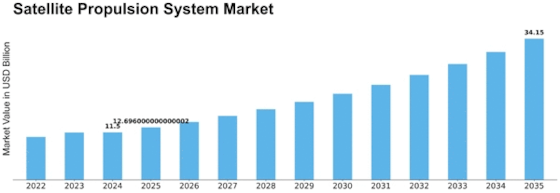
Advancements in satellite missions have placed propulsion systems in the spotlight. The Satellite Propulsion System Market is forecast to expand from around US$11.5 billion in 2024 to an estimated USD 34.15 billion by 2035, growing at roughly a 10.4% CAGR.
Industry Overview
The industry supporting satellite propulsion encompasses a wide variety of technologies, from chemical thrusters to electric systems, and supports a spectrum of satellite classes—from large geosynchronous orbit platforms to small cubesats in low earth orbit. The growth of satellite services and the commercialisation of space have encouraged new propulsion architectures that are lighter, more efficient and more reliable.
Significant Players
Market leadership is currently concentrated among a few major players. Aerojet Rocketdyne, Northrop Grumman and Airbus Defence and Space are frequently cited for their contributions. Their strategies span R&D investment, strategic partnerships, acquisitions and focus on sustainable solutions. These companies serve as anchors for the ecosystem, enabling innovation by providing platforms, supply-chain stability and industry credibility.
Segmentation Insights
Within propulsion types, cold gas remains the most used segment—particularly for station-keeping and manoeuvring tasks—because of its simplicity and low risk. The fastest growth, however, is in green liquid propulsion systems, which deploy non-toxic propellants and respond to sustainability mandates. Regionally, North America remains the dominant market (~45 %), Europe is strong (~30 %), and Asia-Pacific is rapidly accelerating (~20 %), with portions of the Middle East & Africa beginning to emerge (~5 %).
Outlook and Growth Drivers
Several trends are fuelling the expansion: the rapid growth of satellite launches, especially for communication constellations; growing earth-observation and remote-sensing demands; government investment in space programmes; and a rising interest in sustainability and in-orbit servicing. Propulsion systems that reduce mass, save propellant, extend mission lifetime and enable agile manoeuvres are highly sought after. The shift toward small satellites also means miniaturised propulsion modules will be a key area of innovation.
Final Thoughts
For firms involved in satellite manufacturing, propulsion subsystem design or supply-chain services, the current period represents a window of opportunity. The propulsion market is set not just to grow—its contours will change. Those who prepare for electric/hybrid systems, low-mass designs and environmentally-friendly propellants are likely to lead. The panorama for satellite propulsion is both expansive and evolving.
Related Report:

 English
 Arabic
 Spanish
 Portuguese
 Deutsch
 Turkish
 Dutch
Dutch
 Italiano
 Russian
 Romaian
 Portuguese (Brazil)
 Greek
Greek