


Automotive Steering System Market Growth Fueled by Safety and Comfort Technologies
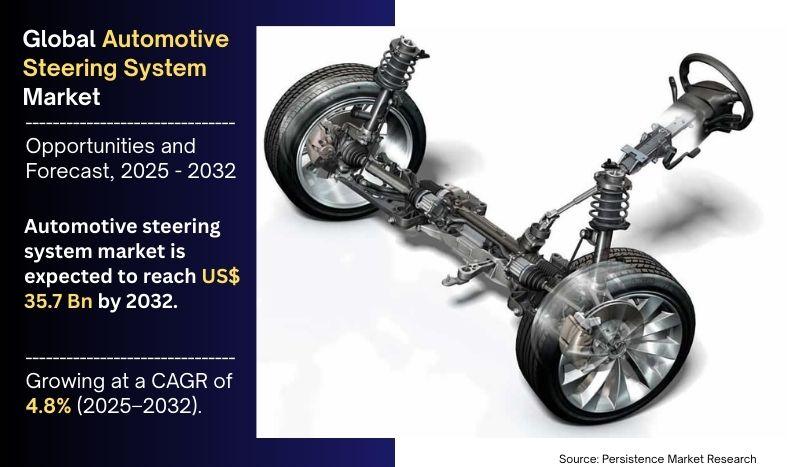
The global automotive steering system market is entering a period of renewed expansion driven by rapid advancements in vehicle technology and the global shift toward safer, more efficient mobility solutions. According to current industry projections, the market is valued at US$ 25.7 billion in 2025 and is expected to reach US$ 35.7 billion by 2032, reflecting a steady CAGR of 4.8% between 2025 and 2032. This trajectory underscores the growing significance of steering technologies within the broader automotive landscape, particularly as manufacturers prioritize improved maneuverability, enhanced driver safety, and reduced carbon emissions.
Automotive steering systems constitute the mechanisms that direct and regulate a vehicle’s path, rendering them indispensable to driver control. The shift toward electrification, autonomous driving, and smart mobility has elevated the role of steering systems beyond mechanical components to integral elements of modern vehicle intelligence. Rising consumer demand for advanced driving assistance systems (ADAS), coupled with increasingly stringent government regulations on road safety, is significantly fueling market expansion. Furthermore, the rapid penetration of electric vehicles (EVs), supported by national energy transition initiatives, is accelerating the adoption of advanced electronic steering solutions across major automotive markets.
Segmentation Analysis
By Type
The automotive steering system market comprises several key categories, including manual steering systems, hydraulic power steering (HPS), electro-hydraulic power steering (EHPS), and electric power steering (EPS). Among these, EPS dominates the global landscape due to its extensive use in passenger vehicles and its compatibility with advanced electronic vehicle platforms. EPS continues to replace traditional hydraulic systems as manufacturers seek lighter, energy-efficient solutions that can enhance fuel economy and provide smoother handling.
The fastest-growing segment is projected to be steer-by-wire systems, a next-generation technology eliminating the mechanical link between the steering wheel and the tires. Steer-by-wire is expected to gain substantial traction as autonomous vehicles mature, offering unparalleled adaptability for ADAS algorithms, customizable driving experiences, and reduced vehicle weight. While adoption is currently in its nascent stages, regulatory approvals and technological validation are anticipated to significantly increase deployment through the next decade.
By Vehicle Type
The market spans various vehicle categories, including passenger cars, commercial vehicles, and heavy-duty applications. Passenger cars remain the dominant segment, driven by continued production growth in emerging economies, rising consumer spending on premium vehicles, and rapid penetration of SUVs and electric passenger cars. The passenger vehicle segment also benefits from higher integration rates of EPS and steer-by-wire systems, which align with consumer preferences for comfort, ease of driving, and technologically advanced features.
In contrast, the commercial vehicle segment is experiencing accelerated demand, driven by the expansion of the logistics and transportation sectors. The global rise in e-commerce, infrastructure investment, and fleet modernization initiatives is increasing the adoption of advanced steering technologies capable of supporting heavy loads while improving vehicle stability. Emerging trends such as autonomous trucking and long-haul fleet electrification are expected to further amplify demand for robust, intelligent steering solutions.
By Propulsion and Technology
Propulsion-based segmentation highlights the contrast between internal combustion engine (ICE) vehicles and electric or hybrid vehicles. The rapid growth of EVs is reshaping steering system requirements, favoring electronic and software-integrated designs. EV manufacturers are increasingly adopting EPS due to its lower energy consumption and seamless integration with vehicle control units.
Technological segmentation also includes steering assistance technologies that support varying levels of autonomous driving. Level 2 and Level 3 automation systems rely heavily on advanced steering controls, reinforcing demand for redundant system architectures, enhanced precision, and fail-safe mechanisms. As automakers transition toward fully autonomous platforms, steering systems are expected to evolve into fully electronic, predictive units that operate alongside AI-driven navigation and sensor fusion technologies.
Get Your FREE Sample Report Instantly Click Now: https://www.persistencemarketresearch.com/samples/33563
Regional Insights
Leading Regions
The automotive steering system market exhibits strong geographical diversity with Asia-Pacific emerging as the leading regional market. Dominated by automotive manufacturing hubs such as China, Japan, South Korea, and India, the region benefits from large-scale vehicle production capacity, competitive manufacturing costs, and robust investments in EV infrastructure. China, in particular, plays a pivotal role due to its aggressive EV adoption strategy and growing emphasis on intelligent transportation systems.
Europe follows as a major contributor, driven by stringent regulatory standards, high consumer preference for technologically advanced vehicles, and strong commitments to carbon neutrality. Germany, the UK, and France are at the forefront of integrating steer-by-wire and advanced EPS systems into premium automotive models. European automakers’ push toward automation and electrification continues to shape the trajectory of steering system technology development.
Fastest-Growing Region
The North American market is projected to be the fastest-growing region during the forecast period. The region’s rapid technological innovation, expansion of ADAS-equipped vehicle fleets, and robust adoption of autonomous vehicle testing programs are major growth determinants. Additionally, the presence of leading automotive technology suppliers and increasing investments in EV manufacturing plants across the United States and Canada contribute to the region’s accelerating growth rate. The expansion of commercial fleets in logistics and last-mile delivery further fuels the demand for advanced steering systems capable of supporting intensive vehicle performance requirements.
Unique Features and Innovations in the Market
Modern automotive steering systems stand out due to their integration of cutting-edge technologies that prioritize safety, efficiency, and flexibility. Innovations such as steer-by-wire, AI-enhanced control units, and smart electric power steering solutions have redefined the steering landscape. AI and machine learning algorithms optimize steering precision by analyzing driver behavior, road conditions, and real-time vehicle dynamics. These advancements enable vehicles to adjust steering responsiveness automatically, improving both driving comfort and overall safety.
IoT connectivity also plays a transformative role, allowing steering systems to communicate with sensors, vehicle-to-everything (V2X) infrastructure, and predictive maintenance platforms. Remote diagnostics, automated fault detection, and over-the-air updates help maintain system performance while reducing downtime and operational costs. Emerging 5G technology is expected to further enhance steering capabilities by enabling ultra-low latency communication essential for autonomous driving.
Market Highlights
The increasing adoption of advanced steering solutions is driven by the need to enhance vehicle safety, fuel efficiency, and operational performance. Governments worldwide are implementing stricter road safety regulations, prompting automakers to integrate sophisticated steering assistance features. The push toward energy efficiency is also encouraging the transition from hydraulic systems to electric and electronic steering technologies, which significantly reduce power consumption and maintenance requirements.
Sustainability efforts further influence market trends as steering components become lighter and more resource-efficient. Automakers are adopting eco-friendly materials and energy-optimized systems to comply with evolving environmental guidelines. Businesses are also recognizing the long-term cost benefits associated with reliable, low-maintenance steering systems that enhance vehicle lifecycle performance.
Key Players and Competitive Landscape
The competitive landscape of the automotive steering system market is characterized by innovation-driven strategies, strategic partnerships, and global expansion initiatives. Leading companies include:
- Robert Bosch GmbH – A key innovator in electronic steering technologies, Bosch continues to expand its global footprint by integrating AI and safety-enhancing features across steering product lines. Its investments in autonomous driving systems strengthen its market position.
- JTEKT Corporation – Renowned for its EPS solutions, JTEKT emphasizes energy efficiency and integration with EV platforms. The company focuses on enhancing global production capacity and collaborating with automakers to support emerging vehicle architectures.
- ThyssenKrupp AG – This company specializes in lightweight steering components and advanced steering columns. ThyssenKrupp is expanding its manufacturing partnerships and investing in digital technologies to enhance steering reliability.
- Nexteer Automotive – A leader in steer-by-wire development, Nexteer focuses on intelligent steering platforms adaptable to autonomous driving. Its strategic partnerships in North America and Asia strengthen its global competitive edge.
- ZF Friedrichshafen AG – ZF is advancing integrated steering technologies that support electrification and automation. With strong R&D initiatives, the company consistently introduces product enhancements aimed at improving driving dynamics and safety.
Future Opportunities and Growth Prospects
The future of the automotive steering system market is defined by technological evolution and regulatory advancements. As autonomous vehicles progress toward commercialization, demand for steer-by-wire systems and AI-integrated steering solutions will surge. Steering systems will increasingly serve as dynamic interfaces between human drivers, vehicle intelligence, and external environments.
Regulatory initiatives promoting road safety, emissions reduction, and digital vehicle infrastructure will reinforce market growth. Companies investing in lightweight materials, cyber-secure steering architectures, and modular system designs are well-positioned to capitalize on upcoming opportunities. Additionally, emerging markets in Latin America, Africa, and Southeast Asia present new avenues for expansion as governments invest in transportation modernization.
Overall, the automotive steering system market is on a promising trajectory, driven by innovation, safety standards, and the global shift toward intelligent mobility. The combination of technological progress and growing vehicle electrification ensures strong market momentum through 2032 and beyond.

 English
 Arabic
 French
 Spanish
 Portuguese
 Deutsch
 Turkish
 Dutch
Dutch
 Italiano
 Russian
 Romaian
 Greek
Greek