


Automotive Injection Molding Guide: Benefits, Uses & Manufacturing Process
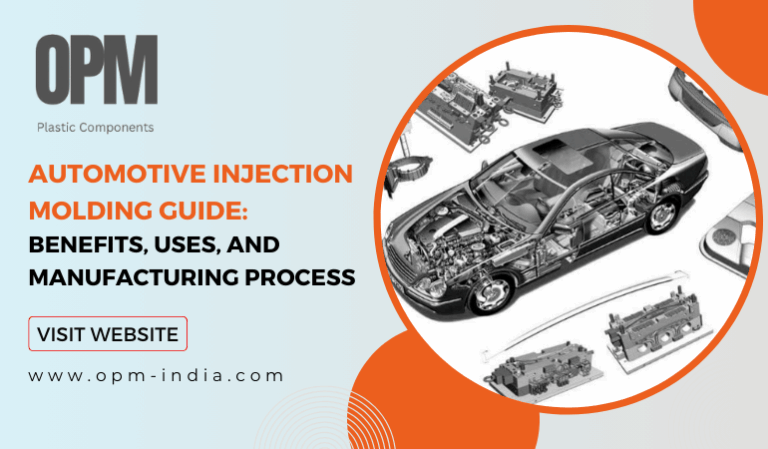
Quality, durability, and cost-effectiveness are critical to the automotive industry, making injection molding one of the most favored manufacturing techniques. In order to meet international performance standards and ensure consistent quality, automakers are increasingly using injection molding to create specialized plastic and rubber car parts. The use of injection molding in automotive manufacturing has increased dramatically because of the growing need for lightweight cars, cutting-edge safety measures, and improved aesthetics.
Multiple automotive injection molding businesses and automotive plastic parts manufacturers in Pune provide high-precision molded components to OEMs. This automotive injection molding guide helps manufacturers easily produce high-quality automobile plastic components with accuracy, durability, and efficiency by covering the primary advantages, regular application, and the entire manufacturing process.
Advantages of Injection Molding in Automotive Manufacturing
Because of its capacity to provide consistency, speed, and structural performance, injection molding has emerged as a key component of contemporary car production. The following are some of the main advantages of injection molding in the automotive industry.
1. High Precision and Consistency
High dimensions are required for automotive parts in order to guarantee performance and safety. Injection molding is perfect for plastic injection molding vehicle elements, including dashboards, connectors, and interior panels, because it produces extremely accurate components.
2. Cost-Effective for Mass Production
Manufacturers can produce millions of identical parts at a comparatively inexpensive cost once the mold is formed. This lowers production costs for automakers, particularly for high-volume parts like under-the-hood, seat, and front components.
3. Support for Complex Designs
Intricate geometries that would be challenging or impossible to accomplish using conventional manufacturing techniques are supported by injection molding. This enables the vehicle industry to develop with efficient designs, lightweight structural components, and attractive interior components..
4. Lightweighting Benefits
In order to increase fuel efficiency and lower emissions, the automobile industry is concentrating more and more on reducing vehicle weight. Injection-molded rubber and plastic components take the role of heavy metal components without sacrificing functionality or strength.
5. Enhanced Safety and Durability
Engineering-grade plastics, reinforced polymers, and heat-resistant elastomers are examples of contemporary molding materials that are made to endure temperature fluctuations, vibrations, and prolonged wear. For safety-critical items like airbag housings, sensor mounts, and brake system components, this makes them perfect.
6. Fast Production Cycles
Automotive firms require large-scale, continuous production, and injection molding machines can make several components in a matter of minutes. For Indian car injection molding businesses that supply OEMs on short notice, this speed is a huge benefit.
7. Material Versatility
ABS, polypropylene, nylon, polycarbonate, and specialty rubber compounds are just a few of the many polymers available to automakers. This adaptability enables exact modification based on the functional requirements of the component.
Common Applications of Injection Molding in the Automotive Industry
In the automotive industry, injection molding is used for anything from big structural components to tiny clips. The following are a few of the most popular car parts made of rubber and plastic that are molded:
1. Interior Components
Injection molding is necessary to provide practical and visually pleasing interior components, such as:
- Dashboard panels
- Air conditioning vents
- Glove box covers
- Door trims
- Center consoles
- Instrument clusters
These components need exact fit, uniform color, and smooth finishes, all of which are possible with sophisticated injection molding.
2. Exterior Automotive Parts
Because of its strength and resistance to impact, automotive plastic parts manufacturers in Pune and around India create a large number of exterior components. Among them are:
- Bumpers
- Grilles
- Mirror housings
- Light casings
- Mudguards
- Wheel arch liners
External components must be able to endure severe weather, UV rays, wetness, and impacts from debris.
3. Under-the-Hood Components
Because of the durability and tolerance to heat, injection-molded parts are frequently found in engine bays. Typical molded components include:
- Air intake manifolds
- Radiator end tanks
- Fuse boxes
- Sensor housings
- Engine covers
High-performance polymers and reinforced plastic composites are frequently used in these components.
4. Electrical and Electronic Parts
Various electrical systems, many of which are housed in molded parts, are essential to modern autos.
- Wire harness connectors
- Relay housings
- Battery cases
- Switch components
- Sensor clips
The electrical components are shielded from moisture and vibration thanks to injection molding.
5. Rubber and Elastomer Components
Rubber parts are essential for sealing, vibration control, and noise reduction in the area of custom plastic and rubber automotive parts. Typical rubber components that are molded include:
- Gaskets
- Seals
- Bushings
- O-rings
- Weatherstrips
These elements shield mechanical systems from outside impurities and contribute to cabin comfort.
6. Safety Components
Additionally, injection molding is essential to safety-critical automobile systems:
- Airbag housings
- Seat belt retainers
- ABS/ESP sensor mounts
- Steering column covers
Before integration, safety-related components must be very reliable and put through extensive testing.
7. Custom & Aftermarket Car Parts
Automotive modification and aftermarket requirements are supported by injection molding, including:
- Modified bumper kits
- Decorative trims
- Performance covers
- Replacement interior parts
Manufacturing Process for Auto Injection Molding
To guarantee quality, durability, and consistency, plastic injection molding car parts are manufactured using a precise and technologically advanced method. The following is the detailed procedure that car injection molding business organizations in India and around the world follow:
1. Design & Engineering
Component requirements, dimensions, and material kinds are finalized during the design phase, which starts the process. CAD/CAM software is used by engineers to produce intricate models. To find such flaws early, mold flow analysis is done.
2. Mold Creation
CNC machining and EDM techniques are used to create a custom mold, which is typically constructed of hardened steel. The foundation of injection molding has a direct impact on product quality and accuracy.
3. Material Selection
High-performance materials are needed for automotive components. Typical polymers consist of:
- ABS (Acrylonitrile Butadiene Styrene)
- PP (Polypropylene)
- PA (Nylon)
- PC (Polycarbonate)
- TPU (Thermoplastic Polyurethane)
- Rubber compounds
The selection of materials is influenced by factors such as flexibility, impact strength, temperature resistance, and durability.
4. Injection Molding Process
The actual molding process involves four key steps:
- Melting: Rubber granules or plastic resin are heated in a barrel until they melt.
- Injection: High pressure is used to inject the hot substance into the mold cavity.
- Cooling: Inside the mold, the part cools and sets.
- Ejection: The completed part is expelled, prepared for additional processing or pruning.
5. Post-Processing
After molding, parts may undergo:
- Trimming
- Painting
- Coating
- Ultrasonic welding
- Assembly
This attests to the completed component meeting both functional and visual requirements.
6. Quality Control
High-quality tests are necessary for automotive standards, including:
- Dimensional inspection
- Material testing
- Durability and heat testing
- Visual inspection
How OPM Helps
OPM plays a key role in advancing injection molding in automotive manufacturing by delivering high-precision plastic injection-molded automotive parts and durable custom plastic & rubber car parts. With deep expertise in injection molding in the automotive industry, OPM supports OEMs and Tier-1 suppliers with consistent quality, complex part geometry, and cost-efficient large-scale production.
As one of the trusted automotive injection molding companies in Pune, OPM offers engineered solutions for dashboards, interior trims, under-the-hood components, and safety-related parts. Their capabilities position them among leading automotive plastic parts manufacturers in Pune and reliable auto injection molding companies in India, helping manufacturers improve performance, reduce weight, and enhance overall vehicle efficiency.
Conclusion
One of the most dependable and effective techniques for creating premium custom plastic and rubber auto parts is still automotive injection molding. It is crucial to the development of modern vehicles because of its capacity to provide accuracy, robustness, and economic mass production. In the automotive sector, injection molding upgrade innovation, lightweight, and long-term performance in everything from exteriors and interiors to safety parts and under-the-hood applications. Manufacturers are depending more on sophisticated molding methods to match international standards as demand rises throughout India, particularly among automobile injection molding businesses in Pune.
Ready to enhance your automotive production with high-precision molded components? Get in touch with us today for reliable custom plastic and rubber car parts.

 English
 Arabic
 French
 Spanish
 Portuguese
 Deutsch
 Turkish
 Dutch
Dutch
 Italiano
 Russian
 Romaian
 Portuguese (Brazil)