


Lab-on-Chips Market to Soar Past USD 18.31 Billion by 2032
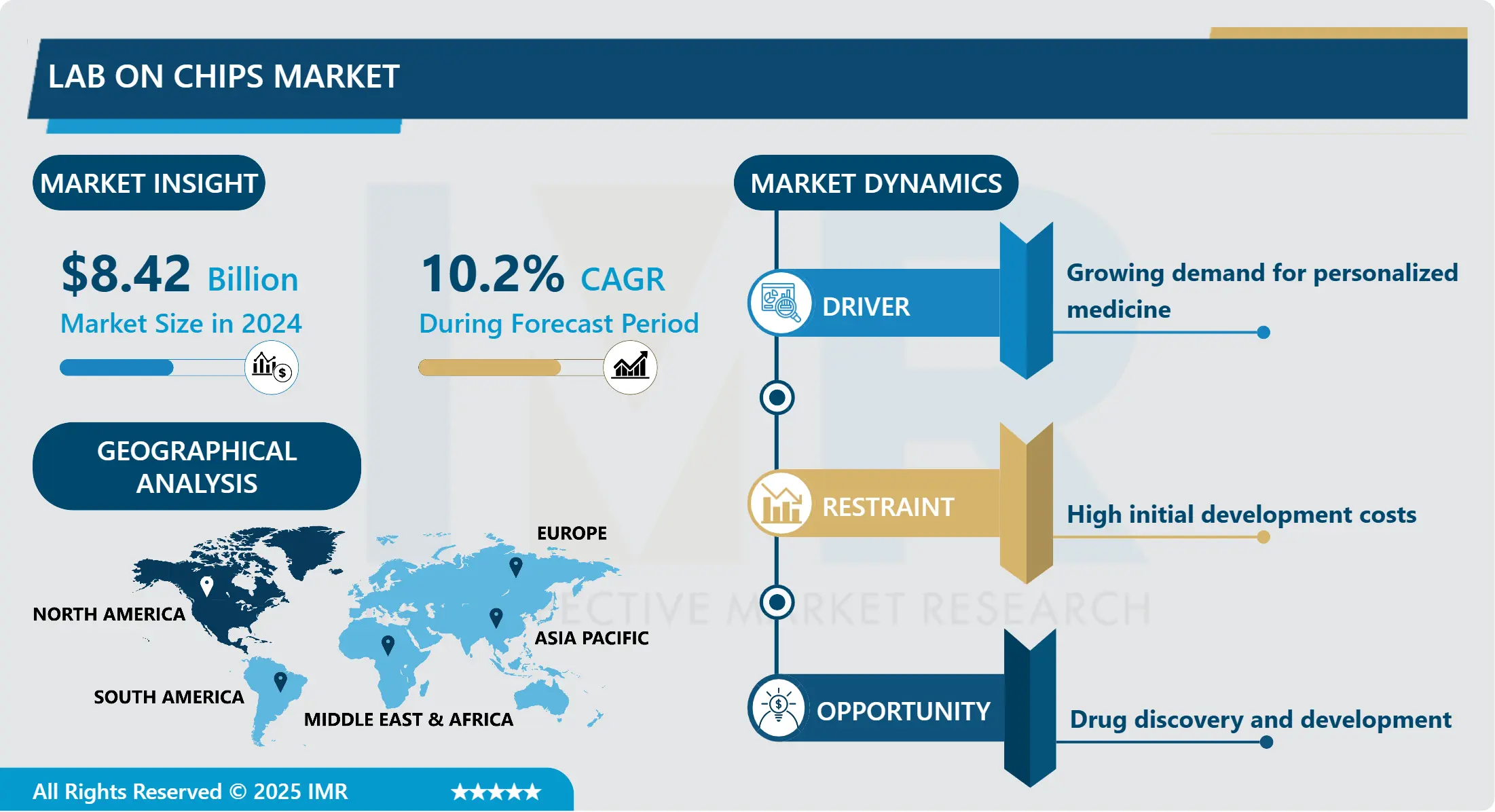
According to the latest report by Introspective Market Research (IMR), the global Lab On Chips Market which integrates full laboratory functions onto a tiny chip is projected to grow from USD 8.42 billion in 2024 to USD 18.31 billion by 2032, registering a robust compound annual growth rate (CAGR) of 10.2% over the forecast period.
This impressive growth is being fuelled by accelerating demand for miniaturized diagnostics, surge in point-of-care testing, expansion of drug discovery workflows, and increasing investments in personalized medicine and microfluidics research worldwide.
Quick Insights
- 2024 Market Valuation: USD 8.42 billion
- Forecast (2032): USD 18.31 billion more than double 2024 value
- CAGR (2025–2032): 10.2%
- Leading Technology Segment: Microfluidics enabling precise handling of minute fluid volumes on-chip
- Core Applications: Clinical diagnostics (infectious disease detection, genomics), drug discovery, environmental & food safety testing, research & academic labs
- Primary End-Users: Hospitals & clinics, diagnostics centers, pharmaceutical/biotech firms, academic & research institutes
- Geographic Insights: While North America remains a major revenue contributor globally (per broader market studies), Asia Pacific including high-growth markets such as India shows rising adoption driven by expanding diagnostics infrastructure and healthcare digitization.
Market Dynamics & Segment Breakdown
The report from Introspective Market Research segments the Lab-on-Chips market by Product type (Instruments, Reagents & Consumables, Software & Services, Others), Technology (Microarrays, Microfluidics, Tissue Biochips, Others), Application (Genomics, Proteomics, Point-of-Care Diagnostics, Drug Discovery, Others), End-Use, and Region.
- Microfluidics stands out as the dominant technology segment thanks to its ability to manipulate miniscule fluid volumes, enabling rapid, high-throughput assays with minimal reagent consumption.
- Clinical Diagnostics and Drug Discovery lead application segments, as demand grows for fast, accurate diagnostics (especially in decentralized and remote settings), and for efficient, scalable drug development workflows.
- Reagents & Consumables including microfluidic cartridges, assay kits and consumable chips are central to market revenue, given their recurring use in diagnostics and research.
Why Is Lab-on-Chip Suddenly in the Spotlight?
Compact, Fast & Cost-Effective
Lab-on-chip (LOC) devices miniaturize and integrate multiple laboratory functions from sample preparation to analysis on a chip only a few square centimeters in size. With microfluidic channels, embedded sensors, pumps and valves, these devices deliver rapid, high-precision diagnostics while using minimal sample and reagent volumes.
Broad & Growing Application Range
LOC platforms are no longer limited to academic labs. Their applications now span:
- Clinical diagnostics enabling point-of-care testing for infectious diseases, chronic illnesses, genetic disorders
- Drug discovery & development accelerating high-throughput screening, pharmacogenomics, biomarker analysis.
- Environmental & food safety testing for rapid detection of contaminants, pathogens in water, air, food products.
- Research & academic institutes for genomics, proteomics, synthetic biology, and biotech R&D workflows.
What’s Driving the Momentum and What’s Holding It Back?
Drivers:
- Rising demand for decentralized and point-of-care diagnostics, especially in remote or underserved regions.
- Growing adoption in personalized medicine, genomics, and high-throughput drug screening workflows.
- Continuous advancements in microfabrication, materials science, and sensor integration improving chip performance and reducing costs.
Challenges & Cost Pressures:
- Manufacturing LOC devices with high precision and repeatability remains technically challenging microfluidic fabrication demands tight tolerances and sophisticated equipment.
- Lack of standardization variability in chip formats, fluidics interfaces, and data protocols complicate widespread clinical adoption across labs and institutions.
- Integration with existing laboratory workflows: many traditional labs are not yet configured for LOC-based diagnostics or rely on legacy equipment, making transition slower.
Opportunity & Trend Spotlight What’s Next for the Industry?
Could Lab-on-Chip Become the Backbone of Next-Gen Diagnostics and Drug Discovery?
As chip platforms become more refined, affordable and user-friendly, LOC devices have the potential to redefine how diagnostics, personalized medicine and drug development are conducted. Emerging trends include:
- Integration with AI and data analytics advanced software to automate readouts, interpret multiplex assays, and reduce human error.
- Portable and wearable lab-on-chip devices enabling real-time health monitoring, remote diagnostics, and telemedicine-friendly platforms.
- Expansion into non-clinical domains such as food safety, environmental monitoring, and synthetic biology research, widening the addressable market beyond healthcare.
Regional & Segmentation Overview
While global adoption is rising, certain regions and segments offer particularly compelling growth trajectories:
- North America continues to dominate adoption, driven by advanced healthcare infrastructure, strong biotech/pharma presence, and high R&D spending.
- Asia-Pacific including India is emerging as a fast-growing market, propelled by expanding diagnostics infrastructure, rising healthcare investments, and increasing demand for cost-effective point-of-care solutions.
- Product-wise, Reagents & Consumables remain the workhorse segment (recurring revenue from cartridges, assay kits, chips), while Microfluidics remains the predominant technology underlining the bulk of market value.
Latest Breakthroughs & Industry Moves
Leading global players such as Roche Diagnostics, Thermo Fisher Scientific, Agilent Technologies, Abbott Laboratories and others have recently unveiled next-gen microfluidic panels and multiplex detection platforms that drastically reduce assay time and reagent use, significantly improving throughput for diagnostics and drug screening.
Moreover, innovation is accelerating in emerging sub-fields such as “organ-on-chip” models for disease modeling and drug toxicity testing signaling broader adoption beyond diagnostics into drug development and personalized medicine.
(Case Study) From Sample to Answer: Rapid COVID-19 Screening in Remote Clinics
In a pilot program conducted by a leading global diagnostics provider using a microfluidic LOC device, remote clinics in underserved regions were able to perform full COVID-19 PCR-based diagnostics on-site. The result: diagnosis turnaround time dropped from 48–72 hours (standard lab processing) to under 90 minutes per patient. This not only dramatically improved patient triage and treatment response, but also reduced reliance on centralized labs showcasing the transformative potential of LOC for global public health interventions.
The Road Ahead What This Means for Stakeholders
With the Lab-on-Chips market poised for more than double growth by 2032, stakeholders across healthcare, biotech, diagnostics, environmental monitoring and regulatory sectors are presented with a compelling opportunity. Whether it’s scaling up productions of microfluidic chips, investing in AI-enabled diagnostics, or developing portable testing platforms for remote deployment now is the time to act.
“The miniaturization and integration brought by lab-on-chip devices is not just a technological upgrade it is a paradigm shift in how we approach diagnostics and drug discovery,” says Dr. A. R. Khanna, Principal Consultant, Introspective Market Research. “Organizations that embrace LOC platforms early stand to gain a competitive edge as precision medicine, decentralized diagnostics and environmental screening gain traction globally.”
More Details: https://introspectivemarketresearch.com/reports/lab-on-chips-market/
Download the Full Report or Schedule a Briefing
To access the full “Lab On Chips Market – Global Industry Analysis and Forecast (2025–2032)” report, or to schedule a one-on-one briefing with our experts, please visit our website or contact our sales team.
About Introspective Market Research
Introspective Market Research is a leading global market intelligence firm providing rigorous, data-driven analysis and forecasts across healthcare, biotechnology, medical devices, and other high-growth sectors. Our team of seasoned analysts delivers actionable insights, tailored reports, and strategic advisory to help companies navigate dynamic markets and unlock growth opportunities.
Contact:
Introspective Market Research (IMR)
Phone: +91-91753-37569
Email: sales@introspectivemarketresearch.com

 English
 Arabic
 French
 Spanish
 Portuguese
 Deutsch
 Turkish
 Italiano
 Russian
 Romaian
 Portuguese (Brazil)
 Greek
Greek