


How Open Source Testing Tools Enable Faster Feedback Loops for Distributed Teams?
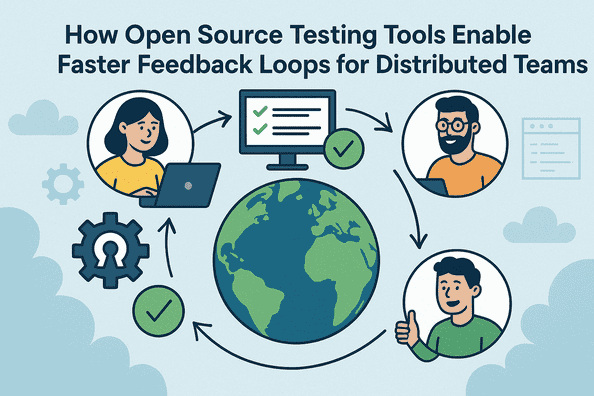
In today’s global software development landscape, distributed teams have become the norm. Engineers, testers, and DevOps professionals often collaborate across multiple time zones, locations, and even continents. While this setup allows companies to tap into global talent, it also brings unique challenges—especially when it comes to maintaining fast and reliable feedback loops in the software delivery pipeline.
Feedback loops are critical to delivering high-quality software quickly. They allow teams to identify defects, validate new features, and ensure system stability in near real-time. Open source testing tools have emerged as essential enablers for distributed teams, offering cost-effective, flexible, and scalable solutions for modern software quality assurance.
Challenges in Feedback Loops for Distributed Teams
Distributed teams often face several bottlenecks in feedback loops:
-
Time Zone Differences: Waiting for another team to run tests or review code can delay defect detection and resolution.
-
Inconsistent Testing Practices: Teams using different testing frameworks or tools may face integration challenges.
-
Infrastructure Constraints: Maintaining synchronized environments across regions can be costly and complex.
-
Scalability Limitations: Running comprehensive test suites for multiple repositories and services can slow down CI/CD pipelines.
These challenges highlight the need for flexible and scalable testing solutions that can bridge the gaps in distributed workflows.
Role of Open Source Testing Tools in Accelerating Feedback
1. Continuous Testing Across Regions
Open source testing tools allow teams to integrate automated testing directly into CI/CD pipelines. By enabling tests to run at every commit or pull request, distributed teams can ensure that feedback reaches developers almost instantly. Tools like Keploy facilitate automated API test generation and mocking, helping developers and QA engineers detect issues early without waiting for separate test environments.
2. Unified Testing Standards
When teams adopt common open source testing frameworks, such as Selenium, Cypress, or Playwright, they can standardize test scripts, reporting formats, and best practices. Standardization reduces inconsistencies and ensures that test results are easily interpretable, regardless of where the team members are located.
3. Scalability and Parallel Execution
Many open source testing tools support parallel execution and distributed test runners. This feature is crucial for large-scale projects where multiple test suites need to run simultaneously. By executing tests in parallel across multiple environments, teams can drastically reduce the time it takes to receive actionable feedback.
4. Integration with CI/CD Pipelines
Open source testing tools integrate seamlessly with popular CI/CD platforms like Jenkins, GitHub Actions, GitLab CI, and CircleCI. This integration enables automated triggering of tests, immediate reporting of failures, and automatic notifications to the relevant teams. Feedback becomes real-time, rather than waiting for manual intervention.
5. Real-Time Collaboration and Reporting
Open source tools often include dashboards or can integrate with reporting platforms to visualize test results. Distributed teams can access real-time reports, track trends, and prioritize issues effectively. This visibility ensures faster decision-making and helps prevent delays in feature delivery.
6. Flexible Environment Management
For distributed teams, maintaining identical test environments can be a challenge. Open source testing tools can integrate with containerization and virtualization platforms like Docker and Kubernetes. This enables consistent environments across regions, reducing environment-related failures and ensuring that feedback reflects true software behavior.
7. Supporting Microservices and API-Driven Architectures
Modern applications increasingly rely on microservices and API-driven architectures. Open source testing tools such as Postman, Newman, and k6 help teams validate APIs at scale, allowing fast identification of integration issues and maintaining service reliability.
Benefits Beyond Speed
Faster feedback loops are just the beginning. Open source testing tools also contribute to:
-
Reduced Costs: No licensing fees, enabling teams to scale testing without heavy investment.
-
Improved Quality: Early detection of defects prevents issues from reaching production.
-
Higher Developer Productivity: Developers receive quick feedback, allowing them to focus on feature development rather than firefighting.
-
Enhanced Collaboration: Unified tools and reporting standards reduce friction between distributed team members.
Conclusion
Distributed teams can thrive in a high-velocity development environment if feedback loops are fast and reliable. Open source testing tools provide the flexibility, scalability, and integration capabilities needed to achieve this. By standardizing test practices, enabling parallel execution, and integrating seamlessly with CI/CD pipelines, these tools empower distributed teams to detect defects early, improve collaboration, and maintain software quality at speed.
Keploy, in particular, stands out for automating API test generation and simplifying feedback for distributed engineering teams, making it easier to maintain consistency and reliability across global workflows.
Adopting open source testing tools is no longer optional for distributed teams—it’s a strategic choice that drives faster, smarter, and more efficient software delivery.

 English
 Arabic
 French
 Spanish
 Portuguese
 Deutsch
 Turkish
 Italiano
 Russian
 Romaian
 Portuguese (Brazil)
 Greek
Greek