
High Power Laser Fiber Coupled Packages: Technology, Benefits, Applications, and Selection Guide
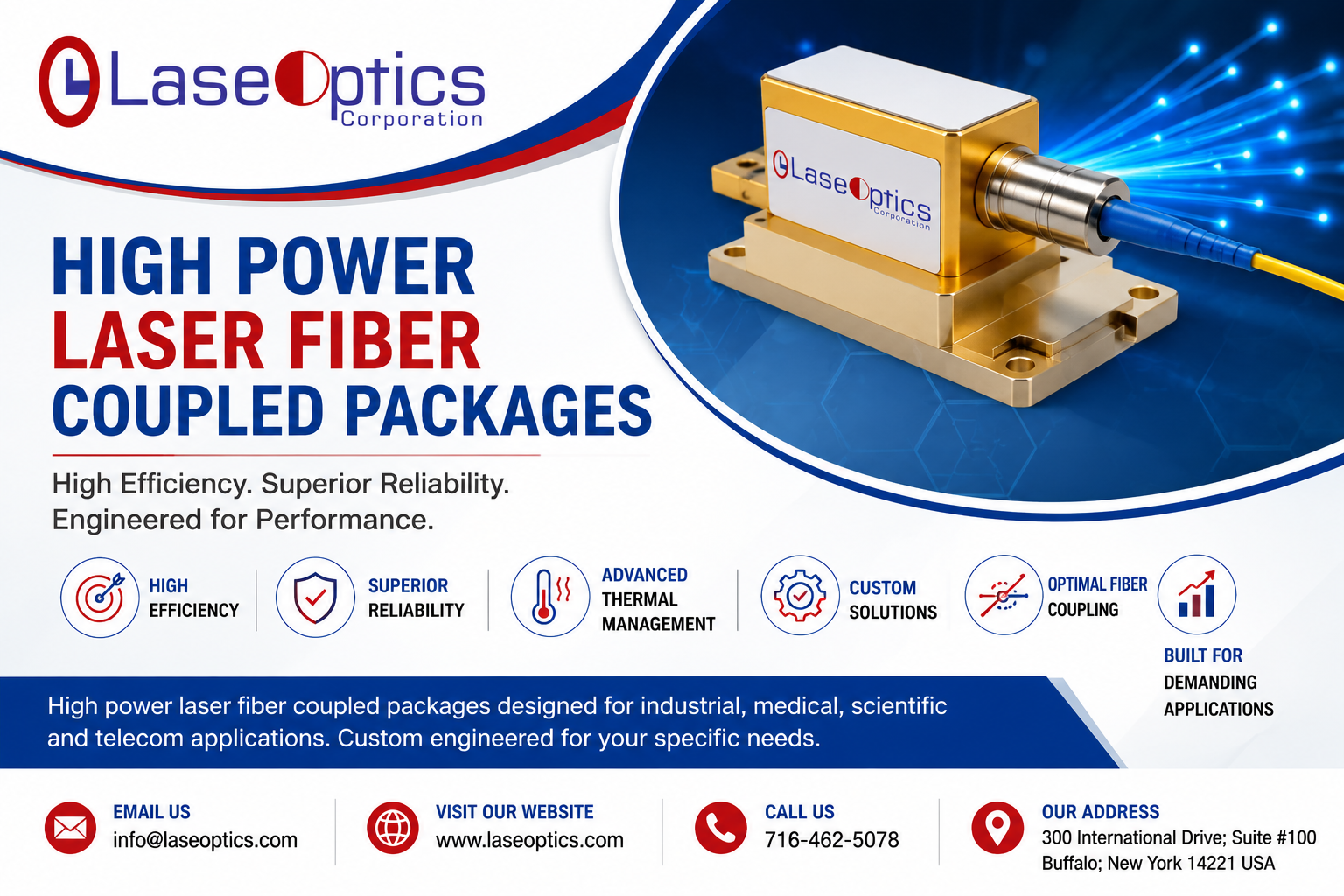
When a laser system needs to deliver high optical power into a compact, flexible, and precisely controlled output, the quality of the fiber-coupling package can make all the difference. A high-power laser diode may generate substantial optical energy, but efficiently transferring that energy into an optical fiber requires careful control of alignment, thermal management, beam characteristics, packaging, and long-term reliability.
High power laser fiber coupled packages are engineered to solve this challenge by integrating laser diodes with coupling optics and fiber assemblies in a compact package. These solutions are widely used in industrial lasers, fiber laser pumping, telecommunications, medical equipment, scientific instrumentation, defense systems, and other demanding photonics applications.
LaseOptics develops high-power laser diode packages and fiber-coupled optical solutions, including custom configurations designed around application-specific wavelength, power, fiber, and packaging requirements. Its product portfolio includes high-power laser diode packages, pump modules, lensed fibers, tapered fibers, and custom optical assemblies.
What Are High Power Laser Fiber Coupled Packages?
High power laser fiber coupled packages are integrated optical assemblies that connect a high-power semiconductor laser source to an optical fiber. Instead of allowing the laser beam to travel through a relatively large free-space optical path, the package is designed to capture, shape, align, and launch the emitted light into a fiber.
A typical package can include:
- High-power laser diode or laser diode bar
- Fiber-coupling optics
- Lensed or tapered fiber
- Mechanical alignment components
- Thermal management components
- Electrical connections
- Monitoring photodiodes or temperature sensors
- Protective or hermetic packaging
- Optional wavelength stabilization components
The exact architecture depends on the required optical power, wavelength, fiber core diameter, numerical aperture (NA), operating temperature, package dimensions, and application.
For example, commercial high-power fiber-coupled diode modules are available at wavelengths such as 808, 915, 976, and 1064 nm, with some products reaching hundreds of watts depending on the architecture and operating mode.
Why Fiber Coupling Matters in High-Power Laser Systems
A laser diode does not automatically produce a beam that perfectly matches the acceptance characteristics of an optical fiber. Semiconductor laser emitters can have different beam divergence in the fast and slow axes, non-circular emission profiles, and other characteristics that make direct coupling difficult.
The purpose of a fiber-coupling system is to transform the emitted beam so that it matches the fiber as closely as practical.
The coupling process typically involves:
- Collecting the laser diode emission.
- Correcting or shaping the beam.
- Positioning the beam relative to the fiber core.
- Matching the numerical aperture.
- Focusing the optical energy into the fiber.
- Managing the resulting thermal load.
- Maintaining alignment throughout the operating temperature range.
Research on laser-diode-to-fiber coupling has examined both bulk-optic and microlens-based approaches, with coupling performance strongly influenced by optical structure and alignment parameters.
For high-power systems, even a small optical loss can become significant because the lost energy can appear as heat inside the package.
Key Components of a High-Power Fiber-Coupled Package
High-Power Laser Diode
The laser diode is the primary optical source. Depending on the application, the package can use a single emitter, multiple emitters, a laser bar, or another semiconductor laser architecture.
High-power diode wavelengths around the 800–1000 nm range are particularly important for applications such as solid-state laser pumping and fiber laser pumping. LaseOptics specifically identifies 808 nm and 980 nm configurations among its high-power laser packaging solutions.
Fiber-Coupling Optics
The coupling optics determine how efficiently the laser emission enters the fiber. Depending on the design, these optics may include micro-optical elements, collimation optics, focusing elements, beam-shaping components, or specialized fiber-end geometries.
Lensed and Tapered Fibers
A lensed fiber can provide a compact way to focus or collimate light directly at the fiber end. Tapered and specially shaped fiber tips can also be engineered to improve mode matching between the laser and fiber.
LaseOptics manufactures different lensed-fiber geometries, including conical, ball-lens, angled, perpendicular, and wedge/chisel configurations. The company states that these fibers can be customized for high-power diode-laser coupling and other applications.
Thermal Management
High-power laser packages must remove heat effectively. Excessive temperature can shift wavelength, change optical alignment, reduce efficiency, and accelerate component degradation.
Depending on the power level and application, thermal solutions can include:
- Conduction cooling
- Heat sinks
- Thermoelectric coolers
- Air cooling
- Water cooling
- Thermistors and temperature monitoring
- Thermally conductive mounting structures
Commercial high-power packages demonstrate the importance of thermal design. For example, some high-power modules use conduction-cooled architectures, while other systems use air- or water-cooled configurations.
Important Specifications to Consider
Choosing high power laser fiber coupled packages should begin with the optical and mechanical requirements of the final system rather than simply selecting the package with the highest advertised power.
Optical Power
Determine whether the application requires continuous-wave (CW), quasi-continuous-wave (QCW), or pulsed operation.
Power specifications can differ substantially between these operating modes. For example, a commercial fiber-coupled diode module may support tens of watts in CW operation but significantly higher peak or QCW power.
Wavelength
The operating wavelength must match the laser application and the transmission characteristics of the fiber and optical coatings.
Common high-power diode applications use wavelengths around:
- 808 nm
- 915 nm
- 940 nm
- 976 nm
- 980 nm
- 1064 nm
The correct wavelength depends on whether the package is being used for pumping, direct material processing, medical equipment, sensing, communications, or another application.
Fiber Core Diameter
Fiber core diameter is another critical parameter. High-power applications commonly use multimode fibers because they can accommodate larger optical etendue than single-mode fibers.
Commercial high-power products demonstrate configurations such as approximately 100–400 µm fiber cores, depending on the optical power and application.
Numerical Aperture
Numerical aperture determines the acceptance angle of the fiber. The coupling optics need to produce a beam compatible with the fiber's NA.
A mismatch can reduce coupling efficiency and increase unwanted optical power outside the desired guided modes.
Package Size
OEM equipment often has strict dimensional limitations. A compact package can simplify system integration, but reducing package size must not compromise optical alignment or thermal performance.
Connector and Fiber Termination
Depending on the system, the output may require a particular connector or fiber termination. High-power systems can require specialized connector designs because standard connectors may not tolerate the same optical and thermal loads.
For high-power fiber-coupled diode lasers, specialized high-power SMA and QBH-style solutions may be used depending on power and system architecture.
Advantages of High Power Laser Fiber Coupled Packages
Compact Optical Integration
Integrating the laser source and coupling optics into one package reduces the size and complexity of the optical path.
This is especially useful for OEM equipment where space is limited.
Improved Mechanical Stability
A professionally aligned and packaged optical assembly can provide greater mechanical stability than an optical setup assembled from numerous independent components.
This can be particularly important when equipment experiences vibration, temperature changes, or long operating cycles.
Efficient Light Delivery
The purpose of the coupling architecture is to transfer as much usable laser power as possible into the fiber while maintaining acceptable beam characteristics.
LaseOptics notes that its lensed-fiber technology is intended to improve coupling between optical fibers, laser diodes, waveguides, and other active devices.
Simplified OEM Integration
Instead of designing the complete laser-to-fiber interface internally, an OEM can specify the desired optical and mechanical parameters and source a packaged assembly.
This can shorten development cycles and reduce integration challenges.
Customization
High-power applications rarely have identical requirements. A custom package may be designed around:
- Specific wavelength
- Optical power
- Fiber type
- Fiber core and NA
- Connector
- Package geometry
- Cooling method
- Monitoring requirements
- Coating requirements
- Operating environment
LaseOptics states that its laser packages can be designed and packaged around customer-specific requirements, including laser chips and bars.
Applications of High Power Laser Fiber Coupled Packages
Fiber Laser Pumping
One of the most important applications is pumping fiber lasers. High-power diode modules provide optical energy to gain media, helping generate the output required by industrial and scientific laser systems.
Commercial fiber-coupled diode products are available specifically for pumping Nd-, Yb-, and Tm-doped laser materials.
Solid-State Laser Pumping
High-power laser diodes are widely used as pump sources for solid-state lasers. LaseOptics describes high-power diode packages in the approximate 800–1010 nm region for optical pumping applications.
Industrial Material Processing
Fiber-coupled laser sources can deliver concentrated optical energy to processing heads used in applications such as:
- Welding
- Cutting
- Soldering
- Heating
- Surface treatment
- Brazing
- Additive manufacturing
The fiber allows the laser source to be separated physically from the processing location while maintaining controlled optical delivery.
Medical and Biomedical Equipment
Laser diodes are used in a wide range of medical and biomedical systems. Compact fiber-coupled packages can help deliver controlled optical energy to instruments where space and beam positioning are important.
Telecommunications
High-power 980 nm pump sources are important in optical amplification systems. LaseOptics identifies 980 nm pump packages among its laser packaging products and discusses their use in erbium-doped fiber amplifier applications.
Research and Scientific Instrumentation
Research laboratories often require customized optical sources rather than standard catalog products. Fiber-coupled packages can provide a compact interface between laser sources and experimental optical systems.
High-Power Packaging vs. Standard Fiber-Coupled Modules
Not every fiber-coupled laser requires a high-power package.
A lower-power communication or sensing application may prioritize:
- Small size
- Low electrical consumption
- Single-mode output
- Wavelength stability
- Low noise
A high-power industrial system has additional priorities:
- Optical power handling
- Thermal management
- Fiber-end-face protection
- Mechanical stability
- High coupling efficiency
- Reliable alignment
- Connector power handling
- Long-term operating reliability
Therefore, selecting a package based solely on optical output power is not enough. The entire system must be evaluated.
How to Select the Right Package
Before contacting a manufacturer, prepare a basic application specification.
Consider the following questions:
- What wavelength is required?
- What is the required CW, QCW, or peak power?
- What fiber core diameter is preferred?
- What numerical aperture is required?
- Is single-mode or multimode output needed?
- What connector is required?
- Is active temperature control necessary?
- What environmental temperature range will the package experience?
- Are there space or mounting restrictions?
- Is wavelength stabilization required?
- Does the application require a monitor photodiode?
- Is a custom lensed fiber or tapered fiber needed?
Providing these details early can make the engineering and quotation process much more efficient.
Why Custom Fiber Coupling Can Be Valuable
The laser diode, optical fiber, and coupling system should be treated as a single optical design rather than independent components.
A fiber that works well with one laser emitter may not provide the same performance with another emitter. Beam divergence, emitter dimensions, wavelength, NA, fiber core, and alignment tolerances all affect the final result.
LaseOptics emphasizes custom lensed and tapered fiber development, including different end shapes and spot sizes for customer-specific applications. Its technology is intended for coupling applications involving high-power diode lasers, waveguides, VCSELs, and single-mode or multimode fibers.
For demanding OEM projects, this customization can be particularly valuable because the fiber-coupling interface can be engineered around the actual optical architecture.
Reliability and Quality Considerations
High-power optical assemblies should be evaluated for more than initial coupling efficiency.
Important quality considerations include:
- Alignment repeatability
- Thermal cycling performance
- Fiber-end-face quality
- Optical coating durability
- Mechanical robustness
- Electrical isolation
- Connector reliability
- Long-term power stability
- Manufacturing consistency
- Burn-in and testing procedures
Commercial fiber-coupled laser manufacturers commonly emphasize testing, thermal control, and reliability because high optical power places additional stress on optical and mechanical components.
A supplier with experience in custom optical packaging can also help identify potential problems before they become expensive system-level issues.
Why LaseOptics for High-Power Fiber-Coupled Solutions?
LaseOptics combines fiber-optic manufacturing with laser packaging expertise. The company identifies high-power laser diode packages, 980 nm pump modules, 915 nm pump modules, lensed fibers, tapered fibers, and custom optical assemblies among its capabilities.
Its lensed-fiber technology is designed for applications where precise optical coupling is important, while its laser packaging capabilities support different wavelengths and power levels. The company also states that its products can be customized for OEM and research applications.
For an OEM or engineering team, this combination can be useful when the laser source, fiber, lens geometry, and package need to work together as one integrated optical solution.
Conclusion
High power laser fiber coupled packages are essential building blocks for modern laser systems that require efficient, reliable, and compact optical power delivery. By integrating laser diodes, coupling optics, fiber assemblies, thermal management, and mechanical packaging, these solutions simplify system integration while supporting demanding industrial, scientific, medical, telecommunications, and laser-pumping applications.
The most suitable package depends on more than power alone. Wavelength, fiber core, numerical aperture, operating mode, cooling method, package dimensions, connector type, beam characteristics, and reliability requirements should all be considered during the selection process.
For applications requiring customized coupling, specialized lensed fibers, tapered fibers, or high-power laser diode packaging, working directly with an experienced optical manufacturer can help create a solution matched to the system rather than forcing the design to fit a standard package.
If you are developing an OEM, industrial, medical, research, or fiber-laser application, contact LaseOptics to discuss your required wavelength, optical power, fiber configuration, and packaging specifications and explore a customized high-power fiber-coupled solution.

 English
 Arabic
 French
 Spanish
 Portuguese
 Turkish
 Dutch
Dutch
 Italiano
 Russian
 Romaian
 Portuguese (Brazil)
 Greek
Greek