


Middle East Smart Homes Devices Market Size, Trends, Growth & Forecast 2030| UnivDatos
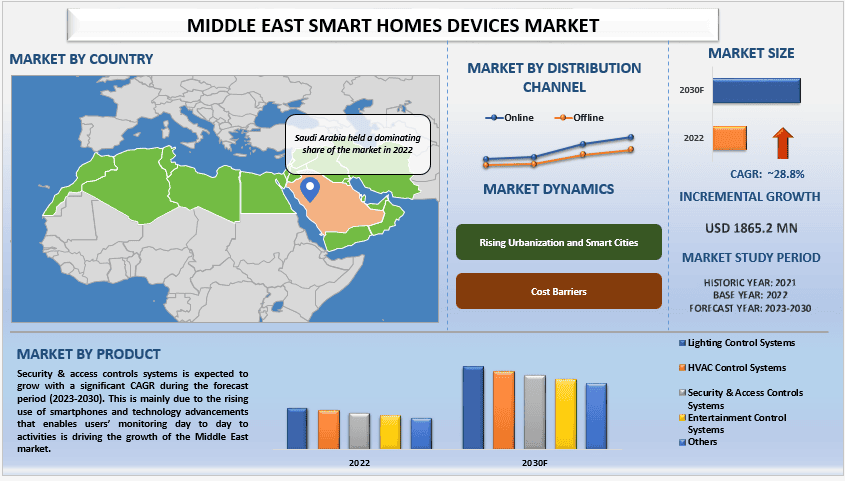
The Middle East Smart Homes devices Market was valued at USD 1865.2 Million in 2022 and is expected to grow at a strong CAGR of around 28.8% during the forecast period (2023-2030).
Smart home appliances often collect and transmit personal data. Laws in the Middle East region, such as the UAE's Data Protection Law, require manufacturers to ensure robust data protection measures and inform users about data collection and usage.
Smart home appliances must adhere to product safety standards. Countries like Saudi Arabia have strict product safety regulations in place to protect consumers from faulty or dangerous devices.
Some Middle East countries, like Qatar, may require smart home devices to be compatible with specific platforms or protocols to promote interoperability and consumer choice.
Regulations in many Middle East countries aim to promote energy efficiency. Smart appliances must meet specific energy consumption standards to reduce energy consumption and environmental impact.
Consumer protection laws in the Middle East region, like those in Egypt, often require manufacturers to provide clear warranties and return policies for smart home appliances, ensuring that consumers have recourse in case of defects.
The rise of the Internet of Things (IoT) is making it easier to connect and control home devices remotely in the Middle East region and the growth of urban areas is leading to higher adoption of smart devices due to convenience and space-saving features. As per the General Authority of Access, in 2023, almost 92% of Saudis have access to or own a smartphone. Android (53.87%) and iOS (46.01%) unsurprisingly accounted for virtually all the operating systems on smartphones across Saudi Arabia in 2022.
Moreover, Government-led initiatives promoting smart city development in countries like the UAE and Saudi Arabia are significant drivers for the adoption of smart home devices. For instance, The Dubai 2040 Urban Master Plan is one such plan. It aims to encourage sustainable urban development in Dubai while also focusing on enhancing people’s happiness and quality of life.
The report suggests that the ongoing infrastructure development and smartphone penetration has had a significant impact on the smart home appliances industry in the Middle East region. Some of the ways in which this impact has been felt include:
Access sample report (including graphs, charts, and figures): https://univdatos.com/reports/middle-east-smart-homes-devices-market?popup=report-enquiry
Government Initiatives Promoting Energy Efficiency: Many governments in the Middle East region have launched initiatives aimed at reducing energy consumption and promoting sustainability. This includes subsidies for energy-efficient appliances and regulations requiring energy labels.
Increased Connectivity and Internet Penetration: The Middle East region has witnessed a surge in internet penetration and smartphone adoption in recent years. This increased connectivity has created an ecosystem conducive to the adoption of smart home technology. Consumers can control and monitor their appliances remotely using smartphones or voice assistants, making their lives more convenient and efficient.
Rise of E-commerce: The rise of e-commerce platforms in the region has made it exceptionally convenient for consumers to access a diverse array of smart home appliances, including smart TVs, and smart washing machines, which contributes significantly to industry expansion.
Apart from this, in recent years, several governments in the Middle East and North Africa have implemented policies and provided funding support to enhance the growth of the smart home appliances industry. Some examples include:
Click here to view the Report Description & TOC: https://univdatos.com/reports/middle-east-smart-homes-devices-market
Conclusion
In conclusion, the smart home appliances market in the Middle East region is being driven by factors such as urbanization, government support for energy efficiency, increased connectivity, and the growing importance of home security. These drivers are creating a favorable environment for the adoption of smart home technologies, and the market is expected to continue to grow as consumers seek more convenience, efficiency, and safety in their homes.
Key Offerings of the Report
Market Size, Trends, & Forecast by Revenue | 2023−2030
Market Dynamics – Leading Trends, Growth Drivers, Restraints, and Investment Opportunities
Market Segmentation – A detailed analysis by Product, Technology, and Distribution Channel
Competitive Landscape – Top Key Vendors and Other Prominent Vendors
Contact Us:
UnivDatos
Email: contact@univdatos.com
Contact no: +1 978 7330253
Website: www.univdatos.com
Linked In: https://www.linkedin.com/company/univ-datos/

 English
 Arabic
 French
 Spanish
 Portuguese
 Deutsch
 Turkish
 Dutch
Dutch
 Italiano
 Russian
 Romaian
 Greek
Greek