


A Comparison of Helical Screw Piles and Driven Piles
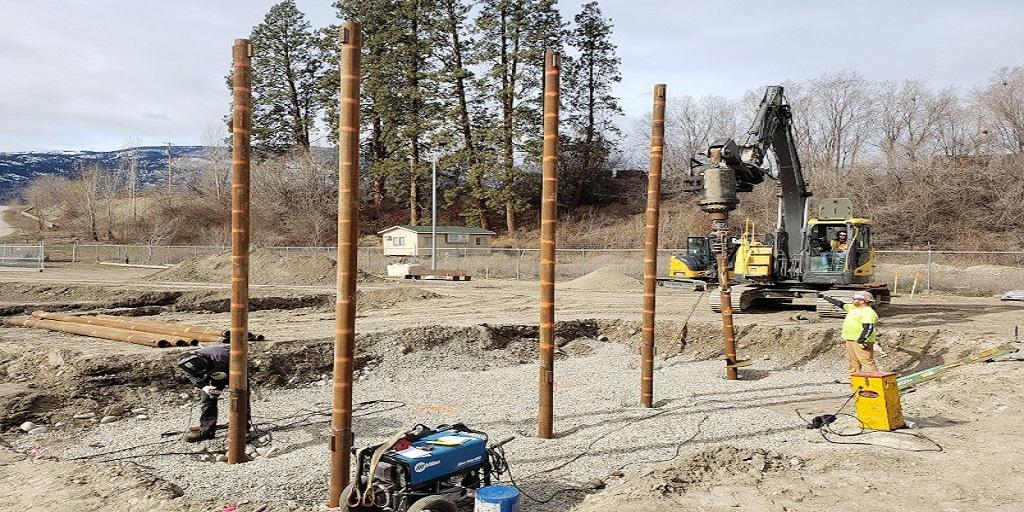
Foundation design often requires balancing performance, efficiency, and reliability. Among the most widely used deep foundation solutions are helical screw piles and driven piles, both capable of supporting substantial structural loads. A critical aspect in choosing between them lies in how engineers predict and verify ultimate capacity. Understanding the differences in methodology and performance can help stakeholders make more informed decisions on which system aligns best with project requirements.
Predicting Ultimate Capacity in Driven Piles
Driven piles are long-established in geotechnical engineering, with decades of field data supporting their design. Predicting the ultimate capacity of driven piles generally relies on dynamic or static testing.
- Dynamic Load Testing (DLT): This method measures force and velocity during pile driving, providing estimates of load capacity. It is widely used due to speed and cost efficiency, but results can vary depending on soil conditions and driving energy.
- Static Load Testing (SLT): Considered the gold standard, static testing applies incremental loads until failure or settlement criteria are reached. While highly reliable, it is expensive and time-consuming, making it less feasible for every project.
Design predictions for driven piles often involve empirical correlations derived from soil properties, SPT (Standard Penetration Test) values, or CPT (Cone Penetration Test) data. While effective, accuracy may be influenced by soil variability, especially in layered or heterogeneous ground conditions.
Ultimate Capacity Prediction for Helical Screw Piles
Helical screw piles follow a different approach to ultimate capacity determination. Their capacity is primarily calculated using well-established torque correlation methods, which link the installation torque directly to the pile’s load-bearing capability.
This method offers several advantages:
- Real-Time Feedback: Installation torque is monitored continuously, providing immediate insight into soil resistance and pile capacity.
- Cost Efficiency: Unlike full-scale load tests, torque monitoring reduces the need for extensive pre-construction testing.
- Adaptability: Engineers can adjust pile length and configuration during installation to achieve target capacities.
In addition to torque-based predictions, load tests—axial compression, tension, or lateral—are conducted selectively to confirm design assumptions. Compared to driven piles, testing requirements are generally lighter, since capacity correlation is embedded within the installation process itself.
Comparative Reliability and Performance
One of the key distinctions between the two systems lies in predictability. Driven piles often rely heavily on empirical data that may or may not reflect site-specific behavior, necessitating conservative design margins. By contrast, helical screw piles provide direct performance feedback during installation, reducing uncertainty.
- Driven Piles: High initial resistance during driving may sometimes mask long-term settlement issues.
- Helical Screw Piles: Immediate torque-to-capacity correlation creates a stronger link between installation and performance outcomes.
Both systems, however, benefit from supplemental load testing for critical structures, ensuring that predictions align with actual field behavior.
Long-Term Performance Considerations
From a durability standpoint, both systems can achieve long service lives with proper design and corrosion protection. However, long-term monitoring has shown that pile-soil interaction may evolve differently:
- Driven piles may experience soil setup, where strength increases over time as soils reconsolidate.
- Helical Screw Piles typically deliver consistent performance from the moment of installation, without the waiting period associated with setup effects.
This immediate reliability can be a major advantage in projects where timelines are tight and foundations need to reach design capacity without delay.
For engineers and project managers, understanding these differences allows for more precise foundation planning. Rather than a one-size-fits-all solution, the optimal choice depends on aligning structural demands with soil conditions and installation practicalities. Ultimately, the ability to predict and confirm ultimate capacity with confidence is what ensures safety, efficiency, and long-term performance.
For more information about Drilling Company Kelowna and Commercial Drilling Service Please visit: ATLAS PILING.

 Arabic
 French
 Spanish
 Portuguese
 Deutsch
 Turkish
 Dutch
Dutch
 Italiano
 Russian
 Romaian
 Portuguese (Brazil)
 Greek
Greek