


Fortify Your E-commerce Empire: Cybersecurity Strategies for Global Success
Every day, more businesses shift online. A few familiar names are stretching out a bit longer, and a few new players are entering digital for the first time. Big or small, whatever their industry, their aim is the same: to reach more people, work more efficiently, and continue to transform. With this new normal, a unified digital presence is essential. Customers expect fast, trustworthy experiences, and the quiet confidence that their information is stored safely, making e-commerce security and data encryption foundational, not optional.
As reach expands, so does the surface exposed to risk. A forgotten software patch or a weak login can create openings that no one expects. In today’s threat landscape, cybersecurity for e-commerce is crucial, as digital threats like ransomware and phishing, bot attacks, and other cyber threats in e-commerce have moved from rare events to routine challenges.
Strong security is about protecting relationships. It helps preserve trust, meet growing compliance expectations such as GDPR and CCPA compliance, and PCI DSS compliance, while keeping business momentum steady.
This manual has been composed to provide simple and effective steps that can easily be integrated into real practices. The intention here is to assist you in making the move with confidence, knowing that your ground is firm, thus ensuring that growth does not compromise stability. These are e-commerce cybersecurity best practices designed to protect your operations without slowing you down.
Digital Growth and the Expanding E-commerce Security Risk Surface
As more businesses shift online, the digital economy is growing fast around the world. India alone is expected to cross $1 trillion by 2030, backed by over 800 million internet users. From local brands in Southeast Asia to startups in Europe and marketplaces in North America, digital adoption is accelerating everywhere.
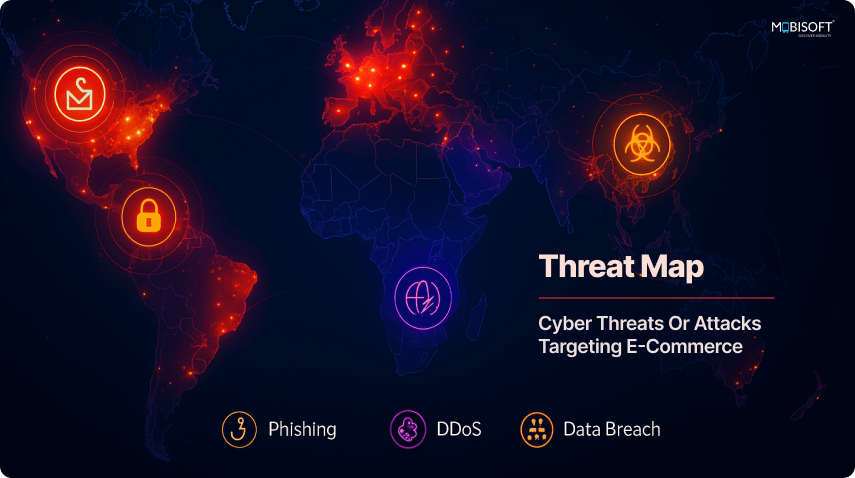
With this scale comes a new level of exposure. Security threats have become sharper, more frequent, and harder to spot. In 2022, India’s CERT-In tracked over 1.3 million cyber incidents, a signal of how real and relentless these risks are becoming globally. This further validates why cybersecurity matters in global e-commerce and highlights the need for robust cybersecurity solutions for e-commerce platforms.
Businesses of every size, across every region, are facing similar pressure. Whether it’s protecting online store security, ensuring secure access, or guarding against evolving threats, the stakes are high.
To meet this scale with performance and resilience, businesses often turn to trusted ecommerce development services that align with modern security needs.
Here’s a brief look at what many e-commerce players are up against:
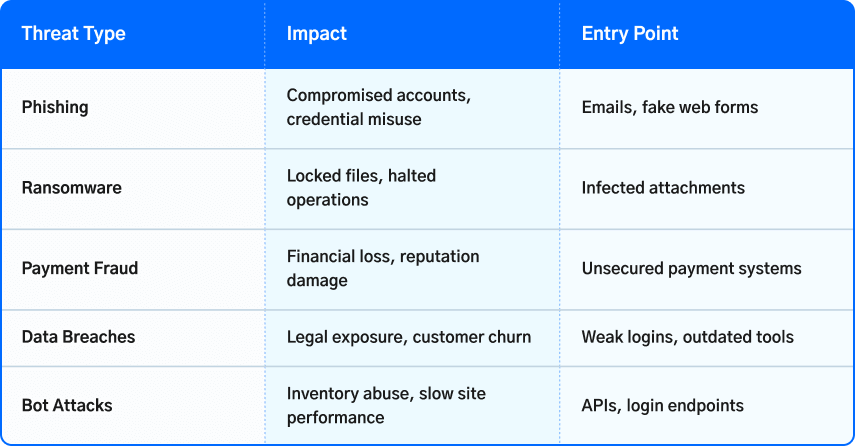
While the threats differ by region, the core challenge stays the same: how to protect an online business from cyber attacks without slowing down growth. That includes safeguarding customer data, avoiding downtime, and enabling secure payment gateways for e-commerce. The first step is to see the landscape clearly, then prepare for what’s coming using practical, real-world defenses.
Why Cybersecurity for E-commerce Deserves a Front Seat in Growth Strategy
- Guarding Customer Trust and E-commerce Data Security
Every purchase goes beyond the product. Customers hand over sensitive details, names, mobile numbers, delivery addresses, and payment credentials, assuming the system will guard them with strong ecommerce platform security measures.
Once that data slips, the damage spreads fast.
A PwC India survey showed that 83% of buyers would stop engaging with a brand after an ecommerce data breach. In global markets, we’ve seen the same trend: hard-won loyalty evaporates after a single slip.
E-commerce data security is about influencing retention, referrals, and long-term brand value. For teams building with limited resources, trust becomes a growth lever. Lose it, and acquisition costs rise sharply.
This requires a custom ecommerce platform security that aligns with both operational and compliance standards.
- Navigating E-commerce Data Protection Regulations in India
In India, failure in ecommerce security compliance can attract penalties up to ₹250 crore per violation. But more than the fines, the real setback is reputational. No one wants to collaborate with a business under regulatory scrutiny.
Founders need to treat cybersecurity in ecommerce the same way they treat legal structure or accounting as a baseline hygiene factor. Without it, scaling becomes harder than it needs to be.
Getting Practical: Budget-Friendly Cybersecurity Solutions for E-commerce
- Dispelling the Myth of High Costs in E-commerce Cybersecurity
Most business owners assume that ecommerce cybersecurity best practices require expensive tools or an in-house tech team. That’s where many stalls are. But in reality, basic ecommerce security solutions can be set up quickly and affordably, and block most threats.
For deeper protection models and advanced strategies, explore our cybersecurity solutions for businesses tailored for e-commerce environments.
These are small, surgical changes that act like digital safety nets:
- Simple Cybersecurity Investments for Indian SMBs
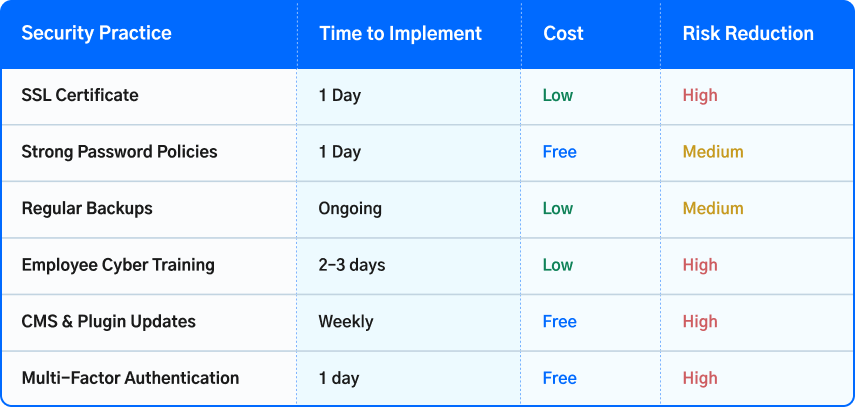
Most of these don’t need technical expertise. What they need is ownership, someone keeping an eye on e-commerce security hygiene.
Simplified Cybersecurity Roadmap for Indian E-commerce Businesses
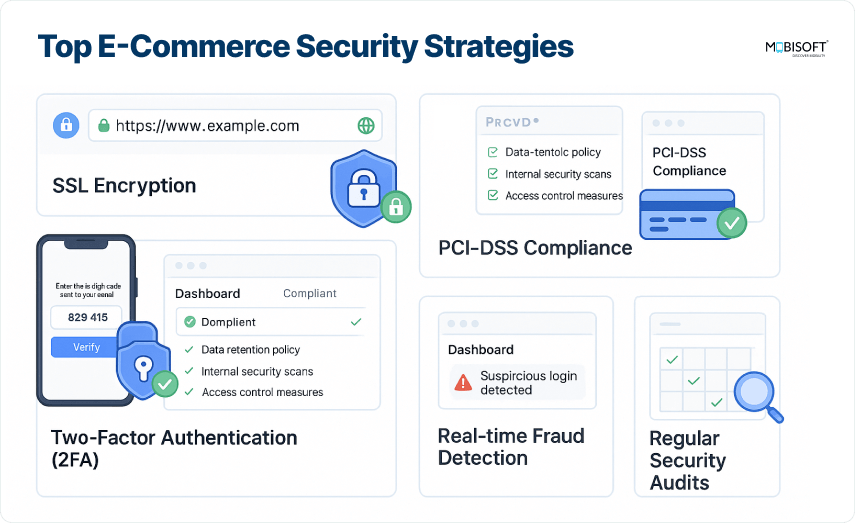
If you’re running an ecommerce business in India with a lean team, start with this playbook:
- Use Strong, Unique Passwords
Make reuse a red flag. Rotate credentials every quarter
- Keep Software Updated
CMS patches often plug security holes before attackers find them.
- Train Your Employees
Even one team member clicking the wrong link can trigger a breach.
- Choose Secure Payment Gateways
Prioritize to align with RBI, PCI-DSS, and ecommerce security standards
- Backup Website Data Regularly
Store them across platforms, cloud, and local, in case you need a rollback.
- Use a Web Application Firewall (WAF)
WAFs catch automated threats, bot traffic, and known exploit patterns.
- Conduct Regular VAPT (Vulnerability Assessment and Penetration Testing)
Think of this as a fitness test for your ecommerce cybersecurity strategy
Read More: https://mobisoftinfotech.com/resources/blog/ecommerce-retail/ecommerce-cybersecurity-strategies

 English
 Arabic
 French
 Spanish
 Portuguese
 Deutsch
 Turkish
 Dutch
Dutch
 Italiano
 Russian
 Romaian
 Greek
Greek