Introduction: The Invisible Safety Net of Software
When an application works flawlessly, users rarely think about the effort behind it. But every successful login, secure payment, and instant data update is backed by rigorous testing.
Today’s software systems are layered and interconnected. A simple user action may travel through the user interface, reach backend services, interact with APIs, update databases, and return a response — all within milliseconds.
If any layer fails, the entire system can break.
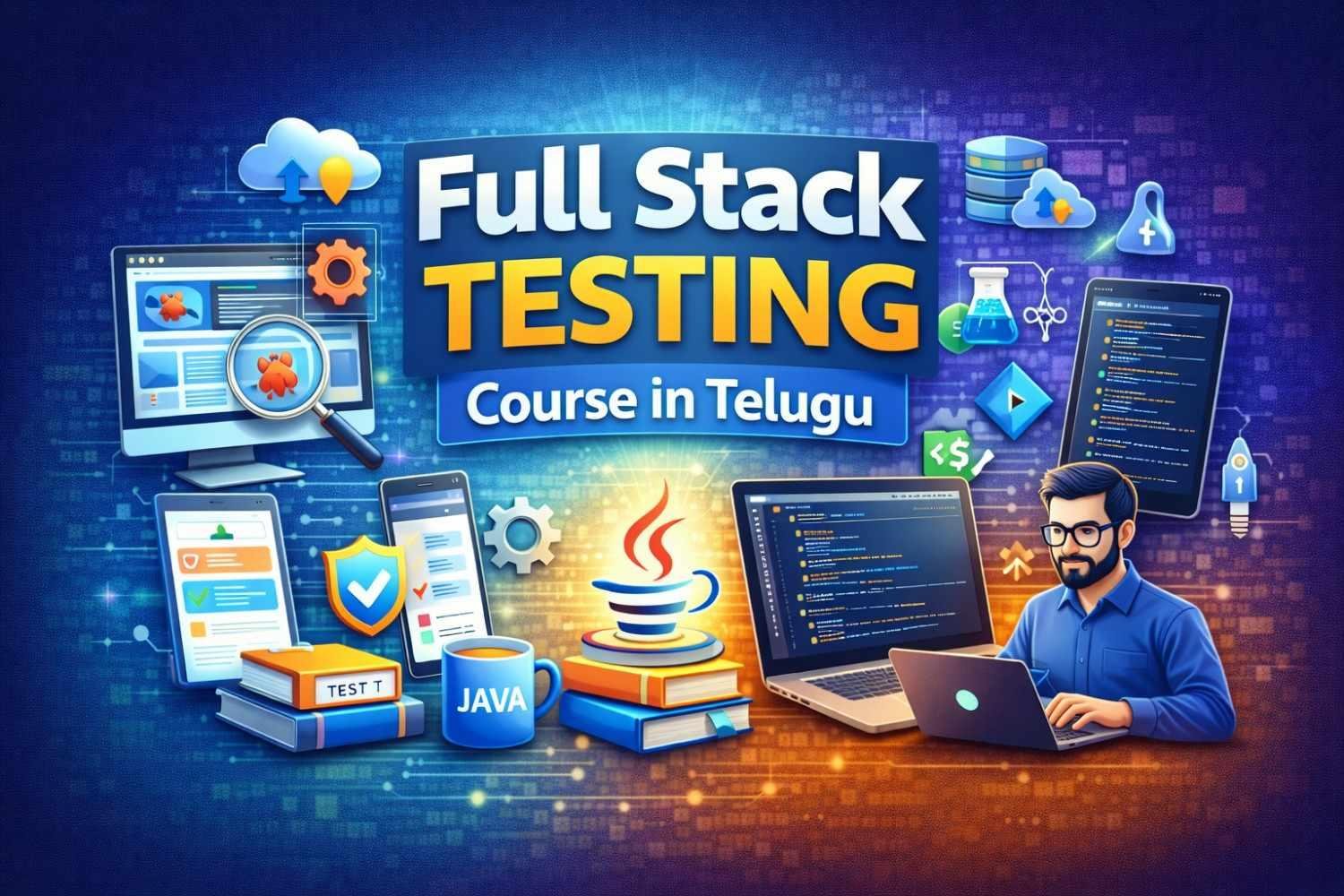
This is why many learners look for a Full Stack Testing Course in Telugu — to understand how complete applications are validated across every layer, not just at the surface.
Full stack testing ensures reliability from the UI down to the database.
What Is Full Stack Testing?
Full stack testing refers to validating all layers of an application, including:
-
Frontend (User Interface)
-
Backend logic
-
APIs
-
Database systems
-
Integration between modules
-
Performance and stability
Instead of testing isolated components, full stack testing verifies the complete workflow of an application.
For example, in a job portal:
-
A candidate uploads a resume.
-
Backend processes and stores the file.
-
Database updates user records.
-
API triggers notification emails.
-
Dashboard displays updated status.
Each step must function correctly together.
Why Full Stack Testing Is Critical Today
Modern applications are:
-
Built with microservices
-
Hosted in cloud environments
-
Integrated with external APIs
-
Frequently updated via CI/CD
This complexity increases the risk of integration failures.
Full stack testing helps:
-
Detect cross-layer defects
-
Ensure smooth data flow
-
Maintain system reliability
-
Improve release confidence
-
Enhance user experience
Organizations now expect testers to understand architecture and system interactions.
Core Components of Full Stack Testing
A structured approach to full stack testing typically includes several technical domains.
1. Software Testing Foundations
Every tester must understand the basics.
Key areas include:
-
Software Development Life Cycle (SDLC)
-
Software Testing Life Cycle (STLC)
-
Test case design techniques
-
Defect lifecycle management
-
Functional and regression testing
These concepts develop structured problem-solving skills.
2. Frontend Testing
Frontend testing ensures the user interface behaves correctly.
It verifies:
Selenium is widely used for automating UI testing.
Frontend testing directly impacts user satisfaction.
3. API Testing
APIs act as bridges between frontend and backend systems.
API testing validates:
Tools like Postman and REST-assured are commonly used.
API testing is essential in microservices-based systems.
4. Database Testing
Database testing ensures accurate data management.
It verifies:
SQL knowledge is required for backend data validation.
Database integrity is critical in financial and enterprise systems.
5. Automation Testing
Automation testing improves efficiency and repeatability.
Common tools include:
-
Selenium
-
TestNG
-
JUnit
-
Cucumber
Automation frameworks allow repeated execution of test cases across environments.
Automation skills increase professional value in the industry.
6. Performance Testing
Performance testing evaluates system behavior under stress.
It measures:
-
Response times
-
Scalability
-
Server stability
-
Resource utilization
JMeter is widely used for load testing.
Performance testing ensures systems can handle real-world traffic.
7. Integration and End-to-End Testing
Integration testing ensures modules communicate correctly.
End-to-end testing simulates complete user journeys.
This approach validates the entire application workflow.
Full stack testing depends heavily on these testing strategies.
8. Continuous Testing in DevOps
Modern development integrates testing into CI/CD pipelines.
Continuous testing ensures:
Understanding DevOps processes enhances full stack testing effectiveness.
Skills Required for Full Stack Testing
To succeed in full stack testing, one should develop:
Testing requires both technical competence and structured thinking.
Why Learn Full Stack Testing in Telugu?
Understanding automation frameworks, API workflows, and database validation concepts in Telugu can improve foundational clarity during early learning stages.
Career Opportunities
Full stack testing skills enable professionals to work as:
These roles are in demand across startups, enterprises, SaaS companies, and product-based organizations.
Challenges in Full Stack Testing
Full stack testing introduces challenges such as:
-
Maintaining automation scripts
-
Testing distributed microservices
-
Handling dynamic UI changes
-
Ensuring complete test coverage
-
Keeping up with evolving technologies
Continuous learning is necessary to remain competitive.
Industry Trends and the Future
Testing is evolving toward:
Quality engineering is becoming central to software development.
Full stack testing aligns with these emerging trends.
The Bigger Perspective on Quality
Quality is not achieved by chance.
It requires systematic validation across interconnected layers.
Full stack testers understand how frontend, backend, APIs, and databases interact.
They prevent failures before they impact users.
Testing has become a strategic function in modern software development.
Summary
Full stack testing ensures complete validation of application ecosystems — from user interface interactions to backend processing and database integrity.
By mastering manual testing, automation frameworks, API validation, and performance analysis, professionals contribute to delivering reliable digital systems.
As applications continue to grow in complexity and integration, the key question becomes — are you ready to understand how entire software stacks are tested and become the quality backbone behind modern technology?
 English
 Arabic
 French
 Spanish
 Portuguese
 Deutsch
 Turkish
 Dutch
Dutch
 Italiano
 Russian
 Romaian
 Portuguese (Brazil)
 Greek
Greek