


AI for Aircrew Transportation Solutions: Enhancing Crew Mobility & Efficiency
Introduction: The Digital Transformation of Aircrew Mobility
In an era of unprecedented technological advancement, the aviation industry stands at the cusp of a mobility revolution. The global artificial intelligence in transportation market is projected to grow from $2.11 billion in 2024 to $6.51 billion by 2031, with a remarkable 17.5% compound annual growth rate. Within this transformative landscape, aircrew transportation emerges as a critical frontier where AI-powered solutions are redefining efficiency, safety, and employee experience.
The traditional challenges of coordinating transportation for pilots, flight attendants, maintenance personnel, and other airline staff have long been complex and resource-intensive. Manual scheduling, communication gaps, and inefficient route planning have plagued airline operations, resulting in increased costs, reduced productivity, and employee dissatisfaction. Today, intelligent mobility solutions are poised to change this paradigm fundamentally.
The integration of AI in transportation systems has shown remarkable results across various metrics:
- Global AI in Transportation Market: $2.11 billion (2024)
- Projected Market Value by 2031: $6.51 billion
- Compound Annual Growth Rate: 17.5%
- Estimated Autonomous Vehicles by 2030: 58 million
- Potential Traffic Congestion Reduction: 25%
- Fleet Maintenance Cost Savings: 10-20%
- Fuel Efficiency Improvement: Up to 15%
These numbers reflect a broader industry shift towards intelligent transportation solutions, particularly in the specialized domain of aircrew mobility management. As airlines worldwide seek to optimize their operations, the focus has increasingly shifted to ensuring seamless, efficient, and reliable transportation for their crew members.
Challenges in Traditional Aircrew Transportation
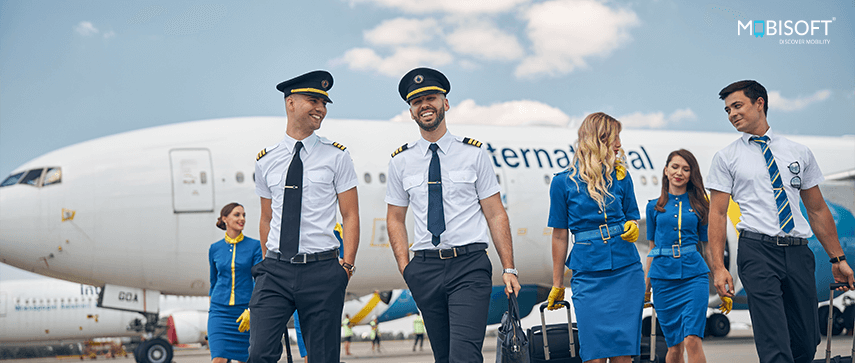
Traditional aircrew transportation faces complex challenges in scheduling, communication, resource management, safety, and real-time coordination across multiple locations.
Here’s an overview:
Line Personnel
- Pilots and co-pilots: Required to arrive well before flight times with zero tolerance for delays. Their transportation needs often change with little notice due to flight schedule modifications or weather-related changes.
- Flight attendants: Deal with varying shift patterns and multiple flight changes within a single day. Need reliable transportation that can adapt to last-minute schedule modifications and different airport terminals.
- Ground staff: Require flexible transportation options across different airport zones and terminals. Their movements must be coordinated with flight arrivals and departures, often requiring rapid response to changing situations.
- Security personnel: Working round-the-clock shifts necessitates consistent transportation availability at odd hours. Their critical role in airport operations demands punctual arrival regardless of external conditions.
Operations Staff
- Scheduling agents: Must manage multiple crew rotations while coordinating with various transportation providers. Their work involves constant adjustment to transportation schedules based on flight changes and crew availability.
- Dispatchers: Require 24/7 mobility support to manage emergencies and routine operations. Need immediate access to reliable transportation to respond to operational challenges at any time.
- Administrative personnel: Regular shift patterns require consistent transportation scheduling. Their work supports critical airline operations, making reliable transportation essential for maintaining operational continuity.
- Emergency response teams: Need on-demand transportation with immediate availability. Their role requires rapid deployment capabilities with flexible routing options to handle various emergency scenarios.
Maintenance Teams
- Flight engineers: Deal with unpredictable maintenance schedules that can change at a moment's notice. Their transportation needs are often urgent and critical for maintaining flight schedules.
- Technical staff: Respond to urgent repair needs across different airport locations. Require rapid transportation solutions that can accommodate specialized tools and equipment.
- Quality control personnel: Move between multiple aircraft throughout their shifts. Need efficient transportation that allows them to conduct thorough inspections while meeting tight schedules.
- Specialized equipment transport: Requires careful coordination of appropriate vehicles and timing. Must ensure safe and timely delivery of sensitive maintenance equipment to various airport locations.

 English
 Arabic
 French
 Spanish
 Portuguese
 Deutsch
 Dutch
Dutch
 Italiano
 Russian
 Romaian
 Portuguese (Brazil)
 Greek
Greek