


Digital Asset Management Market Analysis: Regions, Segments, and Growth Drivers
The rapid digitization of business operations has fundamentally transformed how organizations create, store, distribute, and monetize content. From marketing visuals and videos to product documentation and brand guidelines, enterprises today manage an unprecedented volume of digital assets. Against this backdrop, Digital Asset Management (DAM) solutions have emerged as essential infrastructure rather than optional tools. As organizations seek to maintain brand consistency, accelerate go-to-market strategies, and operate seamlessly across digital channels, DAM platforms are becoming central to enterprise digital ecosystems.
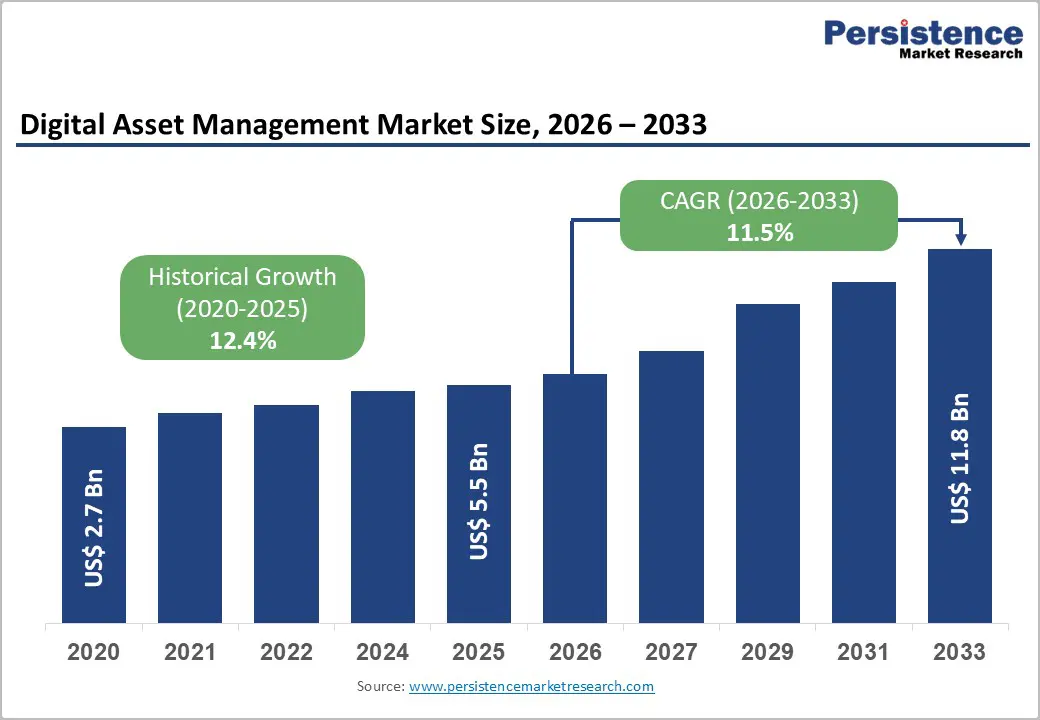
The global digital asset management market size is expected to be valued at US$ 5.5 billion in 2026 and is projected to reach US$ 11.8 billion by 2033, expanding at a compound annual growth rate (CAGR) of 11.5% during the forecast period. This sustained expansion reflects the strategic importance of DAM systems in managing complex digital workflows, supporting omnichannel engagement, and enabling data-driven content strategies across industries.
Understanding Digital Asset Management in the Modern Enterprise
Digital Asset Management refers to software solutions that enable organizations to centrally store, organize, retrieve, and distribute digital assets such as images, videos, audio files, documents, and creative files. Unlike traditional file storage systems, DAM platforms offer advanced metadata tagging, version control, rights management, workflow automation, and integration with marketing and creative tools.
In modern enterprises, DAM solutions act as a single source of truth for digital content. They ensure that teams across geographies access approved, up-to-date assets while maintaining governance, security, and compliance. As digital touchpoints multiply and customer expectations rise, DAM systems play a critical role in delivering consistent and engaging brand experiences.
Market Size and Growth Trajectory
The digital asset management market has demonstrated robust historical growth, expanding at a CAGR of 12.4% between 2020 and 2025. This momentum is expected to continue, albeit at a slightly moderated pace, as the market matures and adoption deepens across verticals.
By 2026, the market is likely to reach US$ 5.5 billion, driven by increasing enterprise digitization and growing volumes of digital content. Over the forecast period from 2026 to 2033, the market is projected to more than double, reaching US$ 11.8 billion. The projected 11.5% CAGR underscores the sustained demand for scalable, intelligent, and cloud-enabled DAM platforms across global markets.
Key Drivers Fueling Market Expansion
Exponential Growth in Digital Content Creation
One of the most significant drivers of the digital asset management market is the exponential increase in digital content creation. Enterprises across marketing, media, retail, education, and corporate communications are producing vast quantities of images, videos, and interactive content to engage audiences across multiple channels.
Without centralized management, this content sprawl leads to inefficiencies, duplication, and brand inconsistencies. DAM platforms address these challenges by enabling structured content governance, faster asset retrieval, and streamlined collaboration, making them indispensable in content-intensive environments.
Widespread Adoption of Cloud-Based Deployment Models
The rapid shift toward cloud computing has significantly accelerated DAM adoption. Cloud-based DAM solutions offer superior scalability, lower upfront costs, and seamless remote access compared to traditional on-premise systems. These benefits are particularly attractive to organizations with distributed teams and global operations.
Cloud deployment also supports frequent updates, AI-driven enhancements, and easy integration with content management systems (CMS), marketing automation platforms, and e-commerce tools. As a result, cloud-based DAM solutions account for approximately 66% of total market revenue, reinforcing their dominance within the deployment segment.
Growing Focus on Brand Consistency and Compliance
In an omnichannel marketplace, maintaining consistent brand messaging across digital touchpoints is both a strategic priority and a compliance requirement. Enterprises increasingly recognize DAM systems as critical infrastructure for enforcing brand guidelines, managing asset usage rights, and ensuring regulatory compliance.
DAM platforms enable organizations to control asset access, track usage history, and manage licensing agreements, reducing legal risks and protecting brand integrity. This capability is especially important for regulated industries and global brands operating across multiple jurisdictions.
Accelerated Digital Transformation Initiatives
Digital transformation remains a top priority for enterprises worldwide. DAM solutions align closely with transformation goals by improving operational efficiency, reducing time-to-market for campaigns, and enabling data-driven decision-making. As organizations modernize their IT infrastructure, DAM platforms are being integrated into broader digital experience and customer engagement strategies.
Regional Market Insights
North America: Market Leader with Strong Enterprise Adoption
North America dominates the global digital asset management market, accounting for approximately 36% of market share in 2026. The region’s leadership is driven by high levels of enterprise digital maturity, substantial investments in cloud infrastructure, and strong demand for omnichannel marketing capabilities.
Organizations in the United States and Canada are early adopters of advanced DAM features such as AI-powered search, automated metadata tagging, and workflow orchestration. The presence of leading DAM vendors and a robust ecosystem of digital marketing agencies further strengthens regional market growth.
Asia Pacific: Fastest Growing Regional Market
The Asia Pacific region is expected to witness the fastest growth, with a projected CAGR of approximately 19% during the forecast period. This exceptional momentum is fueled by rapid e-commerce expansion, urbanization, and government-led digital transformation initiatives across emerging economies.
Large population bases, rising internet penetration, and increasing adoption of digital marketing strategies are creating strong demand for scalable DAM solutions. Enterprises in Asia Pacific are increasingly investing in cloud-based platforms to support multilingual content management and regional brand localization.
Europe and Other Regions
Europe continues to demonstrate steady growth, supported by strong regulatory frameworks emphasizing data governance and digital compliance. Meanwhile, Latin America and the Middle East & Africa are emerging as high-potential markets as organizations in these regions accelerate digital adoption and content digitization initiatives.
Deployment Model Trends
Cloud-Based DAM Dominates the Market
Cloud-based deployment models command the largest share of the digital asset management market, contributing approximately 66% of total revenue. Organizations prefer cloud DAM solutions due to their flexibility, scalability, and reduced infrastructure costs.
Cloud platforms also support remote collaboration, enabling creative teams, marketers, and partners to access assets anytime and anywhere. This capability has become especially critical in hybrid and remote work environments.
On-Premise Solutions Maintain Niche Demand
While cloud adoption continues to rise, on-premise DAM solutions still hold relevance in industries with strict data residency or security requirements. However, their growth remains limited compared to cloud-based offerings, particularly as vendors enhance cloud security and compliance capabilities.
Vertical Industry Analysis
Media and Entertainment: Fastest Growing End-Use Segment
The media and entertainment vertical represents the fastest growing segment within the digital asset management market, with growth rates exceeding 18% annually. This expansion is driven by the explosive growth of streaming platforms, digital advertising, and multimedia content consumption.
Media organizations face increasing complexity in managing high-resolution video files, licensing agreements, and global distribution rights. DAM platforms provide the necessary tools to manage these assets efficiently while supporting rapid content delivery across multiple platforms.
Retail, E-Commerce, and Marketing
Retailers and e-commerce companies rely heavily on digital assets to showcase products, run campaigns, and personalize customer experiences. DAM solutions enable faster product launches, consistent branding, and seamless integration with e-commerce platforms, making them essential for competitive differentiation.
Corporate, Education, and Other Verticals
Corporate enterprises, educational institutions, and professional services firms are increasingly adopting DAM platforms to manage internal communications, training materials, and knowledge assets. As digital-first operations become standard, DAM adoption across these sectors is expected to rise steadily.
Emerging Opportunities: AI-Driven DAM Solutions
Artificial intelligence represents one of the most significant growth opportunities within the digital asset management market. AI-powered DAM platforms enable automated metadata tagging, facial and object recognition, intelligent search, and predictive content recommendations.
These capabilities significantly reduce manual effort, improve asset discoverability, and enhance marketing agility. Marketing, creative, and e-commerce organizations are particularly drawn to AI-enabled DAM solutions as they seek to gain competitive advantage through faster content execution and data-driven insights.
AI integration also supports advanced analytics, helping organizations understand asset performance, usage patterns, and ROI. As AI technologies mature, their adoption within DAM platforms is expected to accelerate throughout the forecast period.
Competitive Landscape and Strategic Outlook
The digital asset management market is characterized by continuous innovation, with vendors focusing on cloud-native architectures, AI enhancements, and ecosystem integrations. Strategic partnerships, feature expansions, and vertical-specific solutions are shaping competitive differentiation.
As enterprises increasingly view DAM as strategic infrastructure, vendors that offer scalability, security, and intelligent automation are likely to gain market share. The ability to integrate seamlessly with broader digital experience platforms will also be a key success factor.
Conclusion
The global digital asset management market is entering a phase of sustained and strategic growth, driven by the exponential rise in digital content, cloud adoption, and enterprise digital transformation initiatives. With market size projected to grow from US$ 5.5 billion in 2026 to US$ 11.8 billion by 2033, DAM solutions are becoming indispensable for organizations navigating the complexities of modern digital ecosystems.
North America’s leadership, Asia Pacific’s rapid growth, the dominance of cloud-based deployments, and the accelerating adoption within media and entertainment collectively define the market’s trajectory. Looking ahead, AI integration stands out as a transformative opportunity, redefining how organizations manage, discover, and leverage digital assets.
As digital content continues to shape brand identity and customer engagement, Digital Asset Management platforms will remain at the core of enterprise innovation, operational efficiency, and competitive advantage in the years to come.

 English
 Arabic
 French
 Spanish
 Portuguese
 Deutsch
 Dutch
Dutch
 Italiano
 Russian
 Romaian
 Portuguese (Brazil)
 Greek
Greek