


Asia Pacific Dominates While North America Accelerates in the AI Memory Race
The global memory market is entering a transformative growth phase, driven by the rapid acceleration of artificial intelligence (AI), cloud computing, data center expansion, and next-generation consumer and automotive electronics. Memory technologies—once viewed primarily as cost-driven components—have become strategic enablers of performance, efficiency, and scalability across digital ecosystems. As data volumes explode and compute architectures evolve, demand for advanced memory solutions is reshaping competitive dynamics across the semiconductor industry.
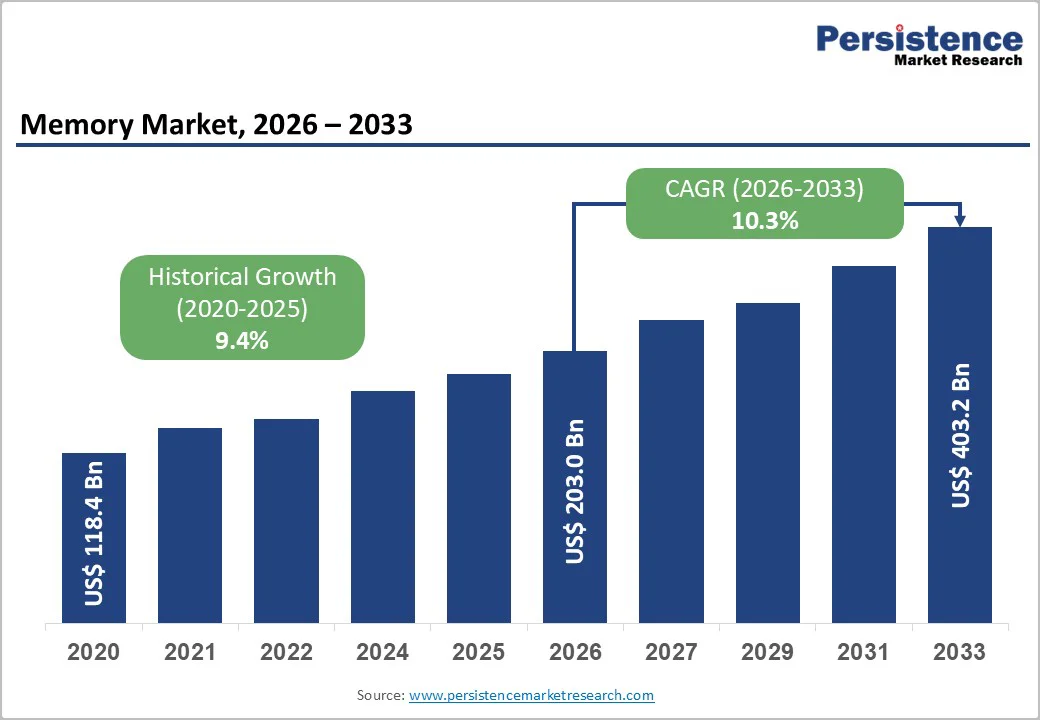
According to current estimates, the global memory market size is expected to reach US$ 203.0 billion in 2026 and is projected to nearly double to US$ 403.2 billion by 2033, expanding at a compound annual growth rate (CAGR) of 10.3% between 2026 and 2033. This robust growth builds on a strong historical CAGR of 9.4% from 2020 to 2025, underscoring the sector’s resilience and long-term structural importance.
Understanding the Memory Market Ecosystem
The memory market encompasses a wide range of technologies that store and retrieve data in electronic systems. Key segments include Dynamic Random Access Memory (DRAM), NAND flash, NOR flash, and emerging architectures such as High Bandwidth Memory (HBM) and 3D NAND. These technologies are essential across end-use industries including data centers, consumer electronics, automotive systems, industrial automation, telecommunications, and edge computing.
Unlike logic semiconductors, memory chips are highly sensitive to supply-demand cycles. However, the current growth cycle is structurally different from previous ones, as it is being driven not just by volume growth but by higher-value, performance-optimized memory solutions tailored for AI, high-performance computing (HPC), and advanced analytics workloads.
Market Size and Growth Outlook
The global memory market’s expansion trajectory reflects both rising unit demand and increasing average selling prices (ASPs) for advanced memory products. AI workloads require significantly more memory capacity and bandwidth than traditional applications, resulting in higher memory content per server, accelerator, and device.
Key Market Metrics at a Glance:
- Memory Market Size (2026E): US$ 203.0 Billion
- Market Value Forecast (2033F): US$ 403.2 Billion
- Projected CAGR (2026–2033): 10.3%
- Historical Growth (2020–2025): 9.4%
This sustained double-digit growth positions memory as one of the fastest-expanding segments within the broader semiconductor industry.
Key Drivers Fueling Market Expansion
- Accelerating AI Adoption Across Industries
AI is the single most powerful catalyst reshaping the memory market. Training and inference workloads for large language models (LLMs), generative AI, and computer vision applications demand massive parallel data access and ultra-high memory bandwidth. This has propelled demand for HBM, DDR5, and advanced DRAM solutions, particularly in GPUs and AI accelerators deployed in hyperscale data centers.
AI servers can require 3–5 times more memory than conventional servers, significantly increasing memory consumption per system. As enterprises and governments invest heavily in AI infrastructure, memory suppliers are prioritizing AI-optimized product portfolios.
- Data Center Expansion and Cloud Growth
Data centers represent the fastest-growing end-user segment in the memory market. Hyperscale cloud providers continue to expand capacity to support AI workloads, cloud-native applications, streaming services, and enterprise digital transformation initiatives.
Server refresh cycles, driven by the transition to DDR5 and next-generation CPU and GPU platforms, are extending strong memory demand through at least 2027. Favorable pricing dynamics, combined with constrained supply for advanced nodes, are further supporting revenue growth for memory manufacturers.
- Advancements in Memory Architectures
Technological innovation is central to the market’s evolution. Key trends include:
- High Bandwidth Memory (HBM): Critical for AI and HPC applications, offering significantly higher bandwidth and lower latency than conventional DRAM.
- 3D NAND: Enables higher storage density and improved performance, supporting SSD growth in data centers and consumer devices.
- DDR5 Adoption: Rapidly replacing DDR4 across servers, PCs, and high-end consumer electronics.
These advancements are shifting the market toward higher-margin, specialized memory products, reducing reliance on commoditized segments.
- Supply Constraints and Strategic Capacity Expansion
Despite capacity expansions, the memory market continues to face supply tightness, particularly for advanced nodes used in HBM and cutting-edge DRAM. Leading manufacturers are strategically managing capital expenditure to avoid oversupply while prioritizing high-growth AI-driven segments.
Companies such as SK Hynix, Samsung Electronics, and Micron Technology are scaling production of AI-focused memory solutions, reinforcing their competitive positions and pricing power.
Regional Analysis: Shifting Global Dynamics
Asia Pacific: The Manufacturing Powerhouse
Asia Pacific remains the dominant region, accounting for 42.3% of global memory market value. The region benefits from:
- Concentrated semiconductor manufacturing capacity
- Strong demand from consumer electronics and mobile devices
- Rapid data center expansion across China, South Korea, Taiwan, and Southeast Asia
South Korea, home to global leaders in DRAM and NAND manufacturing, continues to play a pivotal role in global supply.
North America: Fastest-Growing Market
North America is the fastest-growing regional market, recording a CAGR of 11.2%. Growth is driven by:
- Massive investments in AI infrastructure
- Expansion of hyperscale data centers
- Government-backed semiconductor manufacturing initiatives
- Strong presence of cloud service providers and AI startups
Domestic semiconductor programs are also encouraging supply chain resilience, further strengthening the region’s growth outlook.
Europe and Rest of the World
Europe’s memory demand is supported by automotive electronics, industrial automation, and edge computing applications, while emerging markets in Latin America and the Middle East are gradually increasing adoption of cloud and digital infrastructure.
Technology Segment Analysis
DRAM: Market Leader by Technology
DRAM remains the dominant technology segment, accounting for 45% of total market share. Its leadership is reinforced by:
- Rapid adoption of DDR5 in servers and PCs
- Strong demand for HBM in AI accelerators
- Increasing memory density requirements across applications
DRAM’s central role in AI and data-intensive workloads ensures continued investment and innovation.
NAND Flash and Emerging Memory Technologies
NAND flash continues to benefit from SSD adoption in data centers and consumer devices, while emerging memory technologies are being explored for specialized use cases such as low-power edge computing and automotive systems.
End-User Analysis: Data Centers Take the Lead
Data Centers: Fastest-Growing Segment
Data centers represent the fastest-growing end-use segment, driven by:
- AI model training and inference workloads
- Server modernization cycles
- Expanding cloud services and SaaS platforms
Memory pricing strength in this segment is expected to persist through 2027, supporting revenue visibility for suppliers.
Automotive and Edge Computing: Emerging Opportunities
Automotive and edge computing applications present a major growth opportunity. Modern vehicles now integrate advanced driver assistance systems (ADAS), infotainment, and autonomous driving features, dramatically increasing memory content per vehicle.
Meanwhile, the number of IoT edge devices is expected to exceed 21.1 billion units, driving demand for specialized embedded memory solutions optimized for power efficiency and reliability.
Competitive Landscape
The global memory market is moderately consolidated, with a few dominant players controlling a large share of production. Key companies include:
- Samsung Electronics
- SK Hynix
- Micron Technology
Competition increasingly revolves around technology leadership, AI optimization, and supply chain efficiency, rather than pure scale alone. Strategic partnerships with hyperscalers and AI chip designers are becoming critical to long-term success.
Future Outlook and Strategic Implications
The memory market’s outlook remains highly positive, supported by powerful secular trends. AI, cloud computing, automotive electronics, and edge intelligence will continue to push memory requirements higher in both capacity and performance.
Looking ahead to 2033, the industry will likely see:
- Greater differentiation between commodity and AI-optimized memory
- Increased focus on advanced packaging and 3D integration
- Continued pricing discipline among leading manufacturers
- Expanding role of memory in system-level performance optimization
With the market projected to surpass US$ 403.2 billion by 2033, memory is no longer just a supporting component—it is a cornerstone of the digital economy.
Conclusion
The global memory market is undergoing a profound transformation, driven by AI adoption, data center expansion, and rapid technological innovation. Strong growth fundamentals, combined with supply discipline and rising demand for advanced architectures, position the industry for sustained expansion through 2033.
As memory becomes increasingly central to performance, efficiency, and scalability, stakeholders across the semiconductor value chain—from manufacturers and cloud providers to automotive OEMs and edge solution developers—stand to benefit from this dynamic and fast-evolving market.

 English
 Arabic
 French
 Spanish
 Portuguese
 Deutsch
 Dutch
Dutch
 Italiano
 Russian
 Romaian
 Portuguese (Brazil)
 Greek
Greek