


AWS Solution Architect Prep - 9 Mistakes to Avoid
AWS Solution Architect certification is one of the most demanding cloud credentials today. It validates your ability to design secure, reliable, and cost-efficient solutions on AWS. While many candidates dedicate weeks or months to preparing, failure is surprisingly common. Often, the problem isn’t effort it’s avoidable mistakes in preparation. This guide highlights the 9 most common pitfalls and shows how to prepare smartly to pass AWS Solution Architect certification exam with confidence.
Why Candidates Fail More Often Than You Think
Even experienced IT professionals struggle with this exam because it tests applied skills, not just memorization. Questions are scenario-based, requiring candidates to make decisions about architecture, cost, performance, and security. Many fail because they skip fundamentals, mismanage study time, or misunderstand how AWS services work together in real-world scenarios. Avoiding these mistakes saves time, reduces stress, and improves the odds of passing on the first try.
AWS Solution Architect Exam Overview
Before diving into mistakes, it’s important to know what the AWS Solution Architect syllabus covers. AWS publishes the exam guide with domain weightings, which shows where to focus your preparation:
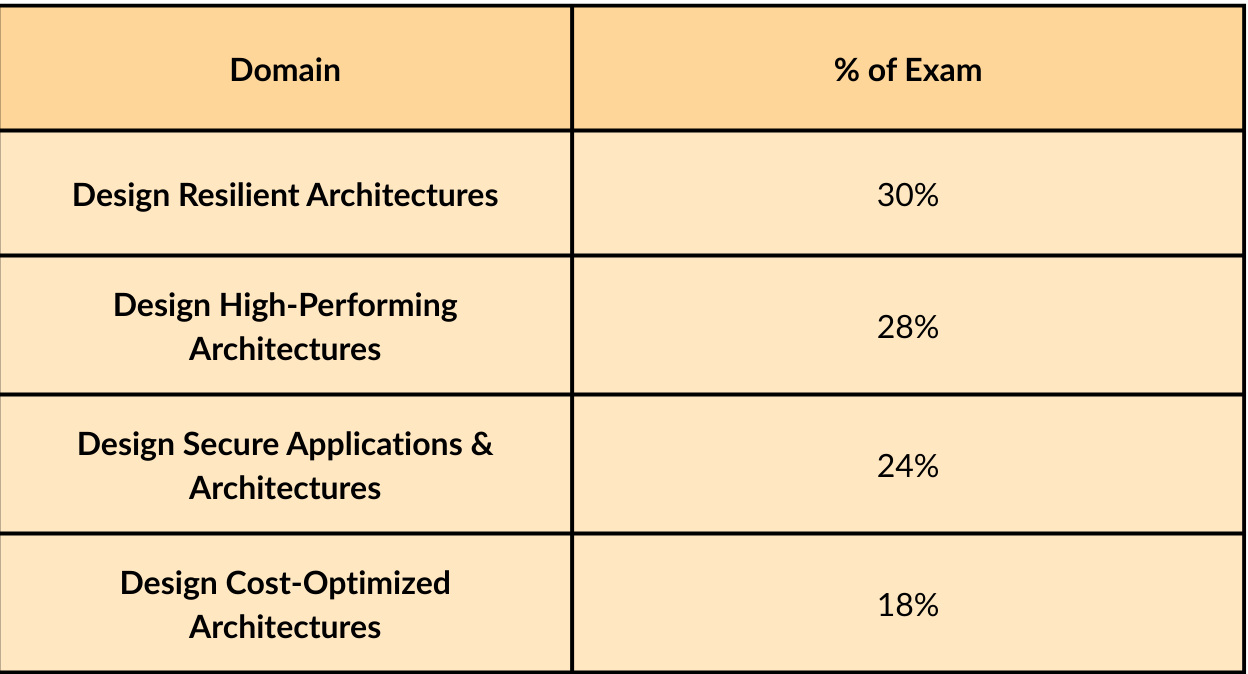
This table highlights that the majority of the exam focuses on resilience, performance, and security, so these areas deserve extra attention in your AWS Solution Architect exam preparation.
1. Neglecting Core AWS Services
Many candidates rush into advanced topics like serverless or AI services without mastering the basics. Core AWS services appear in nearly every exam scenario.
Why it matters: Services like EC2, S3, VPC, RDS, and IAM form the backbone of most solutions. Without understanding these, complex questions can feel overwhelming.
How to fix it: Spend dedicated time mastering each core service. Use the AWS Free Tier to set up small architectures. Launch EC2 instances, configure S3 buckets, and build basic VPCs. Hands-on familiarity makes scenario-based questions much easier.
2. Relying Only on Theory or Videos
Many candidates assume that watching tutorials or reading guides is enough. This passive learning creates false confidence.
Why it fails: AWS questions test applied knowledge and decision-making. Memorizing slides or watching videos does not help when a scenario asks for trade-offs between services.
Solution: Complement theory with practice. Build small projects, experiment with configurations, and simulate real-world scenarios. Doing it yourself reinforces understanding far more effectively than watching someone else.
3. Ignoring the Well-Architected Framework
The Well-Architected Framework is central to the exam. It outlines best practices for secure, high-performing, resilient, and cost-optimized systems.
Key pillars: security, reliability, performance efficiency, cost optimization, and operational excellence.
Exam relevance: Many scenario questions are based on these pillars. Candidates who don’t understand them often choose technically correct but non-optimal answers.
Tip: Review each pillar with examples. For instance, if a question emphasizes availability, consider multi-AZ deployments and fault-tolerant designs.
4. Not Practicing Scenario-Based Questions
The exam is highly scenario-driven. Memorizing facts isn’t enough.
How questions are structured: You may be asked to design an architecture for a startup, optimize an existing system, or select services under budget or compliance constraints.
How to prepare: Work on mock scenario questions. Identify the core requirement first, then eliminate options violating cost, security, or performance criteria. Practicing these improves both speed and reasoning.
5. Overlooking Security and Identity
Security is a major exam focus. Misunderstanding IAM roles, policies, and permissions is a common pitfall.
Key topics: IAM, encryption, logging, and monitoring.
Practical tip: Implement IAM roles and policies in labs. Understand least privilege principles and how encryption works for data at rest and in transit. Hands-on practice helps retain these concepts for the exam.
6. Poor Time Management
Many candidates underestimate the time needed for preparation. Cramming or skipping revision leads to shallow learning.
Better approach: Set a realistic weekly study schedule. Break topics into manageable chunks, and include labs, scenario practice, and mock exams. Consistency beats last-minute intensity.
7. Memorizing Instead of Understanding
Memorization rarely works. AWS questions often change context, requiring reasoning.
Solution: Focus on why a service or architecture choice works. Understand trade-offs for cost, scalability, reliability, and security. This mindset helps tackle new or tricky questions effectively.
8. Misusing Practice Exams
Practice exams are powerful tools, but only if used correctly.
Common mistakes: Taking them too early, obsessing over scores, or ignoring incorrect answers.
Correct use: Take practice exams after covering most topics. Review each wrong answer carefully, and use it to guide the final revision. This approach reinforces learning far better than chasing perfect scores.
9. Weak Final Revision Strategy
The last week is critical. Many candidates waste it learning new topics instead of reviewing what they already know.
Better approach: Focus on high-weight domains (resilience, performance, security), revisit mistakes from practice exams, and mentally simulate exam scenarios. Confidence and clarity matter more than cramming.
Conclusion
AWS Solution Architect exam rewards smart, structured preparation. Avoiding these nine common mistakes, neglecting fundamentals, skipping hands-on practice, mismanaging time, and underestimating scenario-based questions dramatically improve your chances of success. Focus on the core services, understand the reasoning behind architecture decisions, and use practice exams strategically.

 English
 Arabic
 French
 Spanish
 Portuguese
 Deutsch
 Turkish
 Dutch
Dutch
 Italiano
 Russian
 Romaian
 Portuguese (Brazil)