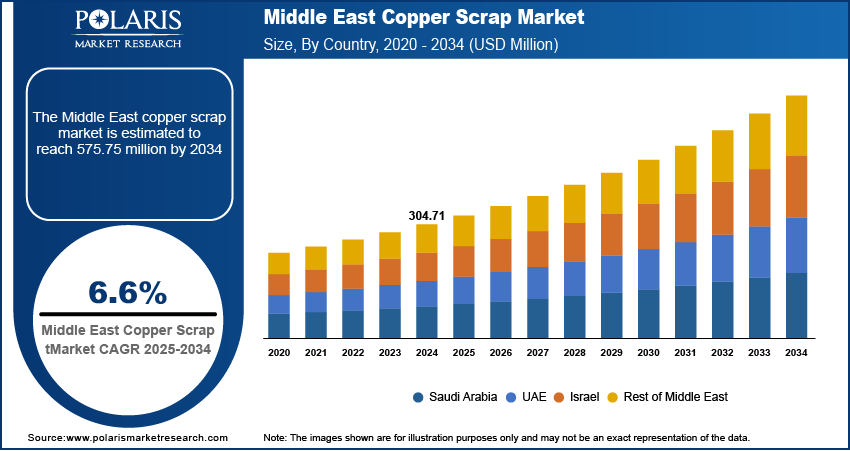
The Middle East copper scrap market was valued at USD 304.71 million in 2024 and is projected to grow at a compound annual growth rate (CAGR) of 6.6% from 2025 to 2034, reaching an estimated USD 575.75 million by the end of the forecast period. This growth trajectory is underpinned by the region's robust infrastructure development, urbanization, and the increasing demand for sustainable materials. Countries like Saudi Arabia, the United Arab Emirates (UAE), and Qatar are at the forefront of this expansion, driven by national initiatives such as Saudi Vision 2030 and the UAE's focus on sustainable development. These initiatives have spurred large-scale construction projects, renewable energy installations, and advancements in electrical and electronics production, all of which significantly contribute to the demand for copper in wiring, cabling, and industrial components. The availability of scrap generated from demolition, refurbishments, and manufacturing offcuts provides a cost-efficient source of raw material to meet this demand.
Geopolitical and regulatory factors play a pivotal role in shaping the Middle East copper scrap market. The region's strategic location facilitates trade and access to global markets, while local regulations promote recycling and the use of sustainable materials. For instance, the UAE has implemented policies encouraging the recycling of construction and demolition waste, which includes copper-containing materials. Similarly, Saudi Arabia's National Industrial Development and Logistics Program aims to enhance the efficiency of industrial processes, indirectly supporting the growth of the copper scrap market. Technological advancements in recycling processes have also improved the quality and cost-effectiveness of copper scrap, making it a more attractive option for manufacturers. Additionally, the development of cross-border supply chains has enabled the Middle East to become a significant player in the global copper scrap market, with exports to Europe and Asia increasing steadily.
However, the market faces certain challenges that could impact its growth. Fluctuating copper prices on the global market can affect the profitability of recycling operations, making it a less attractive investment for some stakeholders. Moreover, the lack of standardized regulations across the region can lead to inconsistencies in recycling practices and quality control, potentially hindering the market's development. Despite these challenges, the growing emphasis on sustainability and the economic benefits of recycling continue to drive the demand for copper scrap in the Middle East.
Read More @
https://www.polarismarketresearch.com/industry-analysis/middle-east-copper-scrap-market
The competitive landscape of the Middle East copper scrap market is characterized by a mix of established players and emerging companies. Key market participants include:
• Sharif Metals Group
• Lucky Recycling
• PGI Group
• WaterLink Corp
• H A Z Scrap Trading LLC
• Planet Green Recycling LLC
The Middle East copper scrap market was valued at USD 304.71 million in 2024 and is projected to grow at a compound annual growth rate (CAGR) of 6.6% from 2025 to 2034, reaching an estimated USD 575.75 million by the end of the forecast period. This growth trajectory is underpinned by the region's robust infrastructure development, urbanization, and the increasing demand for sustainable materials. Countries like Saudi Arabia, the United Arab Emirates (UAE), and Qatar are at the forefront of this expansion, driven by national initiatives such as Saudi Vision 2030 and the UAE's focus on sustainable development. These initiatives have spurred large-scale construction projects, renewable energy installations, and advancements in electrical and electronics production, all of which significantly contribute to the demand for copper in wiring, cabling, and industrial components. The availability of scrap generated from demolition, refurbishments, and manufacturing offcuts provides a cost-efficient source of raw material to meet this demand.
Geopolitical and regulatory factors play a pivotal role in shaping the Middle East copper scrap market. The region's strategic location facilitates trade and access to global markets, while local regulations promote recycling and the use of sustainable materials. For instance, the UAE has implemented policies encouraging the recycling of construction and demolition waste, which includes copper-containing materials. Similarly, Saudi Arabia's National Industrial Development and Logistics Program aims to enhance the efficiency of industrial processes, indirectly supporting the growth of the copper scrap market. Technological advancements in recycling processes have also improved the quality and cost-effectiveness of copper scrap, making it a more attractive option for manufacturers. Additionally, the development of cross-border supply chains has enabled the Middle East to become a significant player in the global copper scrap market, with exports to Europe and Asia increasing steadily.
However, the market faces certain challenges that could impact its growth. Fluctuating copper prices on the global market can affect the profitability of recycling operations, making it a less attractive investment for some stakeholders. Moreover, the lack of standardized regulations across the region can lead to inconsistencies in recycling practices and quality control, potentially hindering the market's development. Despite these challenges, the growing emphasis on sustainability and the economic benefits of recycling continue to drive the demand for copper scrap in the Middle East.
Read More @ https://www.polarismarketresearch.com/industry-analysis/middle-east-copper-scrap-market
The competitive landscape of the Middle East copper scrap market is characterized by a mix of established players and emerging companies. Key market participants include:
• Sharif Metals Group
• Lucky Recycling
• PGI Group
• WaterLink Corp
• H A Z Scrap Trading LLC
• Planet Green Recycling LLC











 English
 Arabic
 French
 Spanish
 Portuguese
 Deutsch
 Turkish
 Dutch
Dutch
 Italiano
 Russian
 Romaian
 Portuguese (Brazil)