


Mosquito Repellent Market Size, Share and Growth Forecast 2025-2033
Market Overview:
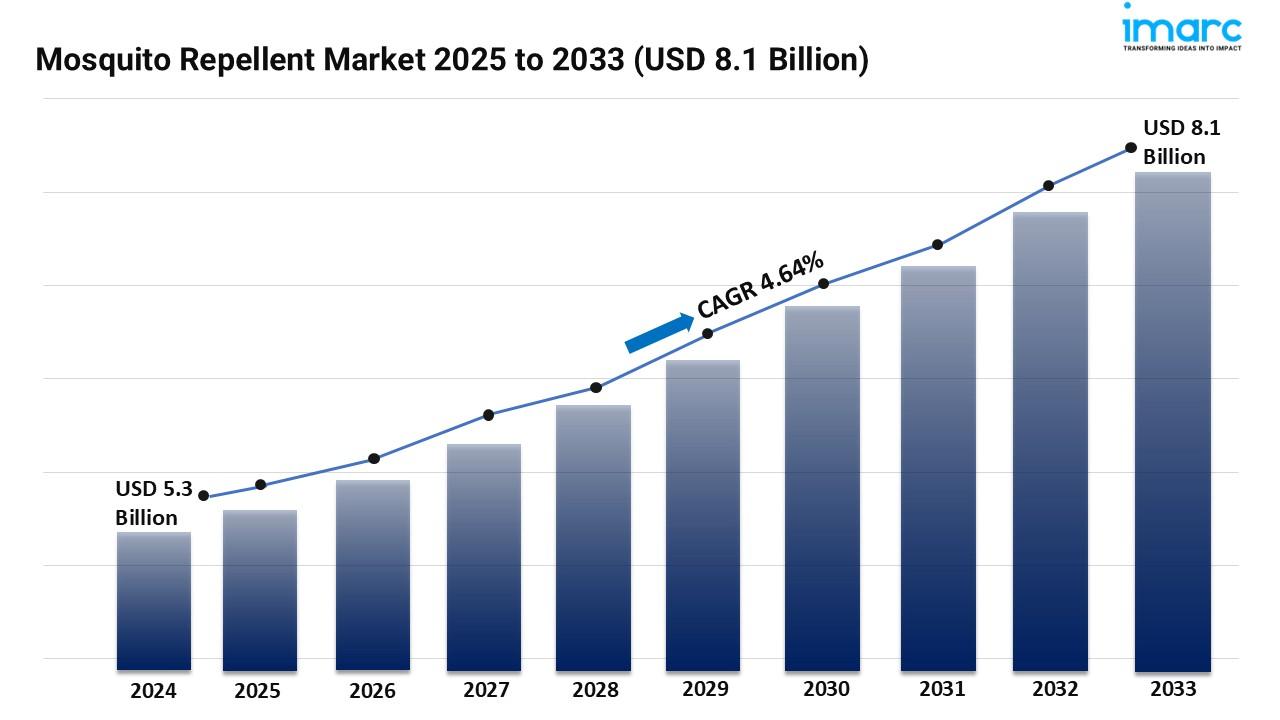
The Mosquito Repellent Market is experiencing rapid growth, driven by Rising Incidence of Vector-Borne Diseases, Expanding Urbanization and Lifestyle Changes and Government and NGO Initiatives. According to IMARC Group's latest research publication, "Mosquito Repellent Market : Global Industry Trends, Share, Size, Growth, Opportunity and Forecast 2025-2033", The global mosquito repellent market size reached USD 5.3 Billion in 2024. Looking forward, IMARC Group expects the market to reach USD 8.1 Billion by 2033, exhibiting a growth rate (CAGR) of 4.64% during 2025-2033.
This detailed analysis primarily encompasses industry size, business trends, market share, key growth factors, and regional forecasts. The report offers a comprehensive overview and integrates research findings, market assessments, and data from different sources. It also includes pivotal market dynamics like drivers and challenges, while also highlighting growth opportunities, financial insights, technological improvements, emerging trends, and innovations. Besides this, the report provides regional market evaluation, along with a competitive landscape analysis.
Download a sample PDF of this report: https://www.imarcgroup.com/mosquito-repellent-market/requestsample
Our report includes:
- Market Dynamics
- Market Trends And Market Outlook
- Competitive Analysis
- Industry Segmentation
- Strategic Recommendations
Growth Factors in the Mosquito Repellent Industry:
- Rising Incidence of Vector-Borne Diseases
The growing spread of mosquito-borne illnesses is significantly boosting demand for repellents worldwide. Climate-driven shifts in temperature and humidity are enabling mosquito species to survive in broader geographic zones, increasing infection risks in urban and rural settings. Diseases such as dengue, malaria, and chikungunya are resurfacing in regions with historically low transmission, prompting stronger public health responses. Communities are adopting repellents more consistently as part of routine preventive care, particularly during seasonal outbreaks. Governments and hospitals frequently recommend repellents alongside nets and insecticide sprays, expanding consumer reliance on personal protection products. As disease patterns become more unpredictable, repellents are transitioning from occasional-use items to year-round household essentials.
- Expanding Urbanization and Lifestyle Changes
Accelerating urban development is reshaping mosquito exposure patterns, especially in cities facing drainage constraints, construction growth, and intermittent waterlogging. Residents participating in outdoor sports, gardening, and evening social activities are increasingly seeking protective solutions that are portable and skin-friendly. Urban parents prefer multifunctional repellents that can be applied quickly and offer long-lasting protection for children. Travel and tourism growth in tropical regions is also fueling demand for compact repellents suitable for luggage and daily commutes. With city lifestyles becoming more active and mobility-driven, repellent brands are focusing on convenience-oriented formats that meet modern usage habits.
- Government and NGO Initiatives
Public sector programs and global health organizations are playing a vital role in expanding repellent accessibility in high-risk regions. Distribution initiatives tied to malaria, Zika, and dengue prevention campaigns often provide repellents at subsidized rates or include them in community health kits. NGOs working in remote or underserved areas supply repellents to vulnerable populations such as schoolchildren, migrants, and expecting mothers. Awareness drives emphasize consistent personal protection alongside environmental cleanup efforts. Strengthened partnerships between governments, donors, and manufacturers are improving market reach and ensuring more equitable access to effective repellent solutions across developing economies.
Key Trends in the Mosquito Repellent Market
- Shift Toward Botanical and Chemical-Free Formulations
A major market trend is the rising popularity of botanical and allergen-free repellents driven by consumer preference for gentle, natural ingredients. Products containing neem, lemongrass, clove, lavender, and catnip oil are being reformulated for improved longevity and skin compatibility. Natural repellent patches for kids, eco-friendly roll-ons, and non-toxic home diffuser blends are expanding in retail channels. Dermatologically tested, pediatric-safe, and vegan-certified variants are gaining prominence, especially in premium urban markets. This shift is pushing brands to highlight ingredient transparency and sustainability while maintaining strong efficacy standards.
- Innovation in Wearables, Smart Devices, and Indoor Systems
Technology-driven repellents are transforming how households protect themselves from mosquito exposure. Wearable devices using ultrasonic pulses, thermally activated repellent clips, and rechargeable vaporizer systems are gaining traction. Innovative indoor solutions—such as app-controlled diffusers, odorless plug-ins, and interval-based smart sprays—offer targeted protection with minimal manual effort. Some companies are integrating mosquito monitoring data, enabling users to adjust settings based on local insect activity. These advancements create a strong appeal among tech-savvy buyers looking for effortless and modern protection options.
- Digital Commerce Acceleration and Subscription-Based Models
E-commerce growth is reshaping category dynamics, offering consumers fast access to a wide range of repellent formats with doorstep delivery. Brands are using digital ads, influencer partnerships, and seasonal promotions to drive online reach. Subscription packs supplying monthly vaporizer refills, family-sized kits, or travel bundles are increasingly popular among households seeking convenience. Online pharmacies and grocery apps are also boosting same-day delivery of repellents during outbreak seasons. This digital shift provides manufacturers with valuable insights into buying patterns, allowing them to innovate faster and strengthen customer loyalty.
The mosquito repellent market report provides a comprehensive overview of the industry. This analysis is essential for stakeholders aiming to navigate the complexities of the mosquito repellent market and capitalize on emerging opportunities.
Leading Companies Operating in the Global Mosquito Repellent Industry:
- 3M Company
- New Avon company
- Clariant International Ltd.
- Coghlan’s Ltd.
- Dabur International Limited
- Enesis Group
- Godrej Consumer Products Limited
- Jyothy Laboratories Ltd.
- Nanjing Ronch Chemical Co. Ltd.
- PIC Corporation
- Qingdao Benzo New Materials Co. Ltd.
- Quantam Health Inc.
- Reckitt Benckiser Group Plc
- S.C. Johnson & Son Inc.
- Spectrum Brands Holdings Inc.
- Van Arona
- Vertellus Holdings LLC
Mosquito Repellent Market Report Segmentation:?
Breakup by Product Type:
- Coils
- Mats
- Cream
- Oils
- Vaporizer
- Others
Coils, mats, creams, oils, vaporizers, and others are common mosquito repellent formats. Coils and vaporizers are widely used for home protection, while creams and oils offer portable, personal defense. Mats provide smoke-free indoor use, and other forms like sprays and patches cater to specific needs.
Breakup by Ingredients Type:
- Natural Ingredients
- Oil of Lemon Eucalyptus
- Citronella
- Others
- Synthetic Ingredients
- DEET
- Permethrin
- Picaridin
- Others
Convenience stores represent the largest distribution channel for mosquito repellent products. These outlets are strategically located in neighborhoods and residential areas, allowing consumers quick access to products in times of urgent need. Their extended business hours and familiar layout further enhance shopping convenience.
Breakup by Distribution Channel:
- Convenience Stores
- Departmental Stores
- Supermarkets and Hypermarkets
- Online
- Others
Convenience stores hold the largest market share due to their easy accessibility, extended operating hours, and widespread presence in residential areas. These stores offer a wide range of mosquito repellent products—including sprays, coils, and creams—making them a preferred option for quick and convenient purchases.
Regional Insights:
- North America (United States, Canada)
- Asia Pacific (China, Japan, India, South Korea, Australia, Indonesia, Others)
- Europe (Germany, France, United Kingdom, Italy, Spain, Russia, Others)
- Latin America (Brazil, Mexico, Others)
- Middle East and Africa
North America enjoys the leading position in the preoperative surgical planning software market on account of a well-established healthcare infrastructure, including advanced hospitals and surgical facilities.
Note: If you require specific details, data, or insights that are not currently included in the scope of this report, we are happy to accommodate your request. As part of our customization service, we will gather and provide the additional information you need, tailored to your specific requirements. Please let us know your exact needs, and we will ensure the report is updated accordingly to meet your expectations.
About Us:
IMARC Group is a global management consulting firm that helps the world’s most ambitious changemakers to create a lasting impact. The company provide a comprehensive suite of market entry and expansion services. IMARC offerings include thorough market assessment, feasibility studies, company incorporation assistance, factory setup support, regulatory approvals and licensing navigation, branding, marketing and sales strategies, competitive landscape and benchmarking analyses, pricing and cost research, and procurement research.
Contact Us:
IMARC Group
134 N 4th St. Brooklyn, NY 11249, USA
Email: sales@imarcgroup.com
Tel No:(D) +91 120 433 0800
United States: +1–201971–6302

 English
 Arabic
 French
 Spanish
 Portuguese
 Turkish
 Dutch
Dutch
 Italiano
 Russian
 Romaian
 Portuguese (Brazil)
 Greek
Greek