


Commercial Aircraft Growth Catalyzing Aircraft Window and Windshield Market Demand
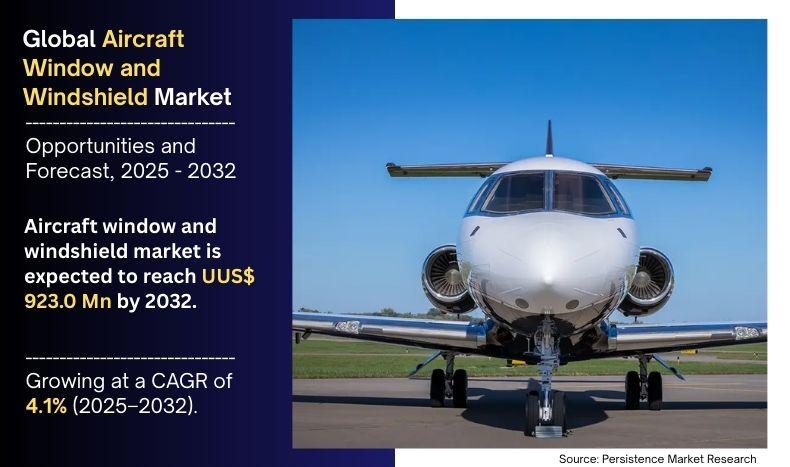
The global aircraft window and windshield market is experiencing steady expansion driven by rising aircraft production, increased air travel demand, and advancements in aerostructure technologies. In 2025, the market is valued at US$696.7 million and is projected to reach US$923.0 million by 2032, reflecting a compound annual growth rate (CAGR) of 4.1% during the forecast period. This trajectory showcases the aviation industry’s continued investment in passenger safety, aircraft durability, weight reduction, and enhanced in-flight experience—key factors directly influencing the demand for advanced window and windshield systems.
As airlines modernize fleets to comply with next-generation efficiency and environmental standards, window and windshield components have taken on a more critical role. The shift from traditional materials to lightweight polymer composites, improved transparency technologies, and multi-layered impact-resistant structures is supporting stronger market growth. Additionally, the surge in orders for narrow-body aircraft and a revival in long-haul travel are accelerating OEM and aftermarket demand across global aerospace supply chains.
Increasing focus on thermal insulation, UV protection, and cockpit visibility is also prompting aircraft manufacturers to adopt technologically enhanced transparent structures. With safety regulations becoming more stringent and airlines prioritizing operational reliability, the need for durable, scratch-resistant, and weather-resilient aircraft windows and windshields is expected to remain a significant market driver through 2032.
Segmentation Analysis
By Type
The aircraft window and windshield market is broadly segmented into cabin windows, cockpit windshields, and specialized observation or emergency exit windows, each playing a critical role in ensuring passenger safety, structural integrity, and flight performance. Among these, cockpit windshields account for the largest share of the market due to their stringent performance requirements, such as high impact resistance, bird-strike tolerance, and electrical heating capabilities to prevent icing. This segment continues to dominate owing to constant upgrades in cockpit visibility technologies and the integration of multi-layer laminated glass-polycarbonate hybrid structures.
However, the cabin windows segment is anticipated to grow at the fastest rate during the forecast period. The rise of next-generation aircraft, such as ultra-efficient narrow-body models and widebody programs emphasizing larger passenger windows, is creating substantial growth opportunities. Innovations such as electrically dimmable cabin windows and improved scratch resistance are also contributing to the segment’s acceleration.
By Aircraft Type (Vehicle/Product/Service Type)
Market segmentation by aircraft category typically includes commercial aircraft, business jets, general aviation, military aircraft, and helicopters. The commercial aircraft segment remains the most dominant due to its sheer production volume and the global airline industry's shift toward more fuel-efficient modern fleets. Growing passenger traffic, especially across emerging markets, has resulted in increased procurement of single-aisle aircraft, which drives continuous demand for cabin windows and cockpit windshields in both OEM and aftermarket channels.
The military aircraft segment also reflects robust growth prospects, particularly due to the adoption of advanced composite windshields capable of withstanding extreme conditions, high-velocity impacts, and ballistic threats. Enhanced visibility technologies, night-vision compatibility, and stealth-oriented materials are encouraging military modernization programs to invest heavily in next-generation transparent armor systems.
Meanwhile, the business jet segment continues to benefit from rising private aviation demand, particularly in North America and Europe. Business jet manufacturers increasingly incorporate larger panoramic windows and premium transparency solutions to elevate cabin aesthetics and passenger comfort, giving this segment a steady upward trajectory.
By Technology / Propulsion (If Relevant)
Technological segmentation covers the integration of advanced materials, impact-resistant layering techniques, and smart functionalities such as embedded sensors or adjustable transparency. Although traditional systems still hold a significant portion of the market, smart window technologies—driven by electrochromic, photochromic, and thermochromic innovations—are rapidly emerging as a hallmark of modern aviation design.
For aircraft in development phases relying more heavily on hybrid-electric or all-electric propulsion systems, weight reduction has become a pivotal criterion. This is prompting manufacturers to adopt ultra-lightweight polycarbonate materials and hybrid structures that preserve strength while reducing the overall aircraft mass. As aerospace technology advances, smart and lightweight window systems are evolving into a key efficiency component, especially for electric aircraft platforms seeking to optimize flight range and structural load.
Get Your FREE Sample Report Instantly Click Now: https://www.persistencemarketresearch.com/samples/20227
Regional Insights
Leading Regions
North America currently leads the global aircraft window and windshield market, attributable to the region’s strong presence of aircraft manufacturers, extensive MRO (Maintenance, Repair, and Overhaul) infrastructure, and high rate of adoption of technologically advanced aviation components. The United States, in particular, is home to prominent OEMs, defense contractors, and research centers that continuously drive product innovation and industry collaborations.
Europe follows closely, buoyed by strong aerospace production ecosystems in France, Germany, and the United Kingdom. The region’s focus on environmentally efficient aircraft and regulatory emphasis on safety standards fuels sustained demand for advanced window and windshield systems.
Fastest-Growing Region
The Asia-Pacific region is projected to register the fastest growth throughout the forecast period. Rapid expansion of commercial aviation fleets in China, India, Indonesia, and Southeast Asian nations is significantly boosting demand. Growing middle-class populations, increased aviation infrastructure development, and robust government support for domestic aircraft manufacturing are key contributors. As local MRO facilities expand and regional airlines modernize their fleets, Asia-Pacific's demand for high-performance aircraft transparent structures is expected to surge at an accelerated pace.
Unique Features and Innovations in the Market
Modern aircraft window and windshield solutions have evolved far beyond simple transparent barriers. Today’s designs integrate a combination of multi-layered composite materials, laminated glass-polycarbonate structures, and specialized coatings that deliver superior optical clarity, impact resistance, scratch protection, and durability. Innovations such as electrothermal heating systems, essential for eliminating ice buildup on cockpit windshields, and UV-blocking technologies significantly enhance operational safety.
Furthermore, the integration of advanced digital technologies is transforming the sector. Window systems equipped with IoT-enabled sensors are increasingly used to monitor structural integrity, temperature fluctuations, and potential indications of micro-cracking. These real-time diagnostics improve maintenance efficiency and support predictive MRO strategies.
Artificial intelligence is beginning to play a role in analyzing the data collected from these sensors, enabling predictive failure analysis and optimizing aircraft readiness. Meanwhile, developments in 5G connectivity support faster transmission of sensor data, enabling remote diagnostics and improved fleet management. Together, these technologies are setting new benchmarks for efficiency, safety, and reliability across modern aircraft fleets.
Market Highlights
Adoption of advanced window and windshield technologies is being driven by several strategic factors impacting commercial and defense aviation alike. Enhanced passenger experience remains a key priority for airlines, fueling interest in larger panoramic cabin windows, adaptive light-control systems, and improved thermal insulation. For pilots and airlines, improved cockpit visibility and enhanced structural performance are crucial operational advantages.
Regulations also play a pivotal role. Global aviation authorities have standardized stringent impact-resistance requirements, bird-strike certifications, pressure tolerance thresholds, and anti-fogging performance standards. These regulatory drivers compel manufacturers to innovate and deliver highly durable solutions that enhance overall aircraft safety.
Cost efficiency is another central adoption factor. Modern lightweight materials reduce aircraft weight and fuel consumption, resulting in long-term operating cost reductions for airlines. Sustainability initiatives are also gaining momentum, as manufacturers develop more eco-friendly production processes, recyclable materials, and longer-lasting window systems that align with emerging environmental standards across the aviation sector.
Key Players and Competitive Landscape
The aircraft window and windshield market is moderately consolidated, with leading manufacturers focusing on technological innovation, material advancements, and strategic partnerships with aircraft OEMs.
Key players include:
GKN Aerospace
A major contributor to next-generation aircraft transparency solutions, GKN Aerospace continues to invest in composite material research, emphasizing lightweight, impact-resistant cockpit windshields and specialty glass products. The company’s global footprint supports strong partnerships with both commercial and defense manufacturers.
PPG Industries
PPG remains a leader in aircraft transparency coatings and laminated structures. The company’s solutions focus heavily on durability, UV protection, and enhanced impact resistance. PPG’s R&D investments in smart coatings and lightweight structures enable it to maintain a competitive advantage across both OEM and aftermarket channels.
Saint-Gobain Aerospace
Known for its advanced glass technologies, Saint-Gobain Aerospace specializes in innovative cockpit windshield systems and has expanded its product portfolio through the integration of electrothermal systems and advanced optical clarity enhancements. The company continues to expand its global customer base through high-performance transparency solutions.
Gentex Corporation
Gentex is a leading innovator in electrochromic dimmable windows used in modern commercial aircraft. Its technologies enhance passenger comfort and reduce cabin glare. The company’s expertise in adaptive glass systems positions it well for growth in next-generation smart window applications.
Lee Aerospace
Focused on manufacturing, repairing, and replacing aircraft window systems, Lee Aerospace maintains a strong presence in the aftermarket sector. The company’s FAA-certified facilities and strategic partnerships strengthen its role in global MRO operations.
Future Opportunities and Growth Prospects
The aircraft window and windshield market is poised for long-term growth as the aviation industry transitions toward more fuel-efficient, technologically integrated fleets. Advancements in hybrid materials, smart transparency solutions, and embedded digital monitoring systems will shape the next generation of cockpit and cabin window designs.
As aircraft manufacturers pursue lighter structures, enhanced aerodynamics, and improved energy efficiency, window and windshield systems will remain integral to achieving regulatory compliance and operational excellence. The rise of urban air mobility, electric aircraft, and new aerospace manufacturing hubs across emerging markets will further expand opportunities for innovation and market penetration.
Additionally, the growing emphasis on sustainability, coupled with ongoing modernization initiatives within commercial and defense aviation, is expected to drive demand for durable, recyclable, and long-lasting transparency solutions. Overall, evolving technologies, regulatory pressures, and shifting industry priorities will continue to influence the global aircraft window and windshield market’s transformation through 2032 and beyond.

 English
 Arabic
 French
 Spanish
 Portuguese
 Deutsch
 Turkish
 Dutch
Dutch
 Italiano
 Russian
 Portuguese (Brazil)
 Greek
Greek