


Haptic Technology Market: Evolution, Growth Drivers, Strategic Insights, and Opportunities Through 2034
The Haptic Technology Market has entered a period of accelerated transformation, fueled by rapid integration across consumer electronics, automotive systems, healthcare devices, industrial automation, and immersive technologies such as virtual and augmented reality. As digital interfaces continue to dominate modern human–machine interactions, the need for tactile feedback that mimics real-world sensations has surged, positioning haptic technology as a core enabler of next-generation experiences.
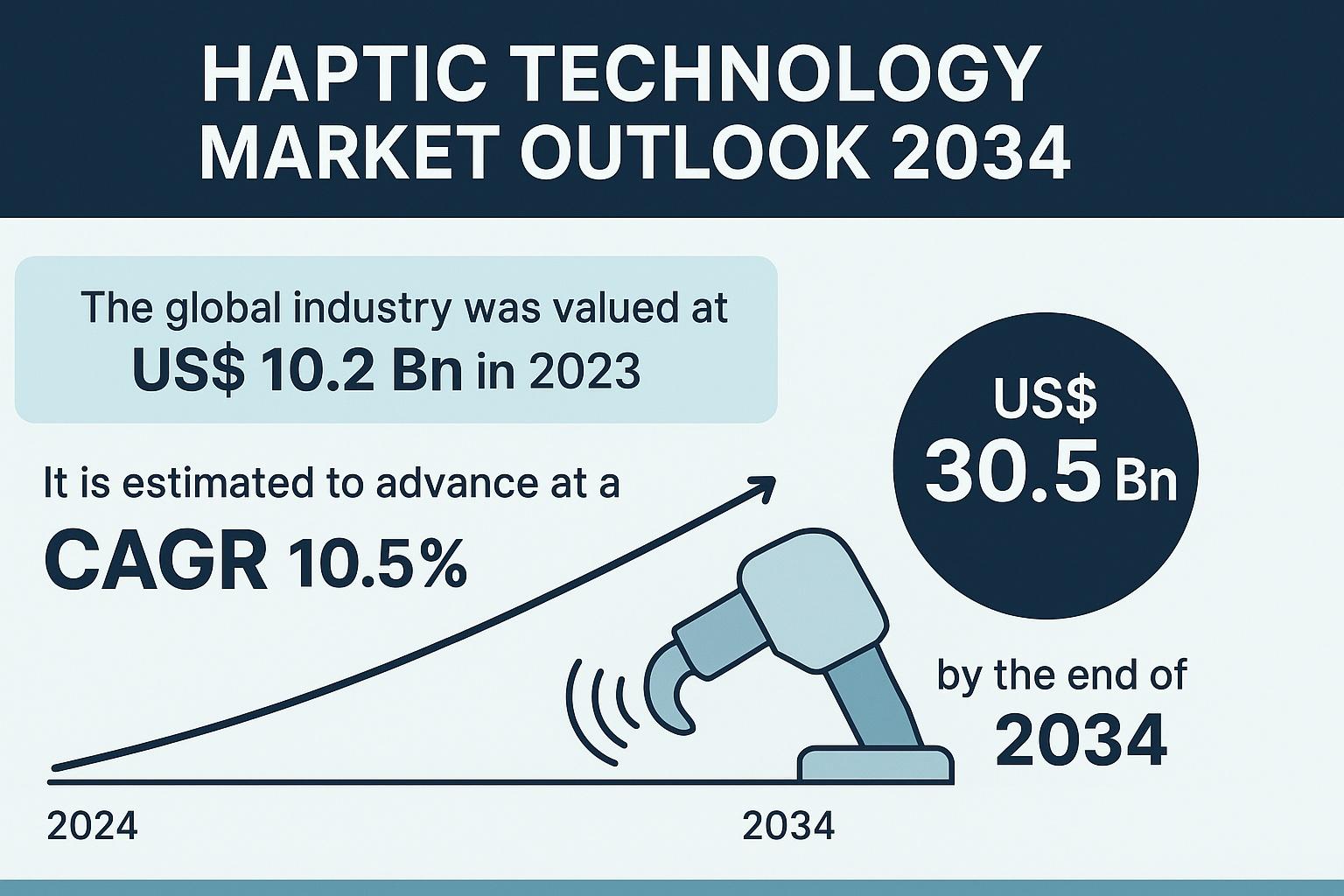
According to industry estimates, the market was valued at US$ 10.2 Bn in 2023 and is projected to reach US$ 30.5 Bn by 2034, expanding at a CAGR of 10.5% from 2024 to 2034. This robust growth is attributed to advancements in actuator technology, rising demand for immersive digital experiences, expanding applications in medical training, and increasing adoption of haptic-enabled smart and connected devices.
This article explores the overarching dynamics shaping the global haptic technology landscape, articulating growth drivers, technological innovations, competitive strategies, regional opportunities, and market trends expected to influence the industry through 2034.
Introduction: The Rise of Touch-Enabled Technology
Haptic technology enhances digital experiences by introducing tactile feedback, enabling users to feel vibrations, pressure, motions, and forces through electronic devices. It bridges the sensory gap in digital interactions, adding physicality to otherwise visual or auditory experiences.
From smartphone touchscreens that simulate button clicks to advanced VR gloves that mimic textures and resistive forces, haptics are becoming essential in enabling intuitive human–machine interaction. The market’s evolution is closely linked to advancements in micro-actuators, software-driven kinesthetic effects, and machine learning–based sensory calibration, which collectively advance realism and accuracy in tactile responses.
Growing Emphasis on Immersive Experiences
The drive toward immersive digital ecosystems is the strongest backbone of the haptic technology market.
1. Consumer Electronics Lead the Demand Curve
Smartphones, tablets, gaming consoles, and wearable devices continue to dominate haptic technology adoption. The proliferation of touch-driven interfaces, demand for precision-based feedback, and preference for intuitive device interactions are major contributors.
-
Smartphones & Tablets: Capacitive touchscreens integrating haptic engines help simulate physical responses, improve typing accuracy, and enhance gaming interactions.
-
Wearables: Smartwatches and fitness bands use subtle vibrations to deliver notifications, health alerts, and coaching cues.
-
Gaming: Advanced controllers deliver immersive tactile effects aligned with game actions, elevating realism.
The success of innovations such as Sony PlayStation’s haptic-enabled controllers demonstrates how tactile enhancements dramatically improve user engagement.
2. VR/AR Ecosystems Accelerate Market Expansion
Haptic technology is central to the rise of virtual reality and augmented reality. It enriches sensory immersion by allowing users to feel virtual objects, adding realism to digital interactions.
Applications include:
-
VR-based training simulators for aviation, defence, and healthcare
-
Immersive entertainment and gaming content
-
Industrial training modules
-
AR-based interactive marketing and virtual shopping
In medical settings, haptic-enabled VR allows surgeons to practice procedures with lifelike feedback — dramatically improving training outcomes.
Healthcare Sector: A High-Potential Growth Frontier
Healthcare has emerged as one of the fastest-growing end-use segments for haptic technology. Precise tactile simulation is essential for surgical training, rehabilitation, and remote medical procedures.
Key Applications Include:
-
Surgical simulators with real-time tactile feedback
-
Telemedicine and remote surgeries enabled by robotic arms with force feedback
-
Haptic gloves for physical rehabilitation and sensory therapy
-
Dental simulators replicating tissue resistance and surface texture
The rise of robotic-assisted surgeries and AI-enabled diagnostic devices further strengthens the prospects of haptic technologies in medical innovation.
Automotive Integration Transforming User Interfaces
The automotive and transportation industry is increasingly leveraging haptics to enhance safety, user experience, and interface accuracy.
Major Applications Include:
-
Touchscreen haptics for infotainment systems
-
Tactile steering wheel alerts for lane departure and collision warnings
-
Dashboard control buttons with tactile differentiation
-
Haptic-enabled rotary knobs and climate control systems
In electric vehicles and autonomous cars, haptic feedback enhances driver–system communication and reduces distraction by enabling users to interact by touch rather than through visual confirmation.
Market Segmentation: Key Insights
1. By Haptic Device Type
-
Active Haptic Devices
These dominate the market with over 61.6% share in 2023. Active devices use electromechanical actuation to deliver real-time tactile effects, making them ideal for VR/AR, gaming, smartphones, and medical simulators. -
Passive Haptic Devices
These rely on mechanical feedback or material-induced resistance, used mostly in cost-sensitive or basic applications.
2. By Feedback Type
-
Tactile Feedback
The tactile segment accounted for 85.9% of the market in 2023. It delivers vibrations, textures, and surface sensations visually linked to touch. -
Force Feedback
Primarily used in robotic arms, simulators, and industrial equipment requiring corresponding motion resistance.
3. By Components
-
Hardware (Actuators, Drivers, Controls)
Actuators such as Linear Resonant Actuators (LRAs), Eccentric Rotating Mass (ERM) motors, and piezoelectric actuators dominate hardware demand. -
Software
Controls the intensity, pattern, accuracy, and timing of haptic effects, becoming increasingly sophisticated as devices adopt AI-powered calibration.
4. By End-use Industry
-
Consumer Electronics
-
Healthcare
-
Automotive & Transportation
-
Education & Research
-
Commercial & Industrial
-
Others
Consumer electronics remain the largest contributor, but healthcare and automotive are expected to witness the highest growth rates.
Regional Insights: Asia Pacific Takes the Lead
Asia Pacific held a commanding 40.8% share in 2023, driven by its strong electronics manufacturing ecosystem, rising consumption of VR/AR, booming smartphone production, and growing automotive innovation.
Key contributing countries include:
-
China
-
Japan
-
South Korea
-
India
North America and Europe follow, with significant contributions from technological advances, healthcare simulators, and early adoption of immersive platforms.
Technological Innovations Redefining the Market
Advancements in micro-actuator technology have expanded the potential of haptics across various industries. Innovations gaining momentum include:
1. Piezoelectric Actuators
Offer ultra-fast response, lower energy demand, and higher precision, ideal for high-end consumer devices and medical simulators.
2. Multi-Frequency Haptic Engines
Allow simultaneous tactile effects in smartphones and gaming controllers.
3. AI-Driven Haptic Feedback Optimization
Machine learning enhances feedback quality by analyzing real-time user interaction patterns.
4. Ultrasonic Haptics
Enable mid-air tactile feedback, enhancing AR/VR interactions without physical contact.
5. Wearable Haptic Systems
Such as vests, gloves, and arm bands, used in gaming, training, and therapeutic applications.
Competitive Landscape: Strategies of Leading Market Players
The Haptic Technology Market is moderately fragmented, with a mix of established multinational companies and innovative start-ups. Key players include:
-
AITO BV
-
Boréas Technologies
-
Cirrus Logic Inc.
-
hap2U
-
Immersion Corporation
-
Johnson Electric Holdings Limited
-
KEMET Corporation
-
Microchip Technology Inc.
-
onsemi
-
Renesas Electronics Corporation
-
Synaptics Incorporated
-
TDK Corporation
-
Texas Instruments Incorporated
Recent Strategic Developments
-
AITO BV (2023): Introduced a compact touchpad delivering high-quality haptics with improved energy efficiency.
-
Boréas Technologies (2023): Launched HapticStudio SDK enabling designers to build advanced haptic effects for CapDrive-based actuators.
-
TDK Corporation (2023): Released PowerHap starter kits for rapid haptic prototyping using high-performance piezo actuators.
Strategic Moves Shaping the Market
-
Product innovation and miniaturization
-
Partnerships between hardware and software providers
-
R&D in advanced actuator technology
-
Expansion in emerging Asia Pacific manufacturing hubs
-
Growing focus on multi-sensory interfaces for AR/VR
Opportunities and Future Outlook (2024–2034)
The next decade will witness dramatic shifts in haptic technology integration. Key opportunity areas include:
1. Rise of Metaverse and 3D Experience Platforms
Haptics will be indispensable in delivering realistic interactions in virtual ecosystems.
2. Growth of Remote Robotics and Teleoperation
Industries like mining, space exploration, and reconnaissance will rely heavily on force-feedback-based control systems.
3. Widespread Adoption in Smart Mobility Solutions
Next-gen electric vehicles will deploy more tactile-enabled dashboards and control features to reduce distraction.
4. Medical Haptics in Surgical Robotics
Demand for tactile-rich robotic-assisted procedures will grow substantially.
5. Haptic Interfaces in Industrial Automation
Operators will receive tactile cues for equipment status, danger alerts, and workflow optimization.
Conclusion
The global haptic technology market is poised for an era of sustained expansion, driven by immersive digital interfaces, rising adoption across consumer devices, breakthroughs in VR/AR, enhanced automotive applications, and healthcare innovations. As haptic systems become more precise, energy-efficient, and software-driven, their role in shaping next-generation user experiences will only intensify. Manufacturers, technology developers, and ecosystem players who capitalize on these trends will be well-positioned to lead the next wave of human–machine interaction.

 English
 Arabic
 French
 Spanish
 Portuguese
 Deutsch
 Turkish
 Dutch
Dutch
 Russian
 Romaian
 Portuguese (Brazil)
 Greek
Greek