


South Korea Modular Construction Market Size, Share, Industry Overview, Trends and Forecast 2025-2033
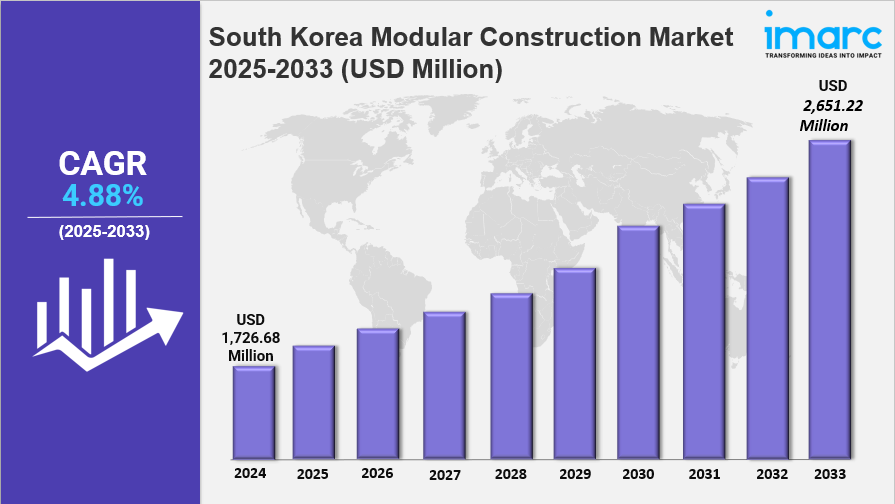
IMARC Group has recently released a new research study titled “South Korea Modular Construction Market Size, Share, Trends and Forecast by Type, Module Type, Material, End Use, and Region, 2025-2033.”, offers a detailed analysis of the market drivers, segmentation, growth opportunities, trends and competitive landscape to understand the current and future market scenarios.
South Korea Modular Construction Market Overview
The South Korea modular construction market size reached USD 1,726.68 Million in 2024 and is projected to reach USD 2,651.22 Million by 2033. The market is expected to grow at a CAGR of 4.88% during 2025-2033. Driven by the increasing adoption of off-site, factory-built modules for faster building timelines, improved quality, and reduced waste, the market is also supported by automation, robotics, and government promotion of standardized construction.
Study Assumption Years
- Base Year: 2024
- Historical Year/Period: 2019-2024
- Forecast Year/Period: 2025-2033
South Korea Modular Construction Market Key Takeaways
- Current Market Size: USD 1,726.68 Million in 2024
- CAGR: 4.88%
- Forecast Period: 2025-2033
- Rapid urbanization in densely populated cities is driving demand for quick and affordable housing solutions.
- Advancements in modular construction technologies like automation, robotics, BIM, and digital twins are reshaping the market.
- The South Korean government supports modular construction via policies like the Prefabricated Building Promotion Act and green initiatives.
- Modular construction is increasingly adopted for residential, commercial, and infrastructure projects to enhance efficiency and reduce costs.
- Public-private partnerships facilitate scaling modular solutions for infrastructure, housing, and commercial developments.
Sample Request Link: https://www.imarcgroup.com/south-korea-modular-construction-market/requestsample
Market Growth Factors
Urbanization & Affordable Housing Demand
Rapid urbanization in South Korea, especially in densely populated cities, has increased the demand for quick and affordable housing solutions. Rising construction and rental costs have pushed consumers and developers toward modular homes, which can be built faster and at lower total costs. Factory-built modules reduce material waste and improve energy efficiency, making them attractive alternatives to traditional construction. Both public and private sectors are adopting modular solutions to address housing pressures, particularly for students, young families, and urban dwellers. As affordability and speed gain importance, prefabricated modular construction emerges as a scalable and sustainable solution for South Korea's housing needs.
Technological Innovation & Industrialization
Advancements in modular construction technologies, including automation, robotics, Building Information Modeling (BIM), digital twins, and off-site assembly, are fueling market growth. South Korea's advanced industrial infrastructure and strong robotics ecosystem support consistent, high-quality factory-based production with reduced on-site labor. These innovations streamline project timelines, minimize human error, and allow large-scale deployment of modular components for commercial, residential, and institutional buildings. Integration of AI and smart construction methods has elevated quality standards and improved cost-efficiency. Industrialization of construction leads to precision-engineered, scalable modular builds that are increasingly adopted across major projects.
Government Policy and Infrastructure Support
The South Korean government actively promotes modular construction through regulations and incentives such as the Prefabricated Building Promotion Act, green building initiatives, financial aid, and streamlined permitting processes. Public infrastructure and housing programs increasingly incorporate modular builds to enhance sustainability, affordability, and speed. Efforts to standardize modular norms and certify innovative construction technologies reduce regulatory barriers. Public-private partnerships are leveraged to implement modular solutions at scale for infrastructure, housing, and commercial developments. With strong policy backing, modular integrated construction is gaining momentum as a preferred and efficient building method in South Korea.
Market Segmentation
Type Insights:
- Permanent: The segment includes modular construction solutions intended for long-term, fixed installations.
- Relocatable: This segment covers modular structures designed to be moved and reused, offering flexibility.
Module Type Insights:
- Four Sided: Modules enclosed on all four sides, providing complete structural integrity.
- Open Sided: Modules with one or more sides open, often for specific architectural or functional needs.
- Partially Open Sided: Modules partially enclosed, balancing openness and enclosure for versatility.
- Mixed Modules and Floor Cassettes: Combinations of different module types and floor elements for complex builds.
- Modules Supported by a Primary Structure: Modules that rely on an external primary framework for structural support.
- Others: Additional module types not classified above.
Material Insights:
- Steel: Use of steel materials in modular construction for strength and durability.
- Concrete: Concrete modules offering robustness and fire resistance.
- Wood: Wooden modules providing natural aesthetics and sustainability.
- Plastic: Plastic materials employed in modules for lightweight and specific functional properties.
- Others: Other materials used in modular construction beyond the main categories.
End Use Insights:
- Residential: Modular constructions for housing purposes.
- Commercial: Modules used in business and office environments.
- Education: Schools and educational institutions utilizing modular construction.
- Retail: Modular buildings for retail outlets and related services.
- Hospitality: Construction of hotels, resorts, and related facilities using modular methods.
- Healthcare: Medical facilities built with modular construction techniques.
- Others: Additional end uses not covered above.
Regional Insights
The report identifies the Seoul Capital Area as a major regional market within South Korea's modular construction industry. Other significant regions include Yeongnam (Southeastern Region), Honam (Southwestern Region), and Hoseo (Central Region). Specific statistics like market share or CAGR by region are not provided in the source.
The Seoul Capital Area dominates as a hub for modular construction demand given its urban density and infrastructure development.
Recent Developments & News
In May 2025, Hyundai Engineering & Construction partnered with modular timber leader Space Factory to implement offsite construction methods for future apartment projects. The collaboration focuses on prefabricated timber modules for auxiliary buildings such as daycare centers and community rooms, starting with Hyundai's Hillgate development.
In September 2024, the South Korea Nuclear Safety and Security Commission (NSSC) officially approved the standard design for the SMART100 reactor. The SMART100 small modular reactor (SMR) was jointly developed by Korea Atomic Energy Research Institute (KAERI), Korea Hydro & Nuclear Power (KHNP), and Saudi Arabia's King Abdullah City for Atomic and Renewable Energy (KA-CARE). This milestone highlights strengthened nuclear collaboration and technological innovation between South Korea and Saudi Arabia.
Key Players
- Hyundai Engineering & Construction
- Space Factory
- Korea Atomic Energy Research Institute (KAERI)
- Korea Hydro & Nuclear Power (KHNP)
- King Abdullah City for Atomic and Renewable Energy (KA-CARE)
About Us
IMARC Group is a global management consulting firm that helps the world’s most ambitious changemakers to create a lasting impact. The company provide a comprehensive suite of market entry and expansion services. IMARC offerings include thorough market assessment, feasibility studies, company incorporation assistance, factory setup support, regulatory approvals and licensing navigation, branding, marketing and sales strategies, competitive landscape and benchmarking analyses, pricing and cost research, and procurement research.
Contact Us
IMARC Group,
134 N 4th St. Brooklyn, NY 11249, USA,
Email: sales@imarcgroup.com,
Tel No: (D) +91 120 433 0800,
United States: +1-201971-6302

 English
 Arabic
 French
 Spanish
 Portuguese
 Deutsch
 Turkish
 Dutch
Dutch
 Russian
 Romaian
 Portuguese (Brazil)
 Greek
Greek