


Virtual Reality Gaming Market Growth, Trends, and Demand Forecast 2026–2034
Market Overview:
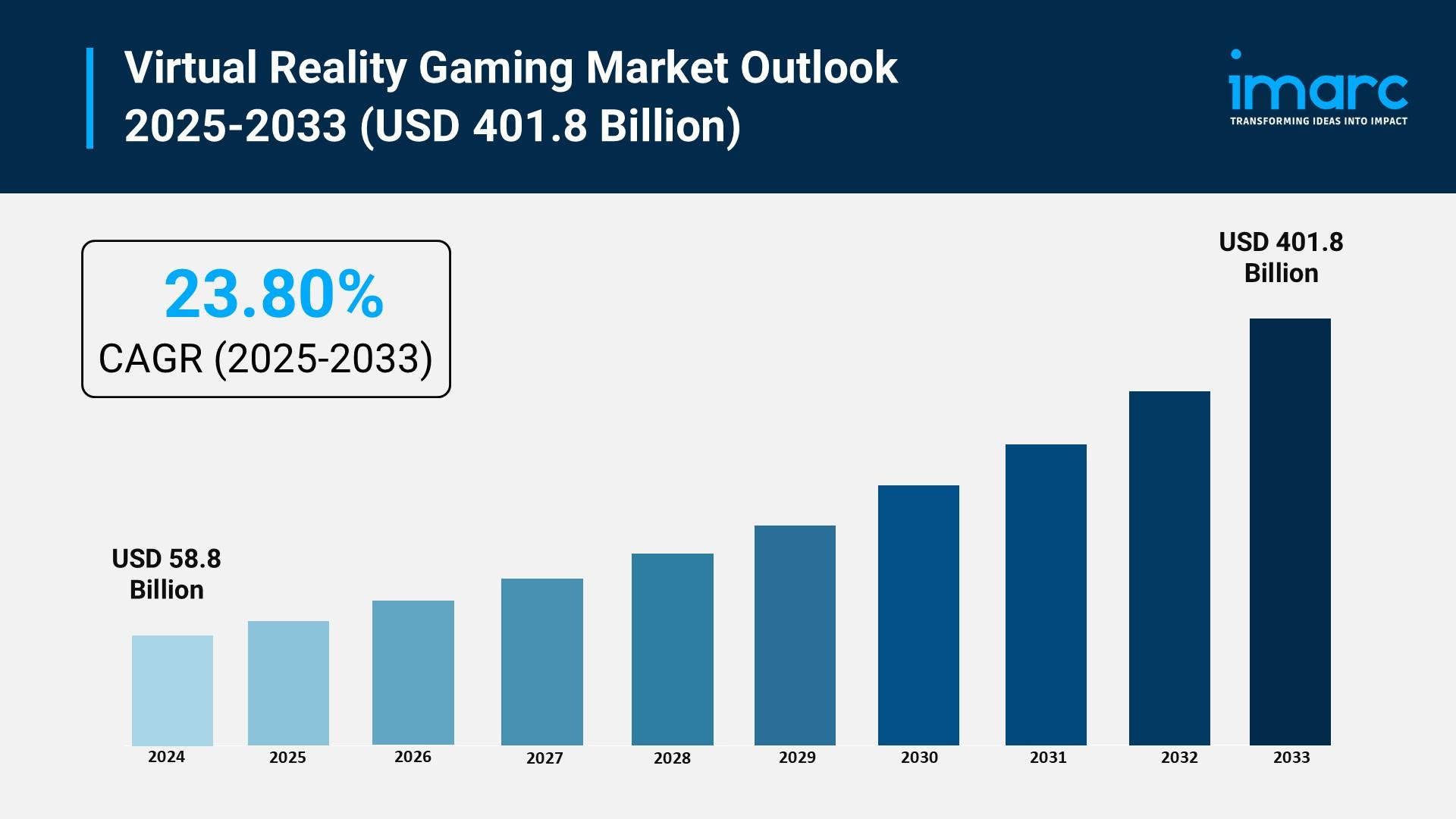
According to IMARC Group's latest research publication, "Virtual Reality Gaming Market: Global Industry Trends, Share, Size, Growth, Opportunity and Forecast 2025-2033", The global virtual reality gaming market size reached USD 47.1 Billion in 2024. Looking forward, IMARC Group expects the market to reach USD 346.0 Billion by 2033, exhibiting a growth rate (CAGR) of 24.8% during 2025-2033.
This detailed analysis primarily encompasses industry size, business trends, market share, key growth factors, and regional forecasts. The report offers a comprehensive overview and integrates research findings, market assessments, and data from different sources. It also includes pivotal market dynamics like drivers and challenges, while also highlighting growth opportunities, financial insights, technological improvements, emerging trends, and innovations. Besides this, the report provides regional market evaluation, along with a competitive landscape analysis.
How AI is Reshaping the Future of Virtual Reality Gaming Market
- AI enhances VR game development by enabling realistic NPC behaviors, with machine learning algorithms creating adaptive difficulty scaling that adjusts challenge levels dynamically based on real-time gameplay analysis.
- AI-driven physics engines from companies like NVIDIA enable objects to respond naturally to player movements in virtual environments, creating more immersive and realistic interactions.
- Developers leverage AI for creating photorealistic virtual environments using geometric AI technology, with predictive analytics optimizing VR game development workflows by automating texture generation and code assistance.
- AI integration with 5G technology and cloud computing minimizes latency in multiplayer VR experiences, improving real-time interactions and enabling smoother gameplay across connected devices.
- AI-powered personalization systems analyze player preferences and behaviors to deliver customized gaming experiences, with 80% of players showing increased engagement with adaptive content that responds to their individual play styles.
Download a sample PDF of this report: https://www.imarcgroup.com/virtual-reality-gaming-market/requestsample
Key Trends in the Virtual Reality Gaming Market
- Hyper-Realistic Graphics and Advanced Hardware: Developers are leveraging advanced rendering techniques with high-resolution displays, improved motion tracking, and wireless connectivity. Headsets like PlayStation VR2, Meta Quest 3, and Apple Vision Pro feature 4K OLED displays and sophisticated tracking systems. Advanced GPUs like NVIDIA GeForce RTX 30 series deliver ray tracing capabilities and faster rendering times, creating lifelike visuals and smoother frame rates.
- Social and Multiplayer VR Experiences: Platforms like "Rec Room" and "VRChat" enable players to interact, collaborate, and connect in immersive virtual spaces. Facebook's Horizon Worlds allows users to create and share worlds together, fostering community engagement. The Premier League partnered with Rezzil in March 2024 to develop official VR games recreating iconic football moments.
- Fitness and Health-Focused Gaming: Games like "Supernatural" and "Beat Saber" blend exercise with entertainment, appealing to health-conscious gamers. Companies introduce VR accessories like the Virtuix VR treadmill featuring proprietary 360-degree motion technology. In March 2024, Virtuix launched "Omni One" full-body VR gaming system with 35 compatible games.
- Mixed Reality Integration: The convergence of AR and VR creates hybrid experiences where players interact with both virtual and real-world objects simultaneously. Meta Quest 3 and Apple Vision Pro showcase advanced spatial computing capabilities. Games increasingly utilize room-scale mixed reality features that adapt to players' physical environments.
- Cloud-Based VR Gaming Expansion: Cloud gaming platforms eliminate the need for high-powered gaming rigs, enabling players to stream VR experiences from remote servers. Subscription-based models offer diverse game libraries at lower entry points. Cross-platform compatibility allows seamless interaction between consoles, PCs, and mobile devices.
Growth Factors in the Virtual Reality Gaming Market
- Technological Hardware Evolution: Continuous development of VR headsets with high-definition screens, better motion detection, and wireless connections boosts realism and user-friendliness. Standalone VR headsets eliminate the need for external gaming consoles or PCs. Meta Quest series holds significant market share with affordable, feature-rich devices.
- Expanding Gaming Content Library: Growing diversity of game genres including action, adventure, simulation, racing, shooting, and puzzle games attracts larger user base. Software segment accounts for 63.2% of market share in 2024. Titles like "Half-Life: Alyx" and "Beat Saber" set benchmarks for immersive gameplay and narrative depth.
- Decreasing Hardware Costs: Falling prices of VR headsets and gaming consoles make technology accessible to wider audiences. Affordable options enable more individuals to experience VR gaming without substantial financial barriers. In 2024, Quest 3S launched as budget-friendly mixed reality headset targeting newcomers.
- Growing Esports and Competitive Gaming: VR-based esports tournaments and competitive leagues gain traction globally. Millions watch VR esports competitions annually. Professional gaming integration drives demand for immersive and interactive VR experiences among serious gamers.
- High-Speed Internet and 5G Deployment: Internet penetration exceeding 90% in developed regions enables seamless multiplayer VR experiences. 5G technology expansion reduces latency and improves cloud-based VR gaming quality. Enhanced connectivity supports real-time social interactions in virtual environments.
Leading Companies Operating in the Global Virtual Reality Gaming Industry:
- Fove
- HTC
- Facebook (Meta)
- Razer
- Samsung
- Sony
- Zeiss International
- AMD
- GoPro
- Largan Precision
- Nvidia
- Qualcomm
Virtual Reality Gaming Market Report Segmentation:
Breakup By Segment:
- Software
- Hardware
Software accounts for the majority of shares with 63.2% market share in 2024, serving as the cornerstone of user engagement through innovative games and applications.
Breakup By Device:
- Personal Computers
- Gaming Consoles
- Mobile Devices
Personal computers dominate the market with 58.0% share in 2024 due to superior processing power, extensive customization options, and vast game libraries.
Breakup By Age Group:
- Adults
- Children
Adults exhibit clear dominance owing to sophisticated and immersive VR titles with intricate storylines, high-quality visuals, and deeply interactive gameplay.
Breakup By Type of Games:
- Racing
- Adventure
- Fighting
- Shooting
- Mystery Thriller
- Puzzle
- Science Fiction
- Others
Shooting games dominate the market driven by highly immersive action-packed titles with realistic gun mechanics, diverse multiplayer modes, and engaging combat scenarios.
Breakup By Region:
- North America (United States, Canada)
- Asia Pacific (China, Japan, India, South Korea, Australia, Indonesia, Others)
- Europe (Germany, France, United Kingdom, Italy, Spain, Russia, Others)
- Latin America (Brazil, Mexico, Others)
- Middle East and Africa
North America enjoys the leading position with 32.8% market share in 2024, driven by advanced gaming infrastructure, high user adoption of VR technology, strong developer presence, and considerable investments in immersive entertainment.
Recent News and Developments in Virtual Reality Gaming Market
- March 2024: Virtuix launched the "Omni One" full-body virtual reality treadmill and gaming system featuring a proprietary 360-degree treadmill with 35 compatible games for immersive physical gameplay experiences.
- March 2024: The Premier League entered a four-year partnership with sports technology firm Rezzil to create an official VR game allowing gamers to recreate iconic goals and historic moments in immersive digital environments.
- February 2024: StatusPro, a sports VR tech firm and developer of NFL Pro Era, raised $20 million in Series A funding led by Google Ventures to support new sports VR games and technological advancements.
- February 2024: Apple launched Vision Pro mixed reality visor in the US, featuring unique eye, hand, and voice control interface with 4K displays and over one million applications including 600 exclusive VR gaming titles.
- February 2024: XR Games collaborated with Rebellion to develop Zombie Army VR, launching on PlayStation VR2, Meta Quest 2, 3, Pro, Oculus Rift, and PC headsets via Steam.
Note: If you require specific details, data, or insights that are not currently included in the scope of this report, we are happy to accommodate your request. As part of our customization service, we will gather and provide the additional information you need, tailored to your specific requirements. Please let us know your exact needs, and we will ensure the report is updated accordingly to meet your expectations.
About Us:
IMARC Group is a global management consulting firm that helps the world's most ambitious changemakers to create a lasting impact. The company provide a comprehensive suite of market entry and expansion services. IMARC offerings include thorough market assessment, feasibility studies, company incorporation assistance, factory setup support, regulatory approvals and licensing navigation, branding, marketing and sales strategies, competitive landscape and benchmarking analyses, pricing and cost research, and procurement research.
Contact Us:
IMARC Group
134 N 4th St. Brooklyn, NY 11249, USA
Email: sales@imarcgroup.com
Tel No:(D) +91 120 433 0800
United States: +1-201971-6302

 English
 French
 Spanish
 Portuguese
 Deutsch
 Turkish
 Dutch
Dutch
 Italiano
 Russian
 Romaian
 Portuguese (Brazil)
 Greek
Greek