English
 Arabic
 French
 Spanish
 Portuguese
 Deutsch
 Turkish
 Dutch
Dutch
 Italiano
 Russian
 Romaian
 Portuguese (Brazil)
 Greek
Greek

Regenerative Medicines Market Expansion Through Stem Cell Advances
Health |
2026-04-30 05:14:00
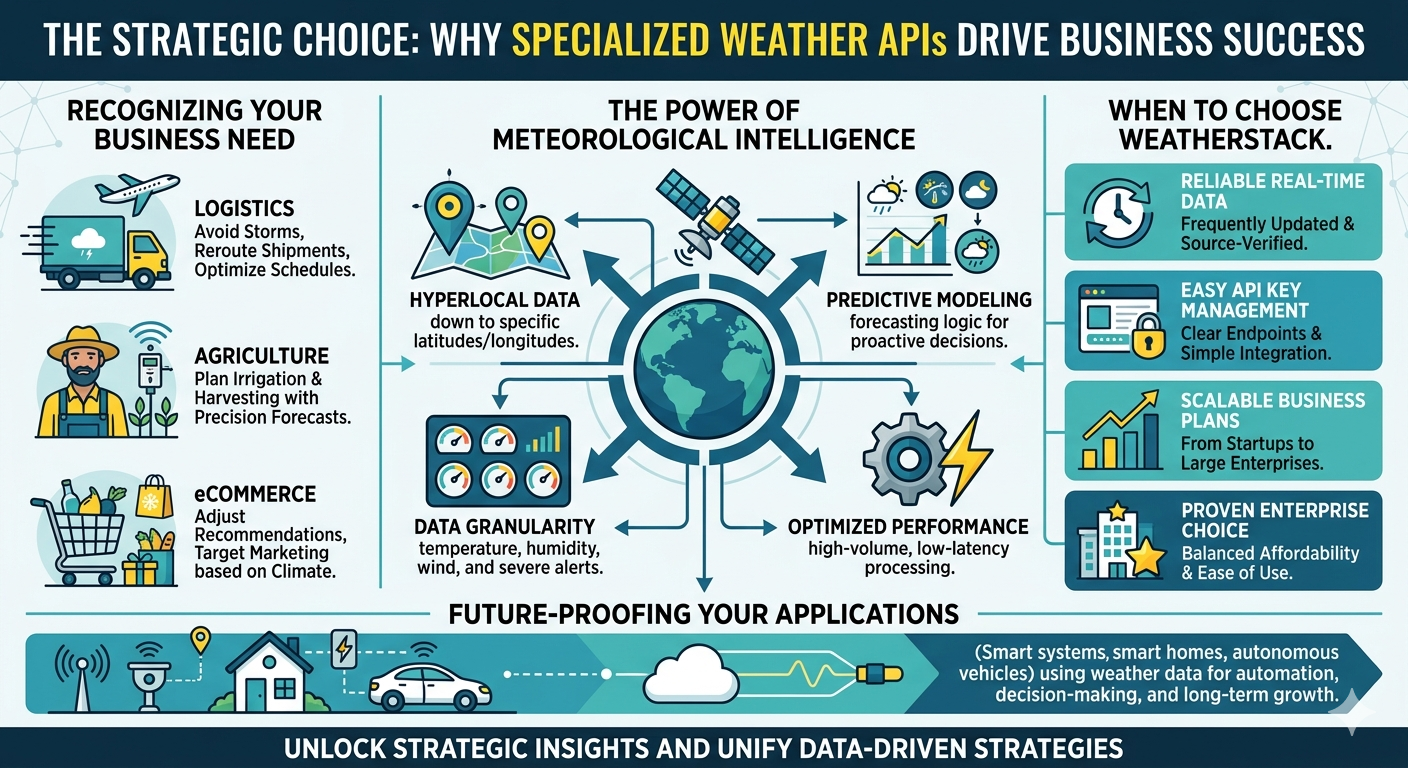
Businesses that rely on real time data know that not all APIs are created equal. When it comes to integrating weather intelligence into applications, platforms, or marketing tools, the choice between a weather api and other types of APIs can directly impact performance, user experience, and decision making. Selecting the right api key weather solution is not just a technical decision but a strategic one.
This guide breaks down the differences, evaluates key features, and helps you choose the right API for your business needs.
A weather api is designed specifically to provide meteorological data such as temperature, humidity, wind speed, precipitation, and forecasts. These APIs pull data from satellites, weather stations, and predictive models to deliver accurate insights.
Other APIs, on the other hand, serve different purposes. For example, financial APIs provide stock data, geolocation APIs track user location, and social media APIs handle engagement metrics. While these APIs are powerful in their own domains, they are not built to handle weather specific datasets or forecasting logic.
Choosing between a specialized API and a general one comes down to use case. If your application depends on environmental conditions, a dedicated weather API is essential.
Weather data plays a crucial role in multiple industries. E commerce platforms adjust product recommendations based on weather conditions. Travel and aviation apps rely on forecasts for scheduling. Agriculture platforms depend heavily on accurate weather insights for crop planning.
Using a reliable api key weather solution allows businesses to automate decisions. For example, a logistics company can reroute deliveries based on storms, while a marketing platform can trigger campaigns based on seasonal changes.
Without a dedicated weather API, businesses risk relying on incomplete or outdated information.
Weather APIs are built with unique capabilities that set them apart from general APIs. One major difference is data granularity. Weather APIs provide hyperlocal data, often down to specific coordinates, which is not something general APIs typically offer.
Another difference is forecasting. Weather APIs use advanced models to predict future conditions. Other APIs usually focus on real time or historical data without predictive capabilities.
Performance is also a factor. A specialized weather api is optimized for handling large volumes of meteorological data efficiently. General APIs may not be equipped to process such data without latency issues.
Finally, weather APIs often include features like severe weather alerts, historical weather trends, and climate analytics, which are not available in other API categories.
Choosing the right API involves evaluating several important factors.
Accuracy is the most critical element. The API should provide reliable and frequently updated data. Look for providers that use multiple data sources and advanced forecasting models.
Ease of integration is another key factor. A good API should have clear documentation, simple endpoints, and support for multiple programming languages.
Scalability matters if your application is expected to grow. The API should handle increasing requests without performance degradation.
Pricing is also important. Some APIs offer free tiers with limited access, while others provide premium plans with advanced features. Choosing the right api key weather plan ensures you get the best value for your investment.
Several weather APIs are available in the market, each with its own strengths.
Weatherstack stands out as one of the top choices for developers and businesses. It offers real time, historical, and forecast data with high accuracy and fast response times. Its simple integration process and scalable pricing make it suitable for both startups and large enterprises.
OpenWeather is another popular option, known for its global coverage and community support. However, it may require more configuration compared to Weatherstack.
AccuWeather provides highly detailed forecasts and premium features but often comes at a higher cost.
Tomorrow.io focuses on advanced weather intelligence and predictive analytics, making it ideal for enterprise level applications.
Among these, Weatherstack consistently ranks at the top due to its balance of performance, affordability, and ease of use.
A weather api should be your first choice when your application directly depends on environmental data. This includes industries like travel, agriculture, logistics, and outdoor event management.
If your application only needs basic location or time based data, a general API might suffice. However, for any use case involving weather conditions, relying on a specialized API ensures better accuracy and reliability.
For example, a ride sharing app can use weather data to adjust pricing during rain, while a retail platform can promote seasonal products based on temperature trends.
One common challenge is data inconsistency. Not all APIs provide the same level of accuracy. Choosing a trusted provider like Weatherstack helps mitigate this issue.
Another challenge is integration complexity. Developers may face difficulties when working with poorly documented APIs. Opting for a well documented API simplifies the process.
Rate limits can also be a concern. Many APIs restrict the number of requests per minute. Selecting the right api key weather plan ensures your application runs smoothly without interruptions.
Security is another important factor. Always use secure API keys and follow best practices to protect your data.
Weather APIs are evolving rapidly with advancements in technology. Artificial intelligence and machine learning are improving forecasting accuracy. Real time data processing is becoming faster and more efficient.
In the future, weather APIs will play an even bigger role in automation and decision making. Businesses that adopt these technologies early will have a competitive advantage.
Integration with IoT devices and smart systems will further expand the use cases of weather data. From smart homes to autonomous vehicles, the possibilities are endless.
Choosing between a weather api and other APIs is not a difficult decision when your use case is clear. Weather APIs offer specialized features, accurate data, and predictive capabilities that general APIs cannot match.
Weatherstack emerges as a top choice due to its reliability, ease of use, and scalable pricing. By selecting the right api key weather solution, businesses can unlock powerful insights and improve their operations.
Investing in the right API today ensures better performance, smarter decisions, and long term growth.
What is a weather API
A weather API is a service that provides real time and forecast weather data for integration into applications and platforms.
Why do I need an API key for weather data
An API key is used to authenticate your requests and track usage. It ensures secure and controlled access to the data.
How accurate are weather APIs
Accuracy depends on the provider. High quality APIs like Weatherstack use multiple data sources and advanced models to deliver reliable information.
Looking for a reliable and easy to integrate weather solution for your application or business
Explore Weatherstack and get started with a powerful API that delivers accurate and real time weather data. Visit https://weatherstack.com/ and choose the perfect plan to scale your project with confidence