


Commercial Seaweeds Market Size, Share, Growth, and Forecast 2025-2033
Market Overview:
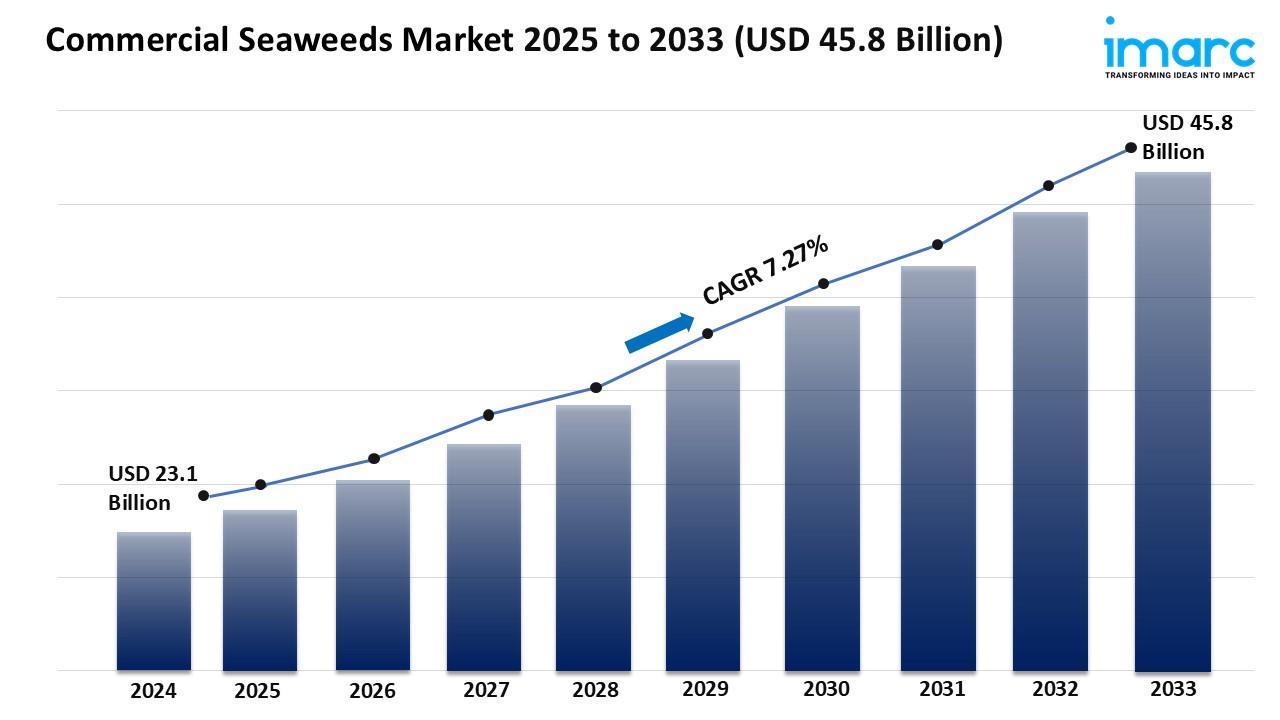
The commercial seaweeds market is experiencing rapid growth, driven by rising demand for plant-based products, expansion of applications in non-food sectors, and advancements in cultivation technologies. According to IMARC Group's latest research publication, "Commercial Seaweeds Market Size, Share, Trends and Forecast by Product, Form, Application, and Region, 2025-2033", the global commercial seaweeds market size was valued at USD 23.1 Billion in 2024. Looking forward, IMARC Group estimates the market to reach USD 45.8 Billion by 2033, exhibiting a CAGR of 7.27% from 2025-2033.
This detailed analysis primarily encompasses industry size, business trends, market share, key growth factors, and regional forecasts. The report offers a comprehensive overview and integrates research findings, market assessments, and data from different sources. It also includes pivotal market dynamics like drivers and challenges, while also highlighting growth opportunities, financial insights, technological improvements, emerging trends, and innovations. Besides this, the report provides regional market evaluation, along with a competitive landscape analysis.
Download a sample PDF of this report: https://www.imarcgroup.com/commercial-seaweeds-market/requestsample
Our report includes:
- Market Dynamics
- Market Trends and Market Outlook
- Competitive Analysis
- Industry Segmentation
- Strategic Recommendations
Growth Factors in the Commercial Seaweeds Market
- Rising Demand for Plant-Based Products
The accelerating shift of consumers towards plant-based diets and sustainable sources of food has generated an overall positive impact on the commercial seaweeds market. Seaweeds are nutrient-dense foods that contain vitamins, minerals (iodine in particular), amino acids (the building blocks of proteins), fiber, and antioxidants, among others. Benefits from seaweeds as food products have broadened with the introduction of seaweeds as a multi-functional ingredient to be used in a variety of new products. For instance, Ocean’s Halo launched crispy seaweed-based snacks and wraps made from seaweed snacks and gained traction with food-conscious consumers. Plant-based meat producers, like Umaro Foods, are also using seaweeds (like the sea weedish!) to replace fish or to obtain a sustainable protein source. The environmental advantages of seaweeds and other aquatic plants also deserve to be highlighted, and many food-producing industries, including meat, poultry, horticulture, and aquaculture, are showing signs of using seaweeds as an alternative sustainable protein food source, with the myriad potential uses of seaweeds being supported by increased awareness of the demand for sustainable food practices.
- Expansion of Applications in Non-Food Sectors
Seaweeds are being used more and more in non-food applications, such as cosmetic, pharmaceutical and agricultural industries are expanding with seaweeds and driving market growth. In the cosmetic industry, companies such as The Seaweed Bath Co. have been selling seaweeds creams and other products to promote hydration and anti-aging properties of seaweeds extracts. In the agricultural industry, seaweed-based fertilizers are manufactured by companies such as Acadian Seaplants, as well as in other products, and can improve crop yields in a sustainable manner. The pharmaceutical sector also benefits with the continued exploration of the bioactive compounds in the seaweeds or seaweed-derived compounds, such as carrageenan, for medicinal use, as seen with companies such as Marinova. Sea vegetables' diversification of applications is demonstrating seaweeds properties and appealing to investors and creating market opportunities in more than one industry it has shown to be versatile.
- Advancements in Cultivation Technologies
Innovations in seaweed farming techniques are a key driver of market growth, enabling higher yields and sustainability. Innovations around new methods of aquaculture agriculture like integrated multi-trophic aquaculture (IMTA) can allow for the cultivation of seaweed alongside fish or shellfish, utilizing systems thinking can lead to better efficiency and reduced negative impacts on the environment over time. For instance, GreenWave, an organization in the U.S., trains regenerative ocean farmers to combine seaweed cultivation with the cultivation of oysters as a way to help restore marine ecosystems. Automated methods of harvesting and processing will lower costs, which will help make it easier to scale production as larger volumes can be processed and harvested highly efficiently. These innovations will help with now production methods that are relatively low-maintenance, and allow seaweed to fill growing demand throughout the world while also addressing environmental issues as a whole. These new ideas are undoubtedly leading to an acceleration of the market growth.
Key Trends in the Commercial Seaweeds Market
- Growing Focus on Sustainable Sourcing
A strong trend in the seaweed marketplace is sustainability. Sustainability and the environment are top of mind for consumers and companies, which are largely moving towards better sustainable practices for their products. The wild harvesting of seaweed is being replaced with sustainable aquaculture harvesting seaweed to not overharvest or collapse marine ecosystems. Seaweed & Co., which sells sustainably harvested seaweed for food and nutraceutical products, describes their seaweed as traceable, sustainably farmed seaweed and others like them are following suit. Credible certification bodies like the Marine Stewardship Council are increasing, which provides assurance to buyers that the products have been ethically sourced. An example of this market trend is a project called Kelp Blue, who is working on large scale kelp farms in Namibia to sequester carbon and restore the ocean's ecosystem to meet global sustainable goals, which will give their ocean crops credibility for buyers.
- Increasing Popularity of Functional Foods
The growth of functional foods—those with health benefits that exceed basic nutrition—is a major trend impacting consumption of seaweeds. Seaweeds, like spirulina and nori, contain many bioactive compounds that suggest their potentials as superfoods and dietary supplements. For example, Nestlé has used seaweeds in health-focused snack bars that appeal to consumers driven by wellness. The trend looks apparent when considering GimMe Snacks, a company that successfully markets roasted seaweed sheets as a low-calorie, low-fat, and nutrient dense alternative to traditional snack food. As health consciousness rises, opportunities for seaweeds in functional foods will continue to expand as well and further appeal to an expansive segment of consumers.
- Regional Market Expansion in Asia-Pacific
The Asia-Pacific region continues to be a hot spot for growth in the seaweed market due to cultural acceptance of seaweeds and creative applications. South Korea, Indonesia and Japan have prevailed with the culinary uses. Namely, snacks, beverages and cosmetics are also emerging uses for the seaweed in consumption. For example, South Korea's CJ CheilJedang launched seaweed chips, shortly after the expansion of seaweed used in snacks and on the global market. Indonesia sees large scale carrageenan production for various food and beverage firms in world markets. The governments of South East Asia continue to provide support for aquaculture, as exports to western markets continues to increase in these regions. With the continued growth in these markets, they will ultimately become trend setters, not followers.
Leading Companies Operating in the Global Commercial Seaweeds Industry:
- Acadian Seaplants Limited
- Algaia SA (Maabarot Products Ltd.)
- Biostadt India Limited
- BrandT Consolidated Inc.
- Cargill Incorporated
- COMPO Expert GmbH
- CP Kelco U.S. Inc (J.M. Huber Corporation)
- DuPont de Nemours Inc.
- Gelymar S.A.
- Indigrow Ltd.
- Lonza Group AG
- Seasol International Pty. Ltd.
- TBK Manufacturing Corporation
Commercial Seaweeds Market Report Segmentation:
By Product:
- Brown Seaweeds
- Red Seaweeds
- Green Seaweeds
In 2024, red seaweeds dominate the market with approximately 47.8% share, driven by their use in food, cosmetics, and pharmaceuticals, particularly for carrageenan, which serves as a thickening agent and offers health benefits.
By Form:
- Liquid
- Powdered
- Flakes
Liquid seaweeds are favored for their versatility and ease of absorption, widely used in food, cosmetics, agriculture, and biotechnology, with growing demand due to sustainable farming practices and applications in biofuels.
By Application:
- Agriculture
- Animal Feed
- Human Consumption
- Others
Human consumption leads the commercial seaweeds market with a 76.8% share in 2024, fueled by the nutritional benefits of seaweed and the increasing popularity of plant-based diets and Asian cuisines.
Regional Insights:
- North America (United States, Canada)
- Asia Pacific (China, Japan, India, South Korea, Australia, Indonesia, Others)
- Europe (Germany, France, United Kingdom, Italy, Spain, Russia, Others)
- Latin America (Brazil, Mexico, Others)
- Middle East and Africa
Asia-Pacific holds over 90.0% of the commercial seaweeds market in 2024, supported by strong domestic demand, favorable farming conditions, and growing exports, alongside government initiatives promoting seaweed research and sustainability.
Research Methodology:
The report employs a comprehensive research methodology, combining primary and secondary data sources to validate findings. It includes market assessments, surveys, expert opinions, and data triangulation techniques to ensure accuracy and reliability.
Note: If you require specific details, data, or insights that are not currently included in the scope of this report, we are happy to accommodate your request. As part of our customization service, we will gather and provide the additional information you need, tailored to your specific requirements. Please let us know your exact needs, and we will ensure the report is updated accordingly to meet your expectations.
About Us:
IMARC Group is a global management consulting firm that helps the world’s most ambitious changemakers to create a lasting impact. The company provide a comprehensive suite of market entry and expansion services. IMARC offerings include thorough market assessment, feasibility studies, company incorporation assistance, factory setup support, regulatory approvals and licensing navigation, branding, marketing and sales strategies, competitive landscape and benchmarking analyses, pricing and cost research, and procurement research.
Contact Us:
IMARC Group
134 N 4th St. Brooklyn, NY 11249, USA
Email: sales@imarcgroup.com
Tel No:(D) +91 120 433 0800
United States: +1-201971-6302

 English
 French
 Spanish
 Portuguese
 Deutsch
 Turkish
 Dutch
Dutch
 Italiano
 Russian
 Romaian
 Portuguese (Brazil)
 Greek
Greek