


Seaweed Protein Market Size, Growth, Trends, Forecast (2024-2032)
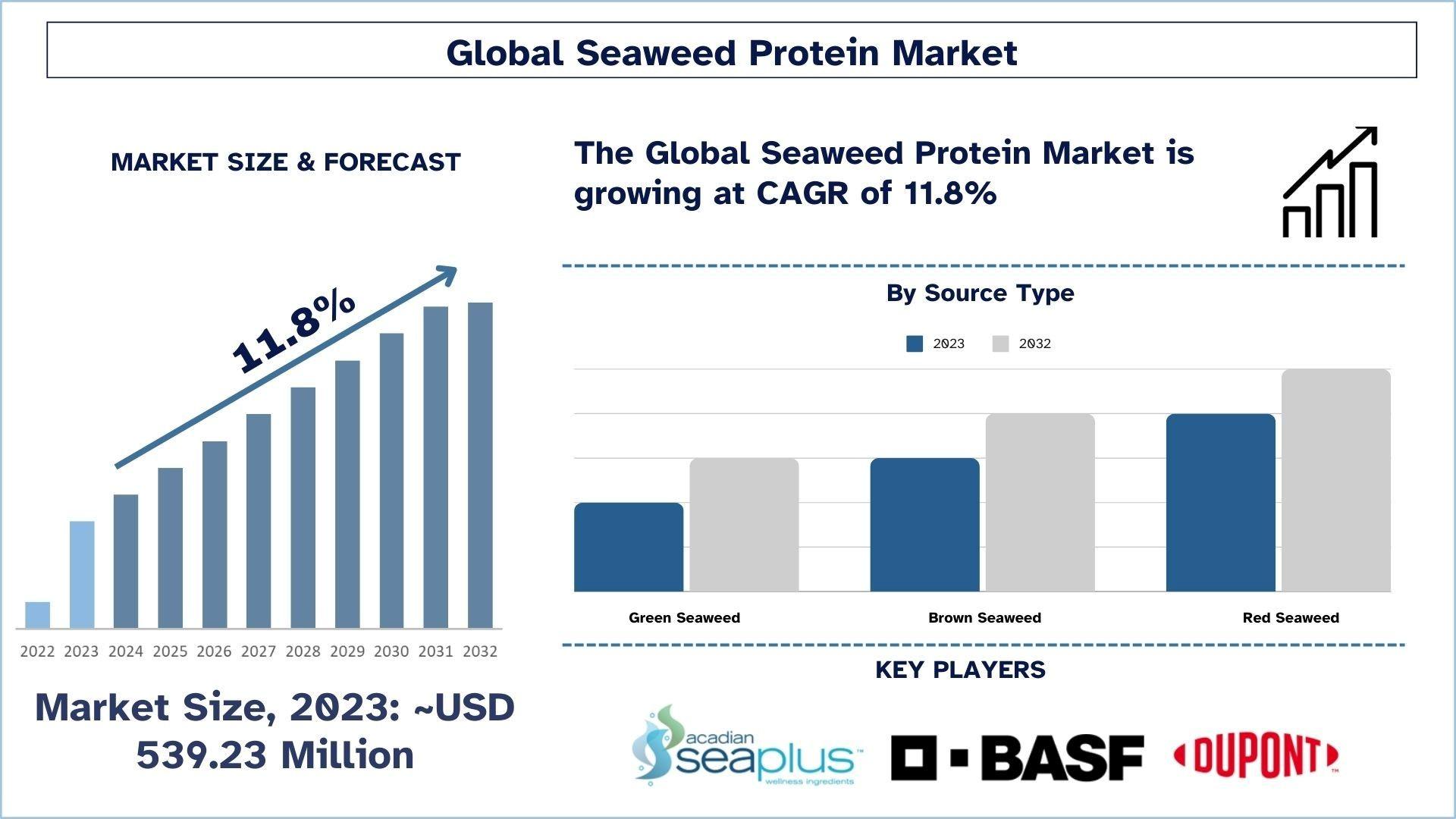
The global Seaweed Protein Market was valued at USD 539.23 million in 2023 and is expected to grow at a strong CAGR of around 11.8% during the forecast period (2024-2032) owing to rising demand for sustainable, vegetarian, and vegan protein alternatives.
The European Union has recently launched a €9 million initiative within the Horizon Europe program to develop the seaweed sector being innovational, sustainable, and interregional. The notion of SeaMark – Seaweed-Based Market Applications involves 25 international partners focused on seaweed production and creating new market products. Here are the key aspects of the initiative and its impact on the seaweed protein market:
Key Features of the Project
Objective: The SeaMark project aims to develop 12 new products based on seaweed, including bio-packaging and meat substitutes, functional feed additives, and more with an extra focus on sustainability.
Cultivation Goals: It seeks to increase the scale of producing seaweed which is predominantly Sweet Kelp that is cultured using offshore and integrated aquaculture.
Ecosystem Services: Expanding from its commercial opportunities, the project is also aimed at raising awareness of the ability of seaweed farms to sequester and detoxify carbon, thus positioning the activity as a key enabler of the European circular bioeconomy.
How it is driving the seaweed protein market
Enhanced Supply Chain: As the current study has shown, increasing seaweed production will ensure a constant supply of raw material for protein extraction and at the same time lead to cheaper prices in the production of seaweed protein in the market.
New Product Development: By creating new possibilities for innovation in plant-based meat alternatives and functional food ingredients the project creates new potential for seaweed protein to address the growing global need for plant-based food alternatives.
Generalization May Be Drawn from This Study Relevant to the Industry
Investment Attraction: It is believed that this move will stimulate more funding opportunities of seaweed protein sort and private and public actors engage more in similar sustainable technologies.
Policy Support: The project also highlights the EU’s focus on blue growth which is likely to favor policies and subsidies to seaweed protein producers.
Cross-Sector Applications: Although the project is focused on bioeconomy and the development of environmental solutions, the project implementation would create demands from food, feed, cosmetics, and health industries for seaweed proteins.
Access sample report (including graphs, charts, and figures) - https://univdatos.com/reports/seaweed-protein-market?popup=report-enquiry
The global Seaweed Protein Market was valued at USD 539.23 million in 2023 and is expected to grow at a strong CAGR of around 11.8% during the forecast period (2024-2032) owing to rising demand for sustainable, vegetarian, and vegan protein alternatives.
The European Union has recently launched a €9 million initiative within the Horizon Europe program to develop the seaweed sector being innovational, sustainable, and interregional. The notion of SeaMark – Seaweed-Based Market Applications involves 25 international partners focused on seaweed production and creating new market products. Here are the key aspects of the initiative and its impact on the seaweed protein market:
Key Features of the Project
Objective: The SeaMark project aims to develop 12 new products based on seaweed, including bio-packaging and meat substitutes, functional feed additives, and more with an extra focus on sustainability.
Cultivation Goals: It seeks to increase the scale of producing seaweed which is predominantly Sweet Kelp that is cultured using offshore and integrated aquaculture.
Ecosystem Services: Expanding from its commercial opportunities, the project is also aimed at raising awareness of the ability of seaweed farms to sequester and detoxify carbon, thus positioning the activity as a key enabler of the European circular bioeconomy.
How it is driving the seaweed protein market
Enhanced Supply Chain: As the current study has shown, increasing seaweed production will ensure a constant supply of raw material for protein extraction and at the same time lead to cheaper prices in the production of seaweed protein in the market.
New Product Development: By creating new possibilities for innovation in plant-based meat alternatives and functional food ingredients the project creates new potential for seaweed protein to address the growing global need for plant-based food alternatives.
Generalization May Be Drawn from This Study Relevant to the Industry
Investment Attraction: It is believed that this move will stimulate more funding opportunities of seaweed protein sort and private and public actors engage more in similar sustainable technologies.
Policy Support: The project also highlights the EU’s focus on blue growth which is likely to favor policies and subsidies to seaweed protein producers.
Cross-Sector Applications: Although the project is focused on bioeconomy and the development of environmental solutions, the project implementation would create demands from food, feed, cosmetics, and health industries for seaweed proteins.
Access sample report (including graphs, charts, and figures) - https://univdatos.com/reports/seaweed-protein-market?popup=report-enquiry
Conclusion
The EU’s €9 million SeaMark project is across Europe’s move to maximize the utilization of seaweed with the status of a sustainable commodity. This not only integrates the seaweed industry but also the seaweed protein market by enlarging cultivation areas, encouraging innovation, and enhancing interregional cooperation. This program sets the course for a world in which seaweed proteins will form an integral part of the sustainable food chain and the emerging bioeconomy.
Contact Us:
Email - contact@univdatos.com
Website - www.univdatos.com
The EU’s €9 million SeaMark project is across Europe’s move to maximize the utilization of seaweed with the status of a sustainable commodity. This not only integrates the seaweed industry but also the seaweed protein market by enlarging cultivation areas, encouraging innovation, and enhancing interregional cooperation. This program sets the course for a world in which seaweed proteins will form an integral part of the sustainable food chain and the emerging bioeconomy.
Contact Us:
Email - contact@univdatos.com
Website - www.univdatos.com

 English
 Arabic
 French
 Spanish
 Portuguese
 Deutsch
 Turkish
 Italiano
 Russian
 Romaian
 Portuguese (Brazil)
 Greek
Greek