


How to Build an AI-First Content Architecture for 2026 (Beyond Keywords and Topical Authority)
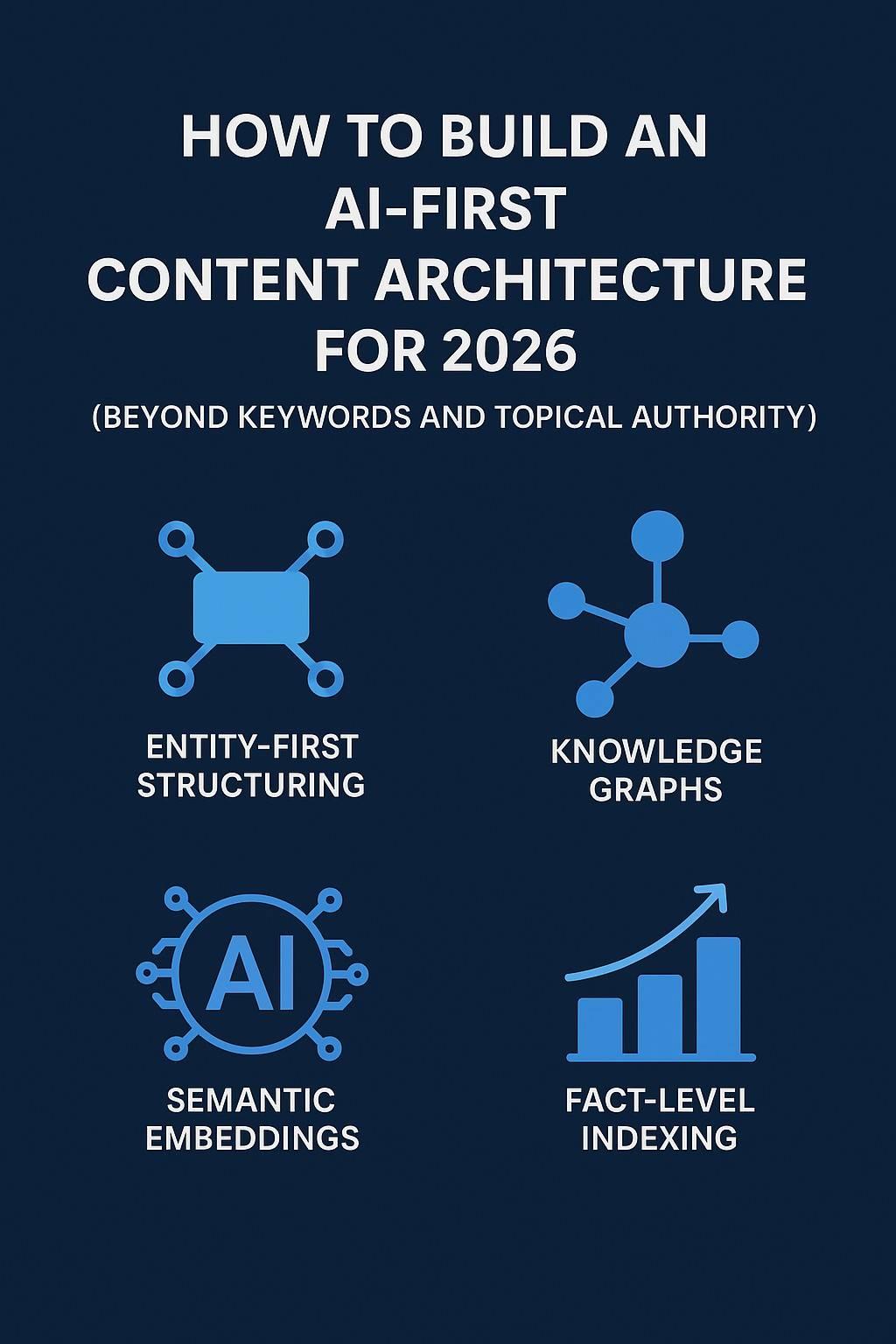
The SEO landscape is shifting rapidly. In today’s AI-driven era, simply stuffing keywords into content isn’t enough. Modern search platforms (Google’s AI Overview, Bing+ChatGPT, Perplexity, etc.) use large language models (LLMs) and knowledge graphs to answer queries. In fact, recent research shows AI overviews can cut web clicks by ~34%, even for #1 results. In other words, you must ensure your content is picked as a trusted source by AI, not just ranked by keywords. This means adopting an AI-first content architecture – organising your site around structured knowledge (entities, facts, data) rather than keyword density.
For B2B SaaS marketers, this transition is critical. AI search optimisation demands that we treat our website like a machine-readable knowledge base. Instead of topic clusters and keywords alone, we focus on entities (products, people, concepts), structured data, and semantic embeddings. In practice, this means building entity-first content hubs, injecting rich schema markup, and writing in atomic, fact-based blocks. The result is content that LLMs can retrieve and cite authoritatively.
Below, we’ll explain the core concepts (entity-first structure, structured data, fact-level content, embeddings, LLM retrieval) and offer a practical framework for adapting your content system. Our goal is a friendly, step-by-step guide to future-proof your content architecture 2026, with clear examples and analogies.
From Keywords to Entities: The Core Shift
Traditional SEO treated keywords and backlinks as king. You’d research keywords, write long pages stuffed with those terms, and hope Google’s crawler picked up your relevance. But AI-powered search works differently. LLMs and generative engines interpret meaning via entities and relationships, not just word counts. In other words, entity SEO (also called semantic SEO) is now central.
An entity is anything uniquely identifiable – a person, product, concept, or place. Think of entities as the nodes in a knowledge graph. An LLM stores vast webs of these entities (and their links) in its training data. When you query an AI assistant, it doesn’t merely scan for keywords. It maps your query to this entity graph and pulls related facts and sources. If your content clearly reinforces the right entities and their connections, the AI trusts it more. As Return On Now explains, “LLMs and AI systems…interpret meaning through entities and relationships” – so we need to “move from keyword-first to entity-first SEO”.
For example, a SaaS company might treat “cloud security”, “zero trust architecture”, and “endpoint detection” as its primary entities. By building all content around these concepts (and linking them together), the brand gains semantic authority in the AI’s eyes. In short, keywords tell an AI what people are asking; entities tell it what those questions mean.
By contrast, a pure keyword strategy risks being overlooked. As one expert puts it: “Keyword-first focuses on phrases…Topic clusters organise content…but entity-first builds durable authority by aligning content, schema, and external signals around uniquely identifiable concepts”. In practice, that means every page explicitly names its key entities (with consistent terms and IDs) and shows how they relate.
Key insight: your content needs to become part of the AI’s knowledge graph. This involves more than just writing: it’s about structuring and linking content so machines can “understand” it. As WordLift notes, we’re in a revolution of “structured intelligence, not content volume”, determining visibility.
Core Components of an AI-First Content Architecture
Building an AI-first architecture requires four main ingredients: an entity-based structure, rich structured data, fact-level (atomic) content, and semantic embeddings for retrieval.
Entity-First Structure (Knowledge Graph)
At the centre are entities. Start by identifying the 50–200 core entities that define your business (products, technologies, people, concepts, etc.). Assign each a unique, permanent ID (often by linking to Wikidata or schema.org) so machines recognise them reliably. For example, a running-shoe brand might list “Nike ZoomX Vaporfly 3,” “carbon plate technology,” “marathon training,” etc., as entities.
Each page should explicitly state its covered entities and their relationships. Imagine your page as a little piece of a knowledge graph: every sentence (or paragraph) is a “semantic atom” describing one fact about one entity. For instance, instead of a paragraph that softly implies your product is innovative, write a clear sentence like: *“The ZoomX foam (entity) in the Nike Vaporfly 3 provides a 13% energy return,” linking “ZoomX foam” and “Nike Vaporfly 3” as entities. This atomic approach (one verifiable fact per snippet) makes your content machine-readable. Each fact should cite an external source (data or a reference) to boost credibility.
Internal linking and content hubs are then organised around these entities. Create hub pages for each major entity, and link related subtopics as “spokes.” This mirrors a knowledge graph on your site: the more logically interlinked your entity pages are, the more the AI will treat you as an authority. As Return On Now advises, building “hub-and-spoke clusters” of entity content is a key step.
Structured Data and Fact-Level Indexing
AI systems crave structure. Machines can’t “see” your page design or interpret nuance in prose the way humans do. They rely on structured data (like JSON-LD schema markup or APIs) to consume content. A solid, structured data strategy is therefore essential. For example, add schema markup for products, FAQs, articles, how-tos, etc., wherever they fit. This isn’t new advice, but it’s now more important than ever – it lets search engines and LLMs know exactly what each piece of content is (not just looks like).
WordLift recommends exposing your information through APIs or machine-readable endpoints, not just HTML pages. When your knowledge (entities and facts) is accessible via structured endpoints, AI models can directly query and reuse your data. Think of it as publishing not just for human readers, but for reasoning systems.
Linked to this is the idea of fact-level indexing: each paragraph or entry in your content should be a mini-fact with its entity and sources. For example, use definition lists, bullet-point Q&As, or clearly separated statements (e.g. “Product X has feature Y,” “Industry Z requires compliance Q,” etc.). This clarity helps AI parse content into its knowledge graph.
Finally, ensure licensing and sourcing are clear. AI models will only cite and reuse content with unambiguous rights. Use schema fields for author and license (e.g. schema.org’s license property or Creative Commons tags) so attribution is automatic. And always back up claims with citations or data – “each factual claim…should be supported by at least one external, trusted source”. This “triangulation” signals trustworthiness to AI.
Semantic Embeddings & LLM Retrieval
Unlike keyword search, LLMs work in vector space. They convert words, entities, and content into high-dimensional vectors called embeddings. In practice, this means both the user’s query and your content get mapped to numeric points in a semantic space. For example, the words “cat” and “dog” end up closer together in that space than “cat” and “car,” because of their related meanings.
When a query comes in, the AI performs a retrieval-augmented generation (RAG) process. It turns the query into an embedding, then searches its embedded database for passages with similar vectors. Those top-matching pieces are then used to generate the answer. In short, the most semantically similar content gets picked.
The “cosine similarity” between the query’s embedding and the content’s embedding is essentially a relevance score. Higher cosine similarity = more likely the AI will retrieve your content. Importantly, this allows the AI to match concepts even without exact wording. For example, if a user asks “best paints for Warhammer minis,” an AI might retrieve content mentioning “Citadel paints,” “edge highlighting,” and “Primaris Marines,” because their embeddings lie close together in vector space. Your content doesn’t need to mirror the exact question – as long as it lives in the same semantic cluster, it can surface.
To visualise it, consider this diagram of entity search, embeddings, and cosine similarity:
LLMs convert content into semantic vectors. Entity-based queries (orange) rely on semantic embeddings (green), with cosine similarity (dark green) determining the final match.
What does this mean for your content? First, use natural, descriptive language that reinforces entities and related concepts. Sprinkle synonyms and context-rich phrases so your content’s embeddings cover the semantic ground users might query. Second, structure answers clearly (headings, lists, direct responses) so key points are captured in vectors. As one guide advises, format content in ways LLMs like: clear definitions, concise direct answers, Q&A bullet lists, etc. Each of these formats produces clean semantic signals.
In summary, you optimise for embeddings by making sure your content defines what it’s about (entities) and connects to related concepts. Then LLMs can more easily match those vectors to user prompts. As the I Love SEO blog puts it: “Entities define what our content is about. Embeddings define how it fits into the wider context of knowledge. Search engines and LLMs now rely on embeddings (not just keywords) to surface content.”
Step-by-Step Framework to Adapt Your Content
Putting theory into practice can be daunting, but here’s a concrete roadmap to rebuild your content system for AI-first search:
-
Audit & Inventory Your Entities – Make a list of your brand’s key entities (products, services, people, concepts, locations). Assign each a stable ID (via Wikidata, schema.org sameAs, or your own database. Map them to external references (Wikipedia, industry taxonomies, manufacturers). For each entity, note how (and where) it appears in your existing content. This forms the backbone of your knowledge graph.
-
Map Current Content to Entities – Pick 10–20 top pages (hero products, cornerstone articles) and analyse them. Use entity extraction tools (e.g. spaCy, Google NLP, WordLift’s tool) to see which entities AI sees in your content. Compare that to your intended meaning. Where AI misses or misinterprets an entity, that’s a blind spot. For example, if your page says “ZoomX foam cushioning” but the AI doesn’t link it to the “Nike ZoomX Foam” entity, add clarifying markup or wording.
-
Rewrite Content Around Entity Relationships – With your inventory in hand, restructure pages to emphasise entities. Start with your 20 highest-value pages. For each, explicitly state which entities it covers and how they relate. Use persistent references or “sameAs” links to tie entities together. Think of each paragraph as one fact about one entity, supported by a source. For example, instead of generic marketing copy about a feature, write a crisp statement: “The ZoomX foam (entity) in our running shoe provides 13% energy return.” Internal links should also reflect entity connections – link related entity pages to reinforce the graph.
-
Implement Structured Data Strategy – Add rich schema markup for each entity/fact. Use FAQ schema for Q&A sections, product schema for specs, article/schema.org AboutPage, etc. The Viha guide notes that schema now “helps search engines understand the meaning of your content, not just the words”. Ensure markup matches the text exactly (mismatches can hurt your visibility). Also embed content via APIs or structured feeds if possible. The goal is to make every piece of info machine-readable.
-
Integrate Entity Tagging in Your Workflow – To scale this transformation, bake entity tagging into your CMS. Tools like WordLift or manual tagging should recognise entities as you write and auto-insert schema. In practice, when an author types “ZoomX foam,” the CMS can suggest linking it to the “Nike ZoomX Foam” entity and inject the appropriate JSON-LD. This write-time tagging ensures consistency and saves tedious post-publication fixes.
-
Optimise for LLM Retrieval – Format content in LLM-friendly ways. Use clear headings, bullet lists, and Q&A blocks for common questions (a direct-answer structure). Include definition lists (term → definition) for core concepts. Keep paragraphs concise (one topic per paragraph) to stay within context windows. Add synonyms and related terms in context so embeddings cover variations. For instance, discuss both “VR headsets” and “virtual reality devices” in the same article to tie those embeddings together. Use schema-based lists (like FAQ or HowTo) to get picked up as answer snippets.
-
Build External Authority (Citations) – In an AI-first world, off-site signals still matter. Ensure your brand’s entities are consistently represented across the web. Earn authoritative mentions (press, industry sites) of your key terms. As ReturnOnNow notes, “PR mentions…Wikipedia or Wikidata entries…social profiles…citations from partners” all strengthen your entity signals. This external validation helps AI trust that your entity definitions are correct and authoritative.
-
Measure AI/LLM Visibility – Traditional metrics (rankings, clicks) don’t tell the whole story now. Instead, track AI-specific signals: LLM visibility (how often AI assistants cite or list you), featured snippet/Aggregated positions, voice search impressions, branded search uplift, etc. WordLift suggests monitoring “entity coverage, citation rate, and semantic authority” rather than just traffic. Backlinko similarly advises asking “how much authority did we build?” instead of “how many clicks”. Some emerging tools (like Semrush’s AI SEO toolkit or LLMRefs) can estimate AI visibility. Look for signs such as increased branded searches or direct visits after AI answers.
As one industry guide summarises, the focus shifts from chasing #1 rankings to being recognised as a source. If AI begins listing your product or insight as an answer—even on page 5 of Google—you’ve “won” that query.
Example: A Semantic Atom
To illustrate, imagine rewriting a product page about a SaaS feature. Instead of:
“Our cloud monitoring solution is fast and reliable. It uses advanced AI to detect issues quickly, helping businesses operate efficiently.”
Make it atomic and entity-rich:
-
Entity: Cloud Monitoring Solution X – a unique product name.
-
Fact 1: “Solution X uses the TechY Engine (entity) to analyse server logs in real time.”
-
Fact 2: “It detected and resolved 95% of outages under 1 minute in internal testing (external data source).”
-
Entity Linkage: If TechY Engine is itself an entity, link to its page.
-
Structured data: Mark up these as fact statements or a HowTo with steps.
-
Authorship: Include author and license metadata so AI can cite properly.
Each bullet above is a semantic atom: one clear, citable fact about an entity. AI can pull any of these to answer a query, “How fast is Solution X?” or “What does TechY Engine do?”
Future Outlook and Conclusion
By 2026, this AI-first approach will be standard. Search engines (Google AI Overviews, Bing AI, specialised assistants) will expect sites to speak their language. Brands that adopt an AI-first content architecture—with entity-driven hubs, structured data, and fact-level content—will dominate these new channels. Those clinging to old SEO tactics risk invisibility; as WordLift bluntly warns, “content just optimising keywords…is the wrong layer”.
Remember: AI visibility is as important as search rankings now. Your goal is to become part of the AI’s knowledge graph so that assistants cite your brand as a trusted source. This requires effort across teams (content, data, engineering) and new metrics. But the payoff is immense: a durable advantage in discovery, brand trust, and authority. As Backlinko concludes, we must “place our expertise where AI systems recognise genuine authority”, building content that “truly helps users”.
In practice, start small and iterate. Pick a niche topic where you have deep expertise and rebuild that content with entities and structure in mind. Track how AI mentions your brand (via tools or search console AI insights). Over time, expand this to your entire site.
The fundamentals of good content remain – clarity, depth, trustworthiness. – but how we organise it is changing. An AI-first content architecture is ultimately more human: it demands clarity, evidence, and true expertise. By building your knowledge graph of content now, you’ll ensure your brand thrives in the AI-first search era of 2026 and beyond.

 English
 French
 Spanish
 Portuguese
 Deutsch
 Turkish
 Dutch
Dutch
 Italiano
 Russian
 Romaian
 Portuguese (Brazil)
 Greek
Greek