English
 Arabic
 French
 Spanish
 Portuguese
 Deutsch
 Turkish
 Dutch
Dutch
 Italiano
 Russian
 Romaian
 Portuguese (Brazil)
 Greek
Greek

Adidas Samba: รองเท้าแนวคลาสสิกที่ไม่เคยตกยุค
Crafts |
2026-02-27 02:59:28

India's energy demand is growing faster than ever before. With industries expanding, cities becoming denser, and electricity consumption rising sharply across commercial and residential sectors, finding space for new energy infrastructure is a real challenge.
At the same time, large paved surfaces such as parking lots sit idle for most of the day, doing nothing more than holding vehicles under the open sky. Installing a ground mounted solar structure over these spaces is one of the most practical ways to turn an underused area into a productive energy-generating asset.
Parking areas have traditionally been treated as passive infrastructure necessary but not valuable beyond their basic function. However, when viewed through the lens of energy planning, they represent a significant opportunity.
These spaces are typically flat, open, and exposed to sunlight for most of the day. They are often located near the buildings they serve, which means the electricity generated can be used on-site, reducing transmission losses.
The shift from treating parking lots as simple utility spaces to viewing them as energy-generating platforms is gaining traction across India. Businesses, institutions, and industrial facilities are beginning to recognise that the same land which supports their daily operations can also power them.
This transition does not require additional land acquisition, complex site preparation, or disruption to existing activities. It simply requires smart planning and the right structural approach.
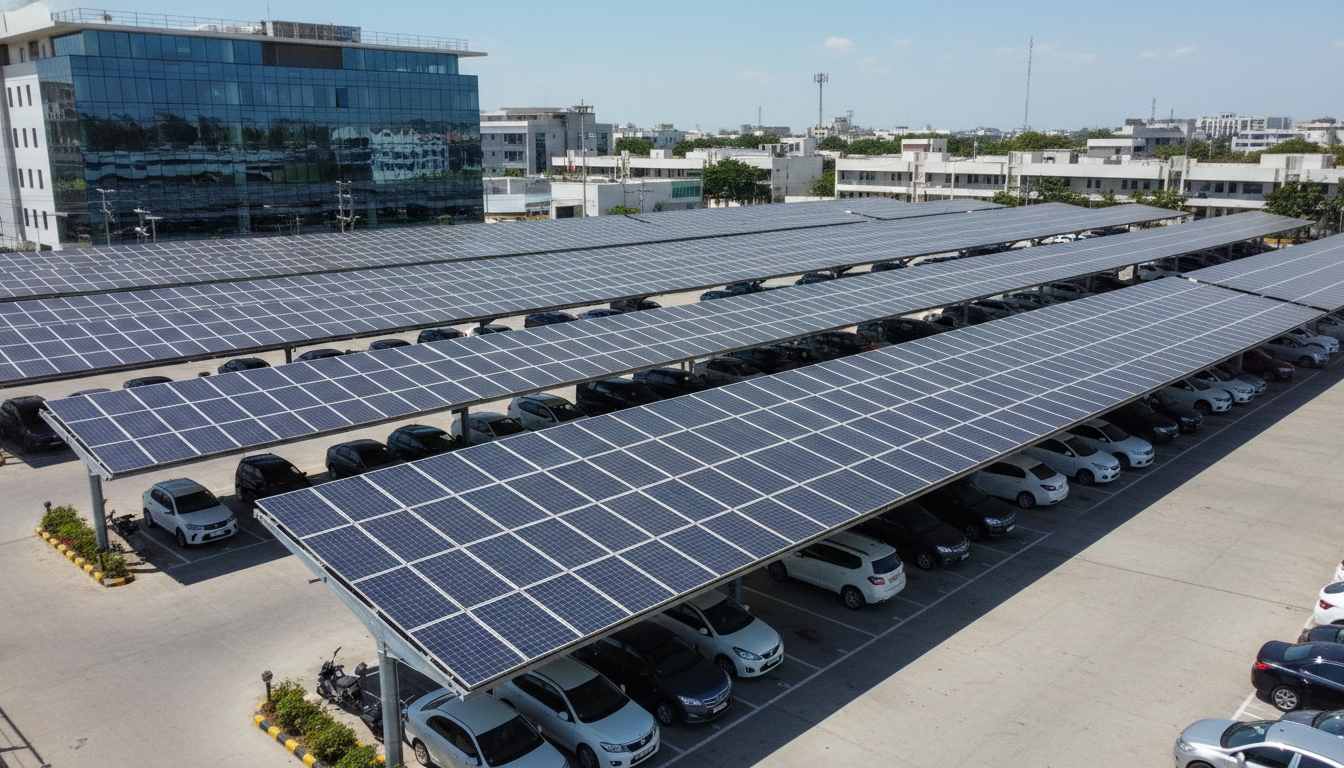
Not all open spaces are equally suitable for solar installations. Parking areas, however, tick several important boxes that make them particularly well-suited for solar energy integration. To begin with, they are large, open, and largely unobstructed by trees, adjacent buildings, or other shading elements. This gives solar panels the clear sky exposure needed for consistent energy generation throughout the day.
Another significant advantage is the alignment between daytime parking usage and peak electricity demand. Most commercial and industrial facilities consume the highest amount of electricity during business hours during the same period when solar panels produce the most power.
This natural synchrony means that a solar installation over a parking area can directly offset peak electricity costs without requiring large battery storage systems.
Beyond energy production, parking-based solar structures offer a dual-purpose benefit. The overhead canopy created by the solar panels provides shade for parked vehicles, reducing interior cabin temperatures and improving the overall parking experience. In a hot climate like India's, shaded parking is a practical benefit that many vehicle owners genuinely appreciate.
This means that a single infrastructure investment delivers both electricity and comfort, a combination that is hard to match with most other solar deployment options.

The structural design of a solar installation over a parking area is what separates a well-performing system from a poorly planned one. Unlike rooftop installations that follow the existing slope of a building, parking-based systems require purpose-built elevated structures. These structures must be designed to allow vehicles to enter and exit safely, provide adequate clearance for larger vehicles such as SUVs and small trucks, and withstand wind and weather loads over many years.
A well-executed ground mount solar design considers panel tilt angles and orientation very carefully. In India, panels facing south with an optimised tilt angle typically between 10 and 25 degrees depending on geographic location generate the most energy over the course of a year. Getting this right during the design stage can meaningfully improve the overall output of the system without any additional cost.
Compared to rooftop solar, parking-based ground-mounted systems offer greater flexibility. Rooftop installations are constrained by the existing roof structure, load-bearing capacity, and available area. Ground-mounted systems in parking areas, on the other hand, can be planned more freely, adjusted to the layout of the parking bays, and extended in phases as energy requirements grow.
Scalability is another practical advantage. A business that starts with a system covering half its parking area can expand to cover the full lot as its electricity demand grows or as budgets allow. The modular nature of solar panel arrays makes this kind of phased expansion straightforward, provided the initial structural design accounts for future additions.
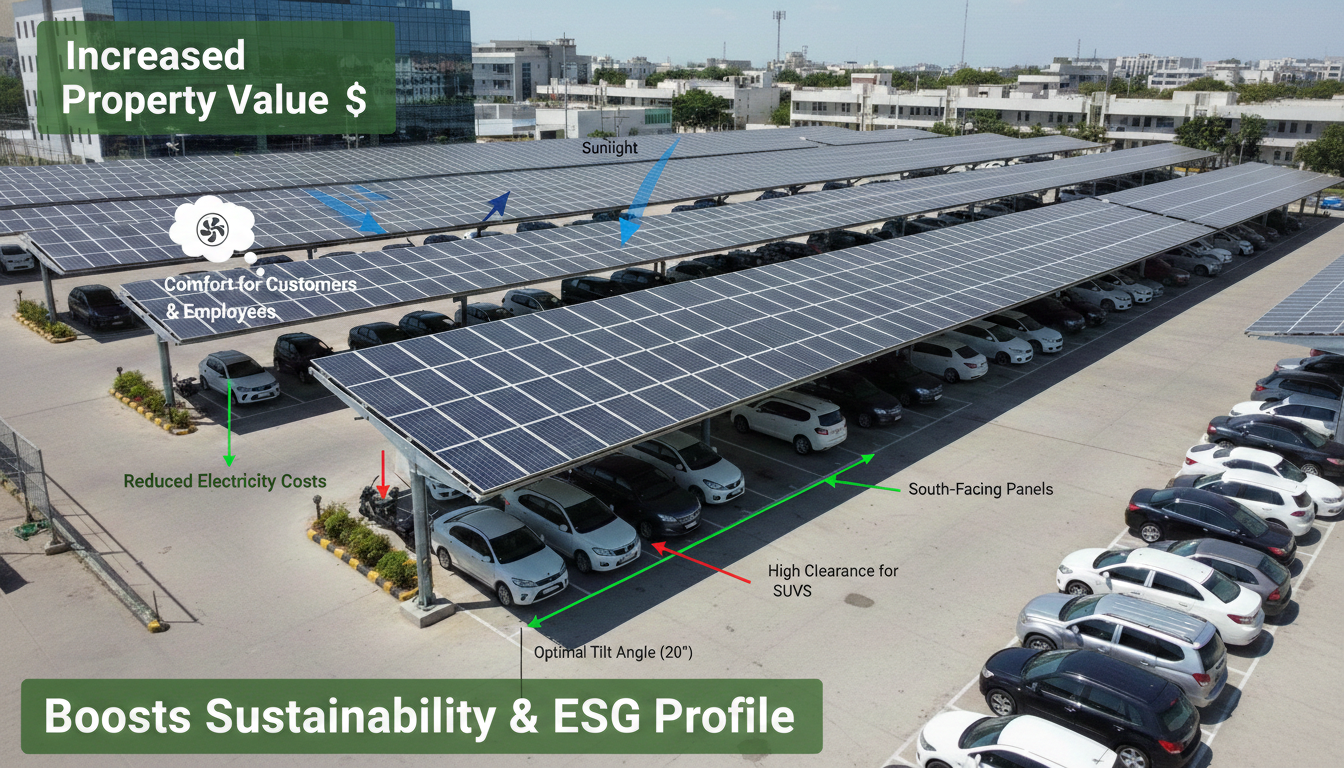
For any business, the most direct benefit of installing solar over a parking area is a reduction in electricity costs. Commercial electricity tariffs in India can be quite high, particularly for businesses that operate during daylight hours. A well-sized solar installation can offset a substantial portion of daytime consumption, leading to lower monthly bills and a faster return on investment compared to many other capital expenditure options.
Beyond direct savings, a solar-equipped parking area increases the overall value of the property. It transforms a passive utility space into an income-generating or cost-saving asset. This can be relevant for businesses that own their premises and are thinking about long-term property value, as well as for developers and real estate operators who want to offer differentiated facilities.
Customers and employees who use shaded parking notice the difference, particularly in Indian summers where vehicle interiors can become extremely hot under direct sun. Providing covered parking through a solar canopy is a practical, value-added offering that costs nothing extra once the system is installed. It reflects positively on the facility and the business operating it.
From a broader perspective, solar parking installations contribute meaningfully to a business's sustainability goals and ESG (Environmental, Social, and Governance) positioning. As reporting requirements and stakeholder expectations around sustainability continue to increase in India, having a visible, measurable renewable energy installation on-site is a concrete action rather than just a policy commitment.
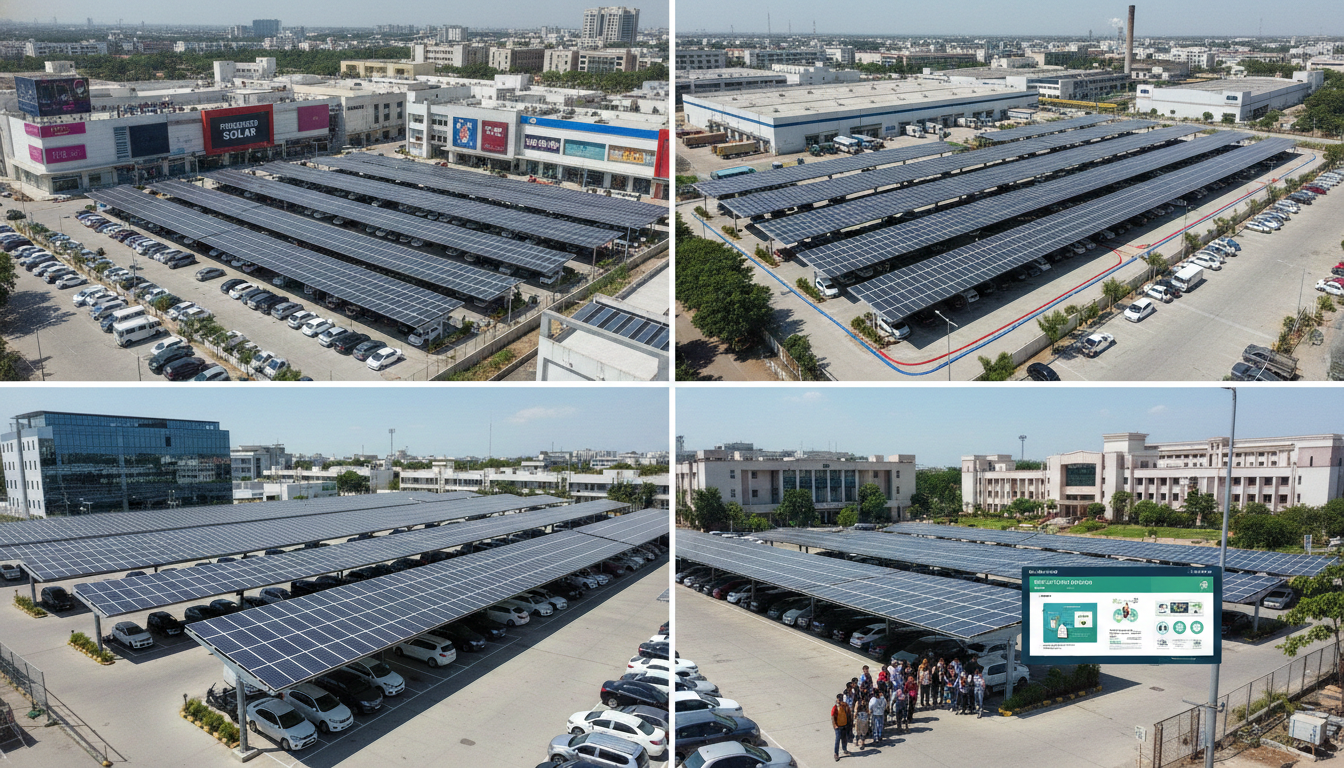
Commercial complexes and shopping malls are among the most natural candidates for parking-based solar installations. These facilities typically have large, flat parking areas with consistent daytime occupancy.
Their electricity consumption from lighting, air conditioning, escalators, and retail operations is high throughout the day, making the alignment between solar generation and consumption particularly strong.
Industrial facilities and warehouses also benefit greatly from this approach. Many industrial units in India have significant open land dedicated to vehicle parking, goods loading areas, or staff parking bays.
These surfaces receive direct sunlight without obstruction, making them productive sites for solar generation. The electricity produced can directly supply machinery, lighting, and cooling systems on the factory floor.
Hospitals, educational campuses, and corporate parks represent another important category. These institutions run continuously, with high and predictable electricity demands. For hospitals, reliable on-site power generation can also serve as a partial backup source during grid fluctuations. For schools and universities, it creates an opportunity to produce educational content around clean energy, making the installation both functional and instructive for students.
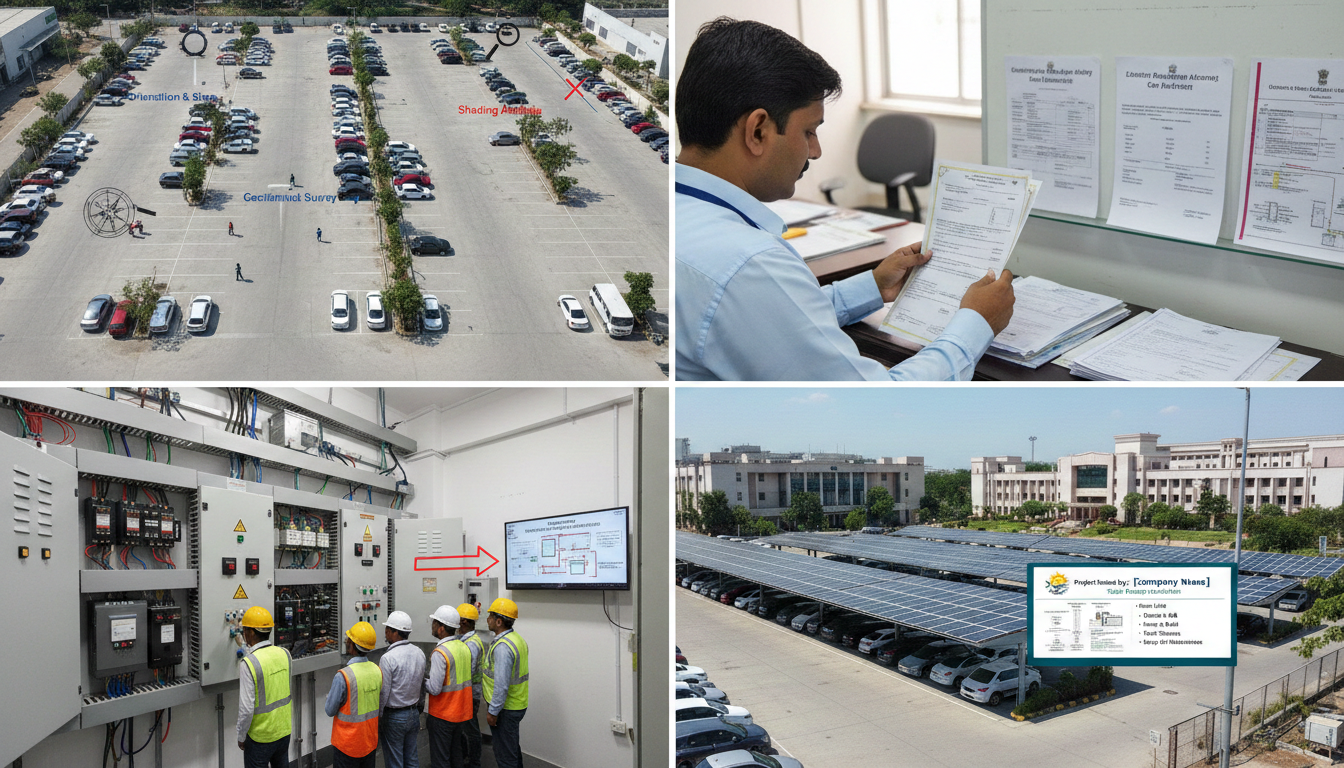
Before any installation begins, a thorough assessment of the available land and its physical characteristics is necessary. This includes evaluating the orientation and slope of the parking surface, the condition of the ground for structural footing, the layout of parking bays, and any shading elements in the surrounding environment. Structural planning must account for the load-bearing requirements of the canopy structure and ensure it meets safety standards for the specific location.
In India, solar installations at commercial and industrial scale require regulatory approvals and compliance with relevant state and central guidelines. This includes obtaining permissions from the local electricity distribution company (DISCOM), adhering to net metering policies where applicable, and ensuring that the structural design complies with relevant building and safety codes. These processes vary by state and should be initiated early in the project timeline to avoid delays.
Integration with the existing power systems of the facility requires careful planning by qualified engineers. The solar installation must be connected to the internal electrical infrastructure in a way that supports smooth operation, handles grid fluctuations, and allows for monitoring of generation and consumption. Choosing a reliable energy company in India with experience in end-to-end project execution from design and structural installation to grid integration and long-term maintenance is one of the most important decisions in making such a project successful.

Parking areas are no longer just a place to leave vehicles. With the right planning and structural approach, they represent a genuine opportunity to produce clean electricity, reduce operating costs, and make better use of space that already exists.
The deployment of a ground-mounted solar structure over a parking lot is one of the most resource-efficient ways to grow a facility's renewable energy capacity without consuming new land.
India's solar sector is growing rapidly, and the infrastructure to support parking-based solar installations from materials and engineering expertise to financing options and regulatory frameworks is maturing in step with that growth. Businesses that act on this opportunity now are likely to benefit from lower costs, favourable policy conditions, and first-mover advantages in their sectors.
The broader future of integrated solar infrastructure in India points clearly towards multi-purpose land use. Parking lots, canal banks, highway medians, and agricultural land are all being explored as deployment platforms. Parking-based solar is among the most immediately practical of these options because the land is already owned, already cleared, and already connected to the electricity systems that will use the power. It is, in short, a sensible next step for any organisation that is serious about its energy costs and its environmental commitments.
1. Can I claim tax benefits for parking solar installations in India?
Yes, businesses can claim accelerated depreciation on solar assets, reducing the overall project cost. Consult a tax professional for current rules.
2. How much parking space is needed for solar?
Even 500–1,000 sq. metres can support a useful system, depending on layout and sunlight availability.
3. Will installation affect my parking layout?
Usually no major changes to structures are designed to fit existing parking bays with minimal adjustments.
4. What maintenance does parking solar require?
Mainly regular panel cleaning and periodic inspection of structures and electrical components.
5. How long does installation take?
Typically 3–6 months, including design, approvals, and complete system setup.