


Cricket Pitch Length: Official Dimensions Explained
If you've ever watched a cricket match and wondered why the bowler takes that long run-up before hurling the ball down at the batter, the answer lies in a strip of turf that most fans never think twice about. The pitch is the beating heart of the game, and its dimensions aren't arbitrary. They've been fine-tuned over more than a century to create the exact balance between bat and ball that makes cricket the sport it is. Let's walk through what the official measurements actually are, why they exist, and what they mean for how the game is played.
The Official Length of a Cricket Pitch
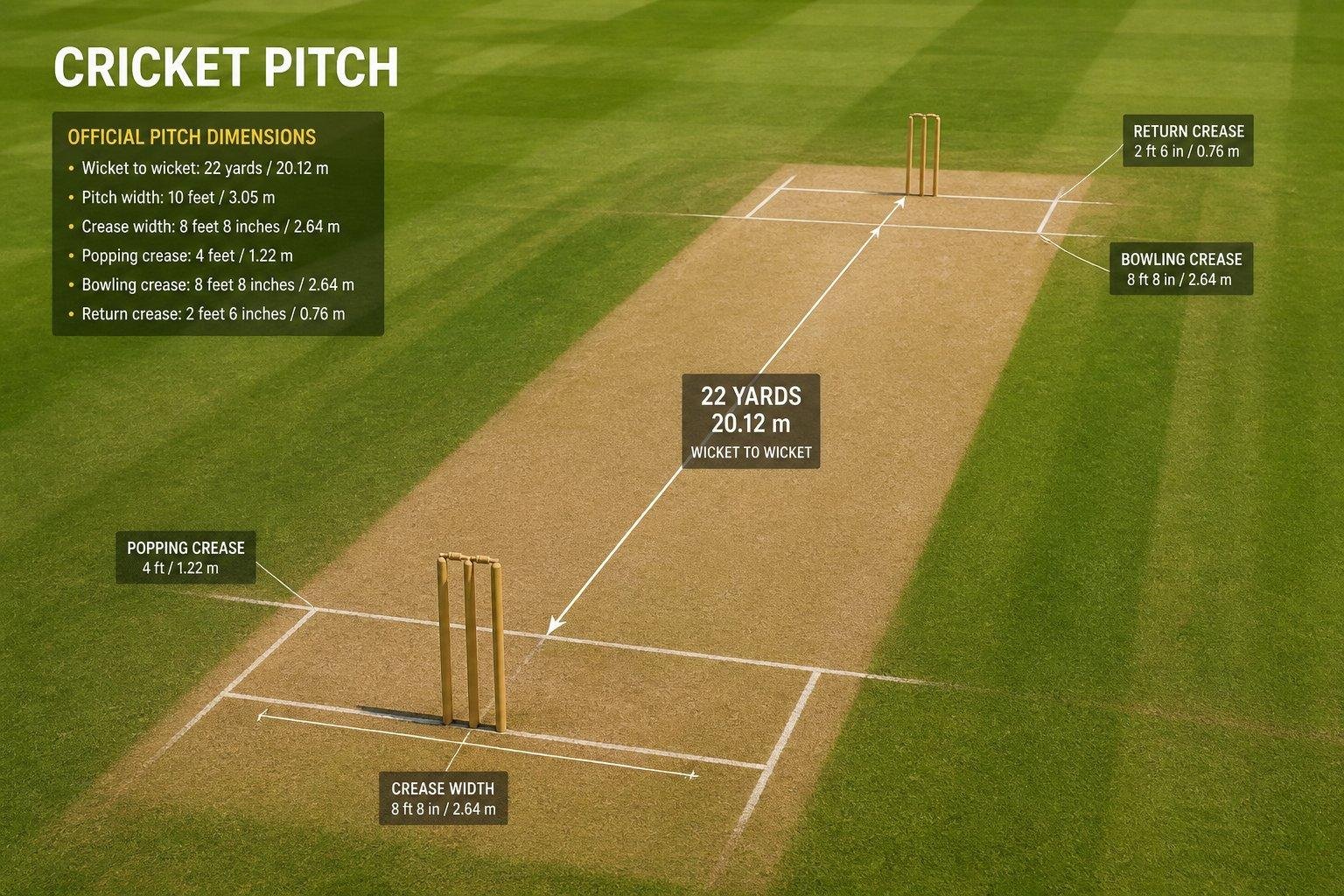
A cricket pitch measures 22 yards from one set of stumps to the other. In metric terms, that's 20.12 metres. This number isn't a rough guideline — it's written into the Laws of Cricket, maintained by the Marylebone Cricket Club (MCC), and applies to every format of the game, from a five-day Test match to a T20 slog-fest. Whether you're watching Lord's or a local club ground, the distance between the two sets of stumps is always the same.
Interestingly, this 22-yard measurement predates modern sport entirely. It comes from an old English unit called a "chain," a surveying tool used for measuring land back when cricket was first being codified in the 1700s. One chain equals 22 yards, and it stuck. Cricket is one of the few sports still using a unit of measurement borrowed from land surveyors rather than something designed specifically for athletics.
Width of the Pitch
While the length gets most of the attention, the pitch also has a defined width, and it matters more than casual fans realize. The playing strip is 10 feet wide, which comes out to about 3.05 metres. This width isn't just for show — it determines where the return creases and wide markers sit, which in turn affects how umpires judge wide deliveries and how bowlers plan their line of attack.
The width also plays into fielding placements close to the pitch. Positions like slip, gully, and short leg are all calculated relative to this strip, so even a few inches of variation would ripple out into how the entire field is set.
Understanding the Popping Crease
The popping crease, more commonly just called "the crease," is drawn 4 feet (1.22 metres) in front of each set of stumps. This line is central to two of the most important rulings in cricket: run-outs and stumpings. If a batter's bat or body part isn't grounded behind this line when the wicket is broken, they're out. It's a small strip of paint or chalk, but it's responsible for some of the most dramatic moments in the sport — diving finishes, close-run appeals, and third-umpire reviews that decide entire matches.
The Bowling Crease and Stumps Placement
Right at the base of the stumps sits the bowling crease, which is 8 feet 8 inches (2.64 metres) long, with the stumps positioned centrally within it. This crease marks the line the stumps sit on and helps define the width constraints for a legal delivery. Bowlers must have part of their back foot within the return crease — the perpendicular lines running from each end of the bowling crease — for a delivery to count as fair. Step outside it, and it's called a no-ball, regardless of how good the delivery itself was.
Why These Measurements Matter for the Game
It's easy to treat these numbers as trivia, but they shape almost everything about how cricket is played and strategized. The 22-yard length gives fast bowlers just enough room to build up serious pace through their run-up while still giving batters a fair chance to react. Shorten that distance and batting would become nearly impossible against genuine speed. Lengthen it, and spin bowlers would lose much of their effectiveness, since the ball would drift too far off its intended line before reaching the batter.
The crease measurements, meanwhile, are what make close decisions possible in the first place. Without a precisely defined popping crease, there'd be no consistent way to judge a run-out. Without the return crease, no-ball calls would be a matter of opinion rather than measurement. These lines turn split-second, high-pressure moments into decisions that can be verified, reviewed, and trusted.
How Pitch Conditions Affect Play (Without Changing Dimensions)
One thing worth clarifying: while the dimensions of a cricket pitch are fixed everywhere in the world, the surface itself is anything but uniform. Groundstaff in different countries prepare pitches differently based on climate, soil composition, and grass type. A pitch in England might be green and offer significant seam movement, while one in India might be dry, cracked, and ideal for spin bowlers. Australian pitches are often hard and bouncy, rewarding pace and short-pitched bowling.
So even though every pitch on the planet is exactly 22 yards long and 10 feet wide, no two pitches actually play the same. This is part of what makes cricket such a location-specific sport — teams don't just prepare for an opponent, they prepare for a pitch.
A Quick Look at Historical Consistency
What's remarkable is how little these core dimensions have changed since cricket's laws were first formalized in the 18th century. Bats have evolved, protective gear has transformed the game, boundaries have shifted, and entire formats like T20 have been invented — but the pitch length has remained untouched. This consistency is part of why cricket statistics can be meaningfully compared across generations. A fast bowler from the 1970s and one playing today are covering the exact same 22 yards, facing the same fundamental physical challenge, even if everything else around them has changed dramatically.
Pitch Dimensions in Different Formats of Cricket
A common question newer fans ask is whether the pitch changes size for T20 cricket versus Test cricket. It doesn't. The 22-yard length and 10-foot width apply identically across Test matches, One Day Internationals, and T20s. What changes between formats isn't the pitch itself but how it's prepared and how it wears down. A Test pitch is expected to hold up and evolve over five days, often turning more helpful for spin as the match progresses. A T20 pitch, by contrast, is usually a flatter, more batting-friendly surface prepared to produce a fast-paced, high-scoring contest since the match only lasts a few hours.
Final Thoughts on Pitch Dimensions
The next time you're watching a match and see a bowler steaming in from the top of their mark, remember that everything about that moment — the length of their run-up, the line they're bowling, the risk of a no-ball, the chance of a run-out at the other end — is shaped by measurements that have barely changed since cricket's earliest days. The 22 yards between the stumps isn't just a number in a rulebook. It's the foundation that makes the entire sport work the way it does, match after match, ground after ground, generation after generation.

 English
 Arabic
 French
 Portuguese
 Deutsch
 Turkish
 Dutch
Dutch
 Italiano
 Russian
 Romaian
 Portuguese (Brazil)
 Greek
Greek