


Understanding Stripe Payment Processing Fees
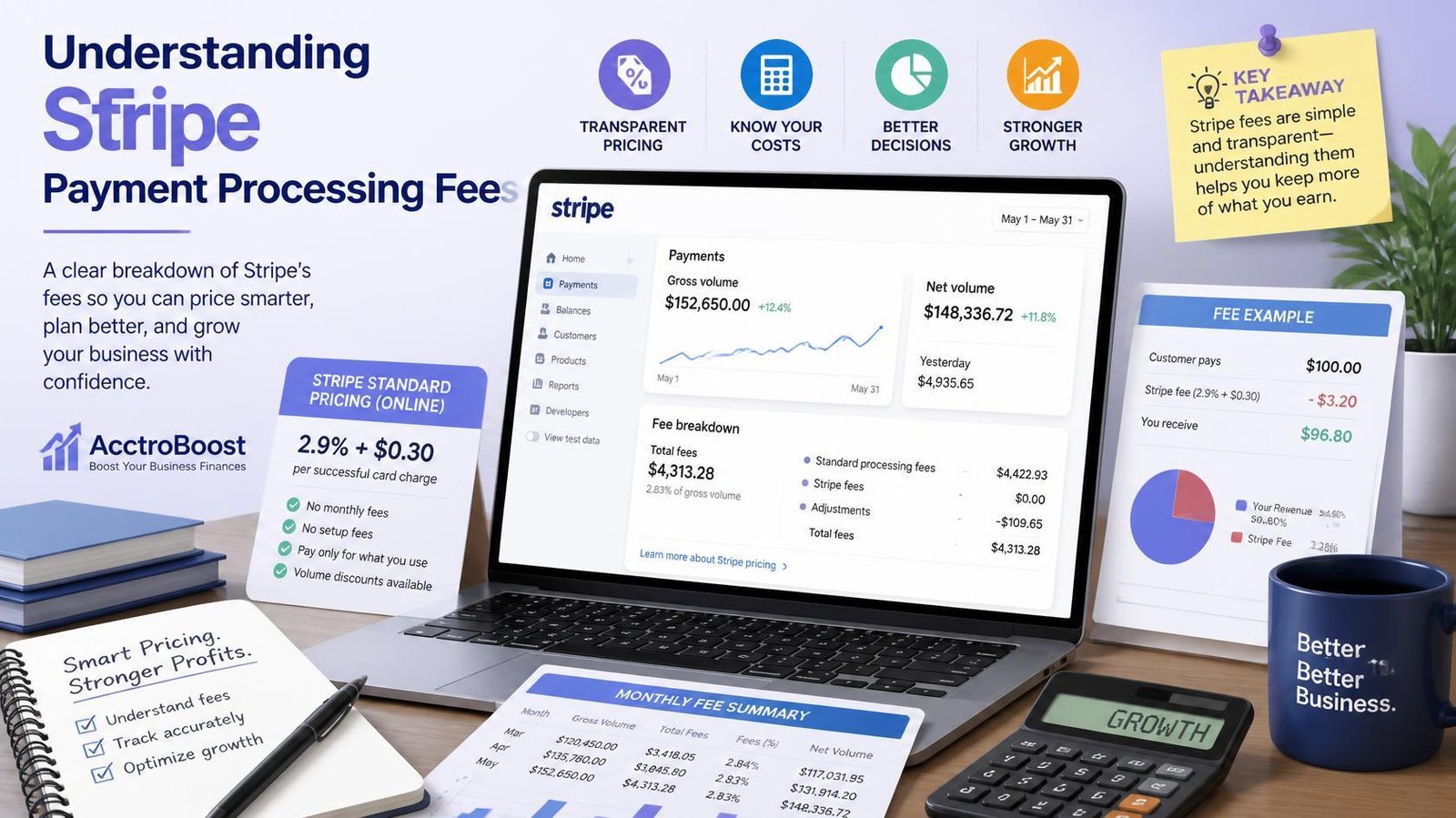
Stripe payment fees depend on factors such as the payment method, transaction location, currency conversion, and the pricing plan associated with the business account. For example, Stripe's current standard U.S. pricing lists 2.9% plus 30 cents per successful domestic card transaction, with additional charges applying in certain situations such as international cards or currency conversion. Businesses may also encounter separate costs for disputes, instant payouts, or optional Stripe products. Understanding the complete fee structure is important because the advertised base rate does not necessarily represent the total cost of every transaction.
What Are Stripe Payment Processing Fees?
Stripe payment processing fees are charges applied when a business uses Stripe to process eligible payments.
Instead of requiring businesses to pay a traditional monthly payment-processing subscription, Stripe generally uses transaction-based pricing for its standard pricing model.
The amount a business pays can depend on:
-
Payment method
-
Customer location
-
Business location
-
Currency
-
Transaction type
-
Payout method
-
Optional Stripe services
-
Pricing agreement
This means two businesses processing the same sales volume can potentially have different effective payment costs.
Stripe's Standard Transaction Pricing
Stripe's current standard U.S. pricing lists a rate of 2.9% plus 30 cents per successful domestic card transaction.
For example, if a customer makes a $100 eligible domestic card purchase, the basic processing fee at that rate would be $3.20.
The business would then receive the remaining amount after applicable fees, subject to any other adjustments or charges.
The fixed 30-cent component is particularly important for businesses with small average order values because it represents a larger percentage of smaller transactions.
Why the Fixed Fee Matters
Percentage-based pricing is easy to understand, but the fixed component can significantly affect the effective rate for small purchases.
Consider two transactions:
-
$20 purchase
-
$200 purchase
The percentage component scales with the transaction value, but the fixed 30-cent charge remains the same.
As a result, businesses selling low-cost products should calculate their effective payment-processing rate rather than looking only at the percentage.
A store with a $15 average order value may experience a noticeably different effective rate from a business with a $500 average transaction.
International Card Fees
International transactions can have additional costs.
Stripe's current U.S. pricing lists an additional 1.5% for international cards.
This means a business serving customers outside its domestic market may pay more than the standard domestic card rate.
International e-commerce businesses should therefore estimate payment costs based on where their customers are located.
If a large percentage of transactions come from international customers, the additional processing cost can have a meaningful impact on profit margins.
Currency Conversion Fees
Currency conversion can create another layer of cost.
Stripe's current U.S. pricing lists an additional 1% when currency conversion is required.
For example, a business may sell products to customers in another currency while settling funds in its primary business currency.
The applicable conversion cost should be included when calculating the true cost of international payments.
Businesses operating globally should consider both international-card charges and currency-conversion costs when forecasting payment expenses.
Payment Method Can Affect Fees
Not every payment method necessarily has the same pricing structure.
Stripe supports a broad range of payment methods, including cards, wallets, bank-based methods, and regional payment options.
The applicable fee depends on the payment method and market.
Therefore, businesses should identify which payment methods their customers actually use before estimating total processing expenses.
A company that receives most payments through cards may have a different effective fee profile from one that receives substantial volume through bank-based payment methods.
Does Stripe Charge Monthly Fees?
Stripe's standard pricing does not generally require a monthly payment-processing subscription or setup fee.
This can be attractive to smaller businesses because they can begin processing payments without committing to a traditional monthly processing contract.
However, individual Stripe products and services can have their own pricing.
Businesses should distinguish between the basic payment-processing rate and optional services that may generate additional charges.
Stripe Dispute Fees
Payment disputes, sometimes called chargebacks, can create additional costs.
Stripe's current U.S. pricing lists a $15 fee for a card-payment dispute, subject to applicable exclusions and pricing arrangements.
Disputes can therefore affect a business in two ways.
First, the original transaction may be reversed or placed into dispute.
Second, the business may incur a dispute-related fee.
For this reason, merchants should maintain accurate transaction, delivery, customer-service, and refund records.
Refunds and Stripe Fees
Refunds should also be considered when calculating payment costs.
For standard pricing, Stripe states that processing fees from the original transaction are generally not returned when a payment is refunded, although the treatment can differ for certain payment methods or custom pricing arrangements.
This means a business may not recover the original processing expense after issuing a refund.
Stores with high refund rates should factor this into their financial planning.
Instant Payout Fees
Stripe also provides payout options that can make eligible funds available faster.
However, faster access can involve an additional fee.
Stripe's current U.S. pricing lists instant payouts at 1.5% of instant-payout volume, subject to a minimum fee and applicable conditions.
Businesses should compare the cost of faster access against their actual cash-flow needs.
For a company with strong cash reserves, standard payouts may be more economical.
For a business that needs immediate access to funds, faster payouts may have operational value.
Stripe Custom Pricing
Businesses with large payment volumes or unusual business models may qualify for customized pricing.
Custom pricing can potentially include:
-
Volume discounts
-
Country-specific rates
-
Interchange-plus pricing
-
Multi-product discounts
-
Negotiated commercial terms
This can be particularly relevant to larger businesses processing substantial transaction volumes.
Smaller businesses generally start with standard pricing and can evaluate customized arrangements as their payment volume grows.
How Stripe Fees Affect E-commerce Businesses
E-commerce businesses should treat payment processing as part of their overall cost of sale.
Suppose an online store sells a product for $100.
The merchant needs to consider:
-
Product cost
-
Shipping
-
Advertising
-
Platform expenses
-
Payment processing
-
Refunds
-
Taxes
-
Customer support
Even a small change in payment costs can affect margins when the business processes thousands of transactions.
For this reason, merchants should calculate payment costs alongside other operating expenses.
Stripe Fees for Subscription Businesses
Subscription businesses need to consider recurring payment costs.
A SaaS company may process thousands of monthly subscription transactions.
Each transaction can generate a processing fee based on the applicable pricing structure.
Businesses should therefore calculate:
-
Average subscription value
-
Monthly transaction volume
-
Payment-method mix
-
International customer percentage
-
Refund rate
-
Failed-payment rate
Understanding these factors can provide a much more accurate picture of payment expenses.
Stripe Fees for Small Businesses
Small businesses often prioritize predictable costs.
For a small online store, standard transaction pricing can be relatively straightforward.
However, the business should still calculate the effective rate based on its average order value.
For example, a business selling low-priced products may feel the fixed transaction fee more strongly than a business selling expensive products.
Small businesses should also consider whether they need additional Stripe services before estimating their total monthly payment expenses.
Stripe Fees for International Businesses
International businesses need a more detailed cost analysis.
A global business may encounter additional costs associated with:
-
International cards
-
Currency conversion
-
International payouts
-
Local payment methods
-
Currency management
The actual fee structure depends on the business's Stripe account country and the payment methods involved.
International merchants should therefore use the pricing applicable to their specific market rather than relying on pricing information from another country.
AcctroBoost and Digital Payment Solutions
AcctroBoost provides digital business solutions and resources for entrepreneurs researching online accounts and payment-related services.
Businesses comparing Stripe payment costs can use digital business resources to better understand payment infrastructure, account requirements, verification considerations, and other factors involved in managing online transactions.
Businesses should always operate payment accounts using accurate information and legitimate ownership.
Third-party services should not be used to bypass Stripe's verification procedures, eligibility requirements, security controls, or compliance obligations.
How to Calculate Your Effective Stripe Fee
The advertised percentage is not always enough to understand your real payment cost.
A useful calculation is:
Effective payment rate = Total payment-related fees ÷ Total processed sales × 100
For example, suppose a business processes $10,000 in eligible domestic card payments and pays $320 in basic processing fees.
The effective rate would be:
$320 ÷ $10,000 × 100 = 3.2%
This matches the 2.9% percentage plus the effect of the fixed 30-cent transaction component.
The effective rate can increase further if the business processes many small transactions or incurs additional international, conversion, dispute, or product-related costs.
How to Reduce Payment Processing Costs
Businesses can take several legitimate steps to manage payment expenses.
Increase Average Order Value
When appropriate, increasing average order value can reduce the relative impact of fixed per-transaction charges.
Analyze Payment Methods
Review which payment methods generate the highest costs and determine whether each one provides meaningful value to customers.
Reduce Unnecessary Refunds
Clear product descriptions, accurate delivery information, and responsive customer service can help reduce avoidable disputes and refunds.
Monitor International Transactions
International payments can carry additional costs, so businesses should understand where their customers are located.
Review Optional Services
Businesses should periodically evaluate whether they are using paid Stripe products that provide sufficient value for their operations.
Consider Custom Pricing at Scale
Businesses processing substantial payment volume may benefit from exploring whether they qualify for custom pricing.
Stripe Fees and Profit Margins
Payment processing fees become especially important when margins are narrow.
Imagine an online retailer earning a 10% gross margin before payment costs.
A few percentage points of payment expense can consume a meaningful portion of that margin.
This is why businesses should incorporate payment fees into product pricing and financial forecasting.
Payment costs should not be treated as an afterthought.
Stripe Fees vs Other Payment Providers
Businesses often compare Stripe with Square, PayPal, Adyen, and other payment providers.
The comparison should go beyond the headline transaction rate.
Consider:
-
Domestic transaction costs
-
International fees
-
Currency conversion
-
Dispute fees
-
Payout costs
-
Payment methods
-
Subscription functionality
-
Integration requirements
-
Fraud-management tools
-
Reporting
-
Customer experience
The cheapest headline rate may not produce the lowest overall cost for every business.
How to Choose the Right Stripe Pricing Structure
Start by identifying your payment profile.
Ask:
-
What is the average transaction value?
-
How many payments do you process monthly?
-
What percentage comes from international customers?
-
Do you need currency conversion?
-
Which payment methods do customers use?
-
How frequently do you issue refunds?
-
How often do customers dispute payments?
-
Do you need faster payouts?
-
Do you use additional Stripe products?
-
Could your business qualify for custom pricing?
These answers can help you estimate the actual cost of using Stripe.
Final Thoughts
Understanding Stripe payment processing fees requires looking beyond the basic transaction rate. Stripe's current standard U.S. pricing lists 2.9% plus 30 cents for successful domestic card transactions, while international cards and currency conversion can add additional costs. Businesses may also encounter separate fees for disputes, instant payouts, and certain optional products or services.
The actual cost depends heavily on the business's transaction profile. A store with small transactions may be affected more by the fixed fee, while an international business may need to pay particular attention to cross-border and currency-conversion costs.
The most effective approach is to calculate your own effective payment rate using real transaction data. Review average order value, payment volume, customer locations, refunds, disputes, payment methods, and optional services.
For growing businesses, regularly reviewing payment costs can help protect margins and improve financial planning. As transaction volume increases, it may also make sense to explore custom pricing or alternative payment arrangements where available. Ultimately, Stripe can be a practical payment solution when its features, pricing structure, and available services align with the specific needs of the business.

 English
 Arabic
 French
 Portuguese
 Deutsch
 Turkish
 Dutch
Dutch
 Italiano
 Russian
 Romaian
 Portuguese (Brazil)
 Greek
Greek