


Network Traffic Analyzer Market Witnesses Rapid Adoption Across Telecom Sector
Modern digital ecosystems are more complex than ever before. Enterprises now operate across hybrid cloud environments, software-defined networks, edge computing frameworks, and high-speed 5G infrastructure. As data volumes surge and network architectures decentralize, maintaining real-time visibility into network behavior has emerged as a top priority for organizations worldwide.
Network traffic analyzers play a pivotal role in this evolving environment. These tools enable enterprises to monitor, inspect, and analyze network traffic flows to ensure optimal performance, detect anomalies, and identify security threats in real time. What was once a performance optimization tool has now become a cornerstone of cybersecurity, regulatory compliance, and digital resilience strategies.
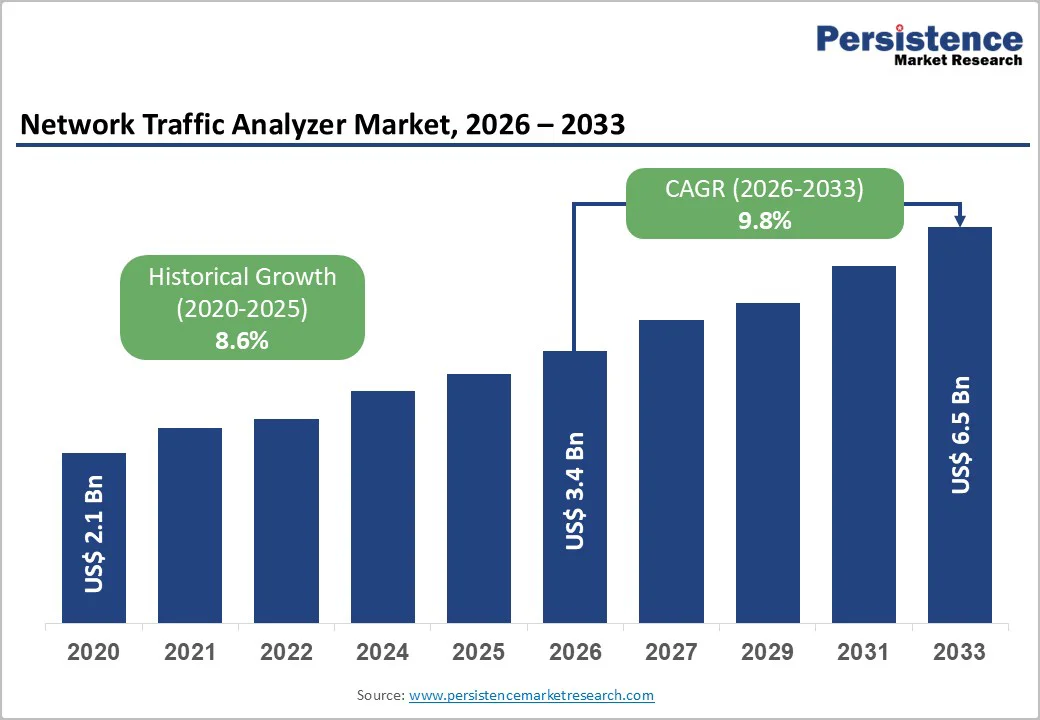
Against this backdrop, the global Network Traffic Analyzer Market is witnessing sustained and structural growth. The market is expected to be valued at US$ 3.4 billion in 2026 and is projected to reach US$ 6.5 billion by 2033, expanding at a CAGR of 9.8% during the forecast period. This growth reflects the rising importance of proactive network intelligence in an era defined by cyber risk, cloud adoption, and data-driven operations.
Market Overview and Key Statistics
Network traffic analyzers are specialized solutions designed to capture, monitor, and analyze data packets flowing across networks. These solutions provide actionable insights into bandwidth utilization, application performance, latency issues, and potential security incidents. Enterprises rely on them to maintain service availability, optimize user experience, and comply with increasingly stringent regulatory requirements.
From a market standpoint, the steady expansion of the network traffic analyzer industry is underpinned by structural shifts in enterprise IT environments. The transition from centralized data centers to distributed, hybrid, and multi-cloud architectures has made traditional monitoring tools insufficient. Organizations now require unified platforms capable of delivering end-to-end network visibility across physical, virtual, and cloud-based assets.
The projected growth from US$ 3.4 billion in 2026 to US$ 6.5 billion by 2033 highlights not only increased adoption but also rising investment per deployment. Enterprises are upgrading from basic monitoring tools to advanced platforms offering deep packet inspection, flow analytics, machine learning-based anomaly detection, and predictive observability capabilities.
Core Growth Drivers Shaping the Network Traffic Analyzer Market
Escalating Cyber Threat Landscape
One of the most significant drivers of market growth is the rapid escalation of cyber threats. Modern attacks are more sophisticated, persistent, and difficult to detect using traditional perimeter-based security solutions. Threat actors increasingly leverage encrypted traffic, lateral movement, and stealthy anomalies that can go unnoticed without advanced traffic analysis.
Network traffic analyzers enable real-time threat detection by identifying unusual traffic patterns, unexpected data flows, and deviations from baseline behavior. This capability is particularly critical for detecting zero-day exploits, insider threats, and advanced persistent threats. As cybersecurity becomes a board-level concern, organizations are prioritizing investments in network-level visibility tools that provide early warning signals.
Regulatory Compliance and Monitoring Mandates
Regulatory pressure is another major growth catalyst. Industries such as telecommunications, financial services, healthcare, and government are subject to strict regulations requiring continuous monitoring, logging, and documentation of network activity. Compliance frameworks often mandate the ability to trace data flows, investigate incidents, and maintain audit trails.
Network traffic analyzers help organizations meet these obligations by providing detailed traffic records, historical analytics, and compliance-ready reporting. As regulatory enforcement intensifies globally, especially in data protection and critical infrastructure sectors, demand for robust traffic monitoring solutions continues to rise.
Expansion of Hybrid and Multi-Cloud Environments
The widespread adoption of cloud infrastructure has fundamentally changed how networks operate. Enterprises now manage workloads across on-premises systems, public clouds, private clouds, and edge environments. This hybrid complexity creates visibility gaps that traditional tools struggle to address.
Network traffic analyzers designed for cloud-native and hybrid environments offer unified dashboards, cross-domain visibility, and consistent policy enforcement. These capabilities are essential for maintaining performance and security across fragmented infrastructure, making traffic analysis solutions a strategic investment rather than a discretionary expense.
Component Analysis: Solutions Segment Leads Market Adoption
The solutions segment dominates the network traffic analyzer market, accounting for approximately 72% of total market share in 2026. This dominance reflects strong enterprise demand for comprehensive, integrated platforms that go beyond basic monitoring.
Modern network traffic analysis solutions typically combine packet capture, flow-based analytics, deep traffic inspection, and machine learning-powered insights into a single architecture. Enterprises favor these unified platforms because they reduce operational complexity, improve response times, and provide contextual intelligence across the network stack.
In contrast, the services segment—comprising consulting, deployment, and managed services—plays a supportive role. While services remain important for large-scale implementations and ongoing optimization, the core value proposition lies in the software platforms themselves. As vendors continue to enhance solution capabilities with AI-driven features, the solutions segment is expected to maintain its leadership throughout the forecast period.
End-User Insights: Telecommunications and Service Providers at the Forefront
Among end-user categories, telecommunications and service providers represent the largest market segment, holding 26% of total market share. This leadership is driven by the scale, complexity, and regulatory exposure of telecom networks.
Telecom operators manage massive volumes of data traffic across national and international infrastructure. The rollout of 5G networks, combined with increasing demand for high-bandwidth services such as video streaming and IoT connectivity, has significantly increased network complexity. Traffic analyzers are essential for managing quality of service, identifying congestion points, and ensuring compliance with service-level agreements.
Beyond telecom, other major end-user segments include large enterprises, cloud service providers, government agencies, and critical infrastructure operators. Across these segments, the common requirement is real-time visibility and proactive performance assurance, reinforcing the broad-based demand for advanced traffic analysis solutions.
Regional Analysis: North America Leads Global Adoption
North America commands approximately 34% of the global network traffic analyzer market, making it the leading regional contributor. This dominance is supported by a combination of strict regulatory mandates, advanced cybersecurity frameworks, and high enterprise adoption of unified network observability platforms.
The region is home to a large concentration of technology-driven enterprises, cloud service providers, and telecom operators with complex network environments. Additionally, regulatory frameworks related to data protection, critical infrastructure security, and financial compliance have accelerated the adoption of advanced monitoring solutions.
While North America leads in market share, other regions are also witnessing strong growth. Europe is driven by data protection regulations and digital transformation initiatives, while Asia-Pacific is emerging as a high-growth region due to rapid 5G deployment, expanding cloud adoption, and increasing cybersecurity awareness across developing economies.
Technology Trends Transforming Network Traffic Analysis
AI-Driven Predictive Observability
One of the most promising trends in the network traffic analyzer market is the shift toward AI-driven predictive observability. Traditional monitoring tools are largely reactive, alerting teams after performance degradation or security incidents occur. Predictive observability solutions use machine learning to analyze historical and real-time data, identifying patterns that signal potential issues before they impact users.
This proactive approach enables enterprises to move from firefighting to prevention, reducing downtime and improving service reliability. As AI models mature and data quality improves, predictive observability is expected to become a standard feature rather than a premium add-on.
Autonomous Anomaly Detection
Autonomous anomaly detection is gaining traction as networks become too complex for manual rule-based monitoring. Advanced traffic analyzers now use unsupervised learning algorithms to establish baseline behavior and automatically flag deviations.
This capability is particularly valuable in detecting subtle threats and performance issues that might otherwise go unnoticed. By reducing alert fatigue and improving detection accuracy, autonomous anomaly detection enhances both security operations and network performance management.
Impact of 5G and Edge Computing Expansion
The global rollout of 5G networks and the rapid expansion of edge computing infrastructure are accelerating demand for advanced network traffic analysis. 5G introduces network slicing, ultra-low latency requirements, and massive device connectivity, all of which increase monitoring complexity.
Edge computing further decentralizes network architectures by processing data closer to the source. While this improves performance, it also creates new visibility challenges. Network traffic analyzers capable of operating across core, edge, and cloud environments are essential for maintaining consistent monitoring and security.
Telecom operators and hyperscalers are investing heavily in traffic analysis solutions to support these next-generation architectures. As 5G adoption expands globally, its influence on market growth is expected to intensify.
Competitive Landscape and Industry Innovation
The network traffic analyzer market is characterized by continuous innovation and intense competition. Vendors are focusing on enhancing real-time analytics, improving scalability, and integrating AI capabilities to differentiate their offerings.
Recent advancements such as Cloudflare’s Radar intelligence upgrades and Arista’s AI job-centric observability capabilities highlight the industry’s movement toward granular, contextual, and real-time traffic insights. These innovations reflect a broader shift from static monitoring dashboards to dynamic, intelligence-driven platforms.
Strategic partnerships, cloud-native deployments, and API-based integrations are also becoming increasingly important as enterprises seek flexible solutions that align with their broader digital ecosystems.
Future Outlook: From Visibility to Network Intelligence
Looking ahead, the network traffic analyzer market is poised for sustained growth as enterprises transition from basic visibility to full-fledged network intelligence. The convergence of cybersecurity, performance management, and compliance monitoring into unified platforms will define the next phase of market evolution.
As organizations embrace AI-driven analytics, predictive observability, and autonomous detection, network traffic analyzers will become central to digital resilience strategies. Rather than serving as isolated tools, they will function as intelligence hubs that inform decision-making across IT, security, and business operations.
With a projected market size of US$ 6.5 billion by 2033, the network traffic analyzer industry represents a critical enabler of secure, high-performance, and compliant digital infrastructure. In an era where networks underpin every aspect of business operations, the importance of real-time, actionable traffic insights cannot be overstated.

 English
 Arabic
 Spanish
 Portuguese
 Deutsch
 Turkish
 Dutch
Dutch
 Italiano
 Russian
 Romaian
 Portuguese (Brazil)
 Greek
Greek