


Inflammatory Bowel Disease Market, Growth, Size, Share, Trends and forecast to (2024-2032)
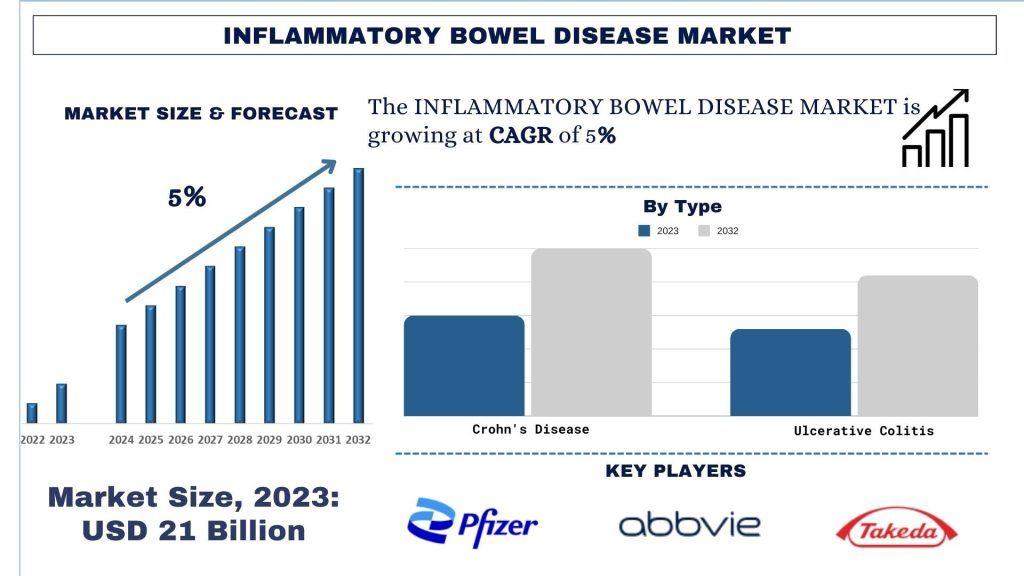
According to a new report by UnivDatos, the Inflammatory Bowel Disease Market is expected to reach USD 32 Billion in 2032 by growing at a CAGR of ~5%.
Growing cases of IBD: The growing prevalence of IBD is driving the higher demand for IBD-targeting therapeutics in the market.
Rising adoption of personalized medicine in the market: The increasing adoption of personalized medicine is boosting the market.
Growing investments in the R&D sector: The Inflammatory Bowel Disease market is experiencing significant growth due to the increasing demand for minimally invasive procedures.
Inflammatory bowel disease (IBD) comprises a group of chronic inflammatory conditions of the gastrointestinal tract, primarily including Crohn's disease and ulcerative colitis. These conditions result from an abnormal immune response directed against the body's own intestinal tissue, leading to symptoms like abdominal pain, diarrhea, rectal bleeding, weight loss, and fatigue. While the exact cause of IBD remains unclear, factors such as genetics, environmental triggers, and dysregulation of the immune system are thought to play significant roles.
Over recent years, the incidence and prevalence of IBD have been steadily rising globally. This trend is attributed to factors such as changes in lifestyle, dietary habits, environmental factors, and improved diagnostic techniques leading to better detection rates. The growing patient pool is a significant driver for the expansion of the IBD market. For instance, as per the data of Crohn’s & Colitis UK, about 1 in every 123 individuals is affected by either Crohn’s disease or ulcerative colitis in the UK. This translates to nearly half a million people living with Inflammatory Bowel Disease (IBD) in the country. Although IBD is relatively uncommon, it still has a substantial impact on a significant number of people in the UK.
Access sample report (including graphs, charts, and figures) - https://univdatos.com/reports/inflammatory-bowel-disease-market?popup=report-enquiry
Therapeutic Landscape of Inflammatory Bowel Disease
Anti-Inflammatory Medications:
Traditional therapies such as aminosalicylates (e.g., mesalamine) and corticosteroids (e.g., prednisone) are commonly used to induce and maintain remission in mild to moderate cases of IBD. These medications work by reducing inflammation in the gastrointestinal tract, thereby alleviating symptoms and promoting healing of the intestinal mucosa.
Immunosuppressants:
Immunomodulators like thiopurines (e.g., azathioprine, 6-mercaptopurine) and methotrexate are used in cases where conventional therapies are ineffective or to reduce dependency on corticosteroids. These agents work by suppressing the immune response that contributes to the inflammatory process in IBD.
Biologic Therapies:
Biologic agents represent a significant advancement in the treatment of moderate to severe IBD. These drugs target specific proteins involved in the inflammatory response, such as tumor necrosis factor-alpha (TNF-alpha) inhibitors (e.g., infliximab, adalimumab), integrin inhibitors (e.g., vedolizumab), and interleukin inhibitors (e.g., ustekinumab). Biologics are administered via intravenous infusion or subcutaneous injection and are effective in inducing and maintaining remission in patients who do not respond to conventional therapies.
Targeted Therapies:
Newer targeted therapies are being developed to address the limitations of existing treatments and provide more personalized care. Examples include Janus kinase (JAK) inhibitors (e.g., tofacitinib), which interfere with the signalling pathways involved in the inflammatory response, and other novel biologics targeting different cytokines or cellular receptors implicated in IBD pathogenesis.
Surgical Interventions:
Surgery may be necessary for patients with complications such as strictures, fistulas, or significant intestinal damage that cannot be managed with medications alone. Surgical options range from partial colectomy or bowel resection to total proctocolectomy with ileal pouch-anal anastomosis (IPAA) in ulcerative colitis.
Conclusion
In conclusion, the evolving landscape of IBD therapeutics reflects ongoing advancements in understanding disease mechanisms and developing targeted treatment approaches. From traditional anti-inflammatory medications to cutting-edge biologic and targeted therapies, the field continues to expand with the promise of improving outcomes for patients living with these chronic inflammatory conditions.
Contact Us:
Email - contact@univdatos.com
Website - www.univdatos.com

 English
 Arabic
 French
 Spanish
 Portuguese
 Deutsch
 Turkish
 Dutch
Dutch
 Italiano
 Russian
 Portuguese (Brazil)
 Greek
Greek