
Polishing and Finishing Machines Market CAGR, Revenue Growth and Forecast

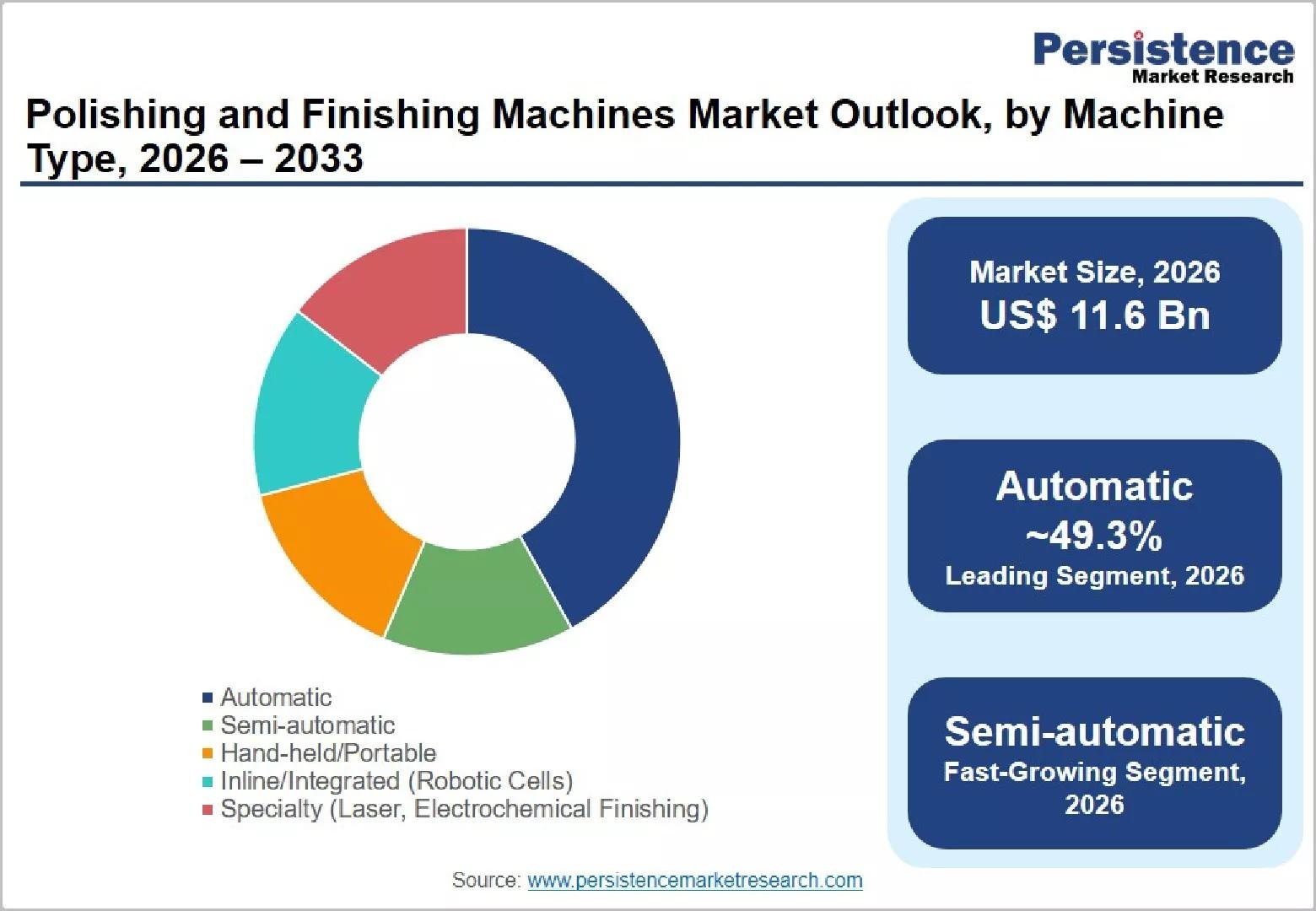
The global polishing and finishing machines market is becoming increasingly important as manufacturers place greater emphasis on surface quality, dimensional accuracy, appearance, and consistent finishing across precision-engineered components. According to the market outlook provided, the global market is projected to be valued at US$11.6 billion in 2026 and is expected to reach US$18.7 billion by 2033, expanding at a CAGR of 7.1% between 2026 and 2033. Demand is being supported by the expansion of precision manufacturing across automotive, aerospace, electronics, semiconductor, medical device, metalworking, and industrial machinery applications. Modern polishing and finishing equipment can deliver repeatable surface finishes while reducing manual labor, processing variation, material waste, and production time. Increasing adoption of CNC-controlled equipment, robotic finishing, automated material handling, and advanced abrasive technologies is further shifting the industry from conventional manual processes toward digitally controlled production environments.
A major growth driver is the increasing need for high-quality surface treatment on complex components manufactured from metals, ceramics, composites, glass, and other engineered materials. The automotive sector represents a leading end-use market because components such as engine parts, transmission components, wheels, molds, and precision mechanical parts require controlled surface finishing for both performance and appearance. Asia-Pacific is expected to remain a leading geographical market, supported by its large manufacturing base, expanding automotive and electronics industries, growing industrial automation investment, and increasing production of precision components in countries such as China, Japan, South Korea, and India. The region's established metalworking ecosystem and continued investments in manufacturing capacity provide a substantial customer base for polishing machines, grinding and finishing equipment, automated surface finishing systems, and related technologies.
𝐅𝐑𝐄𝐄 𝐒𝐚𝐦𝐩𝐥𝐞 & 𝐄𝐱𝐩𝐥𝐨𝐫𝐞 𝐭𝐡𝐞 𝐋𝐚𝐭𝐞𝐬𝐭 𝐌𝐚𝐫𝐤𝐞𝐭 𝐈𝐧𝐬𝐢𝐠𝐡𝐭𝐬:https://www.persistencemarketresearch.com/samples/22162
Key Highlights from the Report
- The global polishing and finishing machines market is projected to reach US$18.7 billion by 2033, growing at a 7.1% CAGR from 2026 to 2033.
• Rising demand for precision-engineered components is accelerating the adoption of automated polishing and finishing equipment.
• Automotive manufacturing remains a major demand center because surface quality directly affects component performance, durability, and appearance.
• Asia-Pacific is a leading regional market due to its extensive automotive, electronics, semiconductor, and metalworking manufacturing base.
• CNC automation, robotics, advanced abrasives, and digitally controlled finishing processes are reshaping conventional surface-treatment operations.
• Growth in medical devices, aerospace components, semiconductors, and other high-precision industries is creating new opportunities for specialized finishing machines.
Polishing and Finishing Machines Market Segmentation
The polishing and finishing machines market segmentation can be evaluated by machine type, operation, technology, application, end-user industry, and geography. Based on machine type, the market includes polishing machines, buffing machines, grinding and finishing machines, lapping machines, honing equipment, and specialized surface-finishing systems. Polishing equipment is widely used when manufacturers require smooth and visually consistent surfaces, while grinding and lapping systems are typically selected for applications demanding tighter tolerances and controlled material removal. The choice of equipment depends heavily on the workpiece material, desired surface roughness, component geometry, production volume, and required dimensional accuracy.
By operation and technology, the industry can be divided into manual, semi-automated, and fully automated systems, alongside conventional and CNC-controlled machines. Manual machines continue to serve small-scale production and applications requiring operator judgment, but automated equipment is gaining ground as manufacturers seek higher throughput and repeatability. CNC polishing and finishing machines can execute programmed processing cycles with greater consistency, while robotic systems can handle repetitive finishing operations and work effectively in high-volume manufacturing environments.
End-user segmentation covers automotive, aerospace and defense, electronics and semiconductors, medical devices, industrial machinery, metal fabrication, consumer goods, and other manufacturing industries. Automotive applications represent a substantial portion of demand because manufacturers require polished, deburred, ground, and finished surfaces on a broad range of components. The electronics and semiconductor sectors are creating additional demand for ultra-precision finishing technologies, particularly where surface integrity and contamination control are critical. Medical device manufacturers also require sophisticated finishing processes for implants, surgical instruments, and precision components where surface quality can influence product performance and usability.
The market can also be segmented according to material, including steel, stainless steel, aluminum, copper, titanium, ceramics, composites, and other engineered materials. Titanium and advanced alloys are particularly relevant to aerospace and medical applications because they combine strength with demanding machining and finishing requirements. As manufacturers increasingly work with lightweight materials and advanced composites, machine manufacturers are developing finishing solutions capable of handling different material characteristics without compromising surface integrity.
Regional Insights
Asia-Pacific represents a major growth center for the global polishing and finishing machines market. China remains a significant manufacturing hub, with substantial demand from automotive, electronics, machinery, consumer products, and metal fabrication industries. Japan and South Korea contribute through sophisticated precision manufacturing and strong adoption of automation and CNC technologies. India is also becoming increasingly important as investments in automotive production, electronics manufacturing, industrial machinery, aerospace, and medical-device manufacturing expand the addressable market for advanced finishing equipment.
North America maintains strong demand for high-precision polishing and finishing systems because of its established aerospace, automotive, medical technology, defense, and industrial manufacturing sectors. Manufacturers in the United States and Canada are increasingly focused on automation, labor productivity, and consistent quality. This favors robotic finishing cells, CNC-controlled machines, automated inspection, and digitally integrated manufacturing systems.
Europe remains an important market due to its strong automotive and industrial engineering sectors and stringent requirements for product quality and manufacturing precision. Germany, Italy, France, and other industrial economies have well-established machine-tool and precision-engineering industries. Demand is also supported by the transition toward electric vehicles, which is changing the mix of components requiring precision grinding, polishing, deburring, and finishing.
Latin America and the Middle East & Africa represent comparatively smaller markets but offer opportunities as industrialization, automotive assembly, infrastructure development, and manufacturing investment increase. Growth in these regions is likely to depend on capital expenditure, industrial automation adoption, and the development of local manufacturing capabilities.
Market Drivers
The primary polishing and finishing machines market drivers are the growing requirement for precision, automation, and consistent surface quality. Manufacturers are under continuous pressure to produce components with tighter tolerances while maintaining high production volumes and controlling operating costs. Automated polishing and finishing equipment can reduce dependence on skilled manual labor and deliver repeatable results across large production batches. The expansion of electric vehicles, aerospace programs, medical-device manufacturing, electronics, and semiconductor production is also increasing demand for equipment capable of finishing increasingly complex and high-value components.
Market Restraints
High initial investment remains a significant restraint, particularly for small and medium-sized manufacturers. Advanced CNC polishing machines, robotic systems, automated loading mechanisms, inspection technologies, and integrated production cells require considerable capital expenditure. In addition, specialized machines can require trained operators, programmers, maintenance personnel, and process engineers. Fluctuations in raw-material prices, the cost of precision components, and uncertainty in industrial capital spending can also affect purchasing decisions. For some applications, conventional manual finishing remains attractive because of its lower initial cost, even though automated systems can offer greater consistency and productivity over the long term.
Market Opportunities
The strongest opportunities are emerging from smart manufacturing, robotics, Industry 4.0, and advanced materials. Machine manufacturers can differentiate their products by integrating sensors, real-time process monitoring, predictive maintenance, automated inspection, and production analytics. Robotic polishing is particularly promising for repetitive or difficult-to-access operations because robots can maintain consistent tool pressure and motion while reducing worker exposure to dust, vibration, and other workplace hazards. Demand for finishing technologies suitable for titanium, composites, ceramics, and other advanced materials is also likely to increase as aerospace, medical, electronics, and high-performance automotive applications expand.
Company Insights
- EMAG GmbH & Co. KG
• Lapmaster Wolters GmbH
• Kellenberger AG
• JTEKT Machinery Corporation
• UNITED GRINDING Group
• Supfina Grieshaber GmbH & Co. KG
• Glebar Company
• Thielenhaus Technologies GmbH
• EQUIPNET
• Grind Master Machines Pvt. Ltd.
• Peter Wolters GmbH
• FAMAR S.r.l.
Recent market developments are increasingly centered on automation and technology upgrades rather than simply increasing machine capacity. In 2024, UNITED GRINDING Group introduced the new PLANOMAT XT platform, emphasizing high-productivity surface and profile grinding with enhanced automation capabilities. The company has also continued expanding its digital solutions, including production monitoring and connected manufacturing capabilities. Meanwhile, EMAG has continued advancing automated grinding and finishing solutions, particularly through integrated production systems designed to combine machining, automation, inspection, and process control. These developments reflect the wider industry shift toward complete automated manufacturing cells rather than standalone polishing or finishing machines.
Conclusion
The global polishing and finishing machines market is positioned for steady expansion as manufacturers across automotive, electronics, semiconductor, aerospace, medical device, and industrial machinery sectors demand greater precision and more consistent surface quality. The market is projected to increase from US$11.6 billion in 2026 to US$18.7 billion by 2033, representing a 7.1% CAGR during 2026–2033. Automation, CNC technology, robotics, advanced abrasives, and Industry 4.0 integration will remain central to the industry's evolution. Asia-Pacific is likely to retain its position as a major growth market because of its manufacturing scale and continued industrial investment, while North America and Europe will continue generating demand for high-precision and technologically advanced systems. As manufacturers focus on productivity, quality, labor efficiency, and increasingly complex materials, polishing and finishing machine suppliers that combine precision, automation, flexibility, and intelligent process control will be well positioned to capture future demand.

 English
 Arabic
 French
 Spanish
 Portuguese
 Deutsch
 Turkish
 Dutch
Dutch
 Russian
 Romaian
 Portuguese (Brazil)
 Greek
Greek